
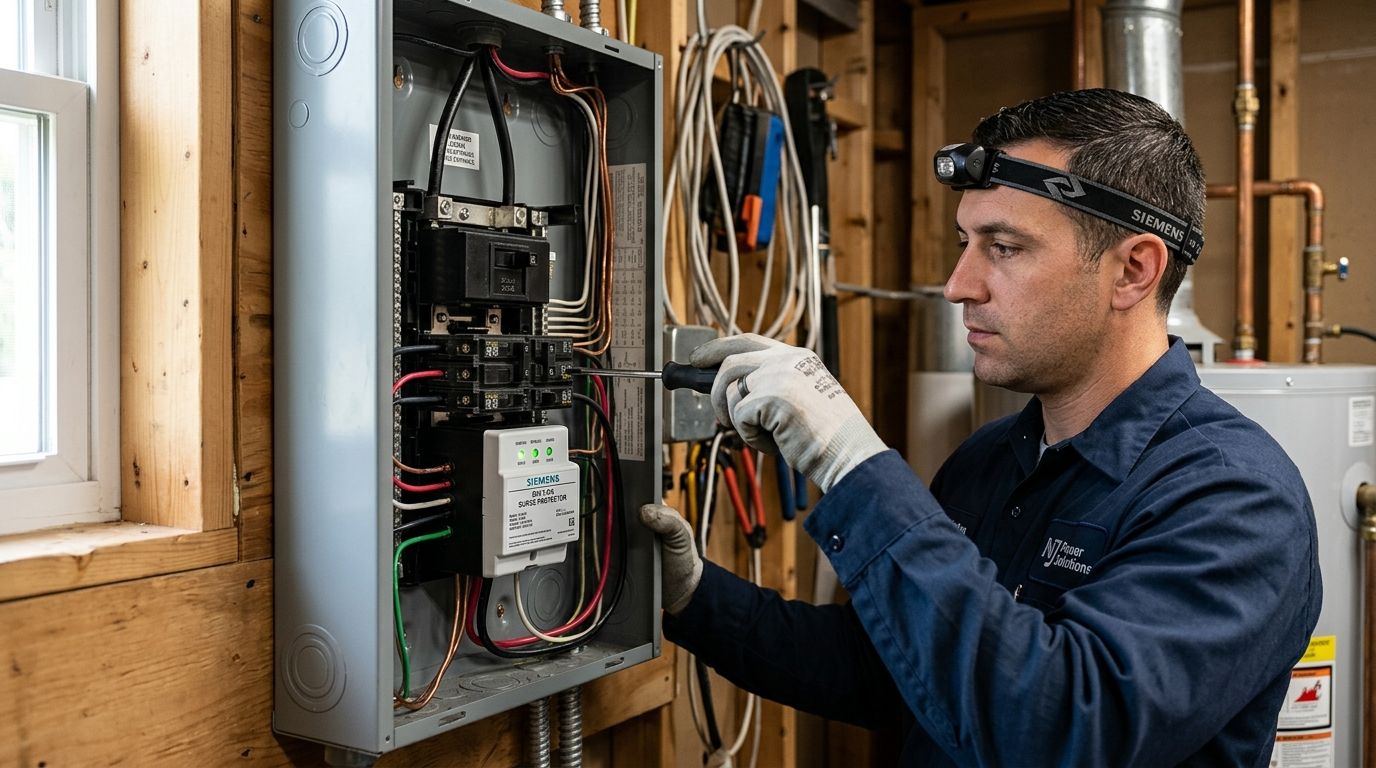
A whole-house surge protector installed at your electrical panel is the single best defense against the small, repeated power surges that damage HVAC boards, EV chargers, and generators long before a homeowner notices anything wrong. Best overall: Leviton SPD3-VAR120-M. Best for older panels: Square D HEPD80. Best for new panel installs: Siemens FS140. Best supplemental protection: point-of-use surge strips paired with a panel-mounted unit.
- Leviton SPD3-VAR120-M is the best whole house surge protector for most Central NJ homes in 2026 — panel-mounted, UL 1449 listed, 50kA per mode.
- Square D HEPD80 fits homes with older QO-style panels that need a retrofit add-on rather than a rebuild.
- Siemens FS140 makes sense when you're already scheduling an electrical panel upgrade in 2026.
- Point-of-use strips protect individual electronics but never replace a whole-house unit.
- PSE&G and JCP&L grid surges hit Monmouth, Middlesex, Somerset, and Union county homes year-round, not just during storms.
Why this matters
Most surge damage in New Jersey doesn't come from lightning. It comes from grid switching, downed lines being reconnected, and utility equipment cycling on and off during summer heat waves and winter nor'easters. Those small surges add up over years and quietly shorten the life of HVAC control boards, refrigerator compressors, and EV charger electronics.
Homes running a standby generator, an EV charger, or a heat pump have more sensitive electronics on the panel than a house built in the 1980s did, which is exactly why check if your electrical panel needs an upgrade before adding a surge protective device. A 100-amp panel or an older Federal Pacific or Zinsco box can't always accept a modern SPD safely, and that gets caught during an inspection, not after installation.
A whole-house surge protector doesn't stop a direct lightning strike on your home. It stops the thousands of smaller surges that happen every year and wear out equipment gradually.
What makes the best whole-house surge protector
- UL 1449 listing — the safety standard for surge protective devices; anything without it isn't code-compliant
- Surge current rating (kA) — most licensed electricians recommend at least 40kA per phase for whole-house protection in 2026
- Response time — modern MOV-based units react in nanoseconds, fast enough to clamp a surge before it reaches your breakers
- Panel compatibility — Type 2 devices mount inside or beside your main panel; Type 1 units mount ahead of the meter
- Failure indicator — a visible LED or audible alarm that tells you the device has absorbed a surge and needs replacement
- Panel age and capacity — the device has to match your existing load center or require a compatible retrofit kit
Best whole-house surge protectors at a glance
| Device | Best for | Standout feature | Key limitation |
|---|---|---|---|
| Leviton SPD3-VAR120-M | Most NJ homes | 50kA per mode, three-mode protection | Requires open panel space |
| Square D HEPD80 | Older QO panels | Audible failure alarm | Square D panels only |
| Eaton CHSPT2ULTRA | Homes on Eaton/Cutler-Hammer panels | Built for CH and BR load centers | Not universal fit |
| Siemens FS140 | New panel installs | Direct panel or meter-mount options | Best value during a panel upgrade, not standalone |
| Point-of-use strips | Supplemental protection | Protects individual electronics | Does nothing for panel-level surges |
1. Leviton SPD3-VAR120-M: best whole-house surge protector for most NJ homes
The SPD3-VAR120-M mounts directly at the panel and protects all three modes of wiring (line-to-neutral, line-to-ground, neutral-to-ground), which is why it shows up as the default recommendation on most licensed electrician job sheets. It's UL 1449 listed and carries a 50kA surge current rating per mode, giving it 150kA of combined capacity.
Leviton SPD3-VAR120-M pros:
- Protects all three wiring modes, not just line-to-neutral
- LED status indicator shows protection status at a glance
- Fits most standard 200-amp panels used in NJ homes built after 1990
- Widely stocked, so replacement units aren't a scheduling problem
Leviton SPD3-VAR120-M cons:
- Needs a dedicated double-pole breaker space in the panel
- Not a fit for panels already at full breaker capacity without a subpanel
Best for: homeowners with a modern 150-200 amp panel and open breaker space. Verdict: Buy.
2. Square D HEPD80: best for older panels needing a retrofit
The HEPD80 is built to plug directly into Square D QO-style load centers, which is common in Central Jersey homes built between the 1970s and 1990s. It gives an audible alarm and a status light when it's absorbed enough surges to need replacement, so you're not guessing whether it's still working.
Square D HEPD80 pros:
- Audible alarm on failure, not just a light
- Direct fit for QO panels without an adapter kit
- UL 1449 listed
Square D HEPD80 cons:
- Locked to Square D panel compatibility
- Doesn't help if the panel itself is undersized or outdated (a common issue in homes with Zinsco or Federal Pacific panels)
Best for: homes with an existing Square D QO panel that isn't due for a full replacement. Verdict: Buy, if your panel is compatible.
3. Eaton CHSPT2ULTRA: best for homes already on Eaton panels
The CHSPT2ULTRA is built specifically for Eaton CH and BR load centers, which show up in a meaningful share of Union and Middlesex county homes. It installs as a two-pole breaker-style unit rather than a bolt-on add-on, which keeps the panel layout cleaner.
Eaton CHSPT2ULTRA pros:
- Clean breaker-slot installation, no external box
- LED indicators for each protection mode
- Compatible with both CH and BR series panels
Eaton CHSPT2ULTRA cons:
- Panel-specific — won't fit Square D or Siemens load centers
- Slightly less common brand recognition among NJ homeowners doing their own research
Best for: homes already running an Eaton or Cutler-Hammer panel. Verdict: Buy, if panel-compatible; skip otherwise.
4. Siemens FS140: best for new panel installs
The FS140 is worth pricing into the job when you're already scheduling an EV charger panel upgrade or a full panel replacement in 2026, since Siemens SPDs mount directly into Siemens and ITE panels without extra adapters. Trying to retrofit it into an unrelated brand's panel adds labor and defeats the point.
Siemens FS140 pros:
- Direct panel or meter-mount options
- Straightforward integration during a panel swap
- UL 1449 listed
Siemens FS140 cons:
- Not the right call as a standalone retrofit on a non-Siemens panel
- Meter-mount version requires utility coordination before install
Best for: homeowners already scheduling a panel upgrade or new construction. Verdict: Buy, bundled with a panel job.
5. Point-of-use surge strips: best supplemental protection for electronics
A whole-house SPD stops the big surges from reaching your panel, but it doesn't fully eliminate smaller fluctuations that can still affect sensitive equipment plugged directly into an outlet — think home theater systems, home offices, or EV charger control modules. A UL 1449-rated point-of-use strip adds a second layer for the individual devices that matter most.
Point-of-use strip pros:
- Inexpensive, no electrician required for basic units
- Protects specific high-value electronics directly
- Easy to replace if it takes a hit
Point-of-use strip cons:
- Does nothing to protect HVAC systems, generators, or hardwired equipment
- Often mistaken as a substitute for whole-house protection, which it isn't
Best for: layering extra protection on top of a whole-house SPD, never as a replacement. Verdict: Buy as a supplement, not a standalone.
How we ranked these
Every device on this list had to carry a UL 1449 listing, a documented surge current rating, and a failure indicator — the three non-negotiables an electrician checks before recommending anything. Panel compatibility broke the ties: a device that requires an adapter kit or extra labor ranked below one that installs directly into the panel brand it's paired with.
“A whole-house surge protector doesn't stop a direct lightning strike; it stops the smaller surges that happen year-round and quietly wear out your equipment.”
Which whole-house surge protector should you choose?
If your panel has open breaker space and you're not sure which brand fits, start with the Leviton SPD3-VAR120-M — it's the most panel-agnostic option on this list and covers all three wiring modes. If you already know your panel brand, match it: Square D HEPD80 for QO panels, Eaton CHSPT2ULTRA for CH/BR panels, Siemens FS140 if you're bundling it into a panel upgrade already scheduled for 2026. Add a point-of-use strip on top regardless of which unit you pick — it's cheap insurance for the electronics you can't protect at the panel.
Homes running a generator or home battery backup system should treat surge protection as part of that install, not an afterthought — a home battery backup system that isn't protected at the panel is exposed to the same surges everything else on the circuit is.
Get your panel checked before installing
A licensed NJ electrician confirms panel compatibility before any surge protector goes in.
FAQ
What is the best whole house surge protector for 2026?
The Leviton SPD3-VAR120-M is the best whole house surge protector for most homes in 2026 because it protects all three wiring modes and fits standard 150-200 amp panels. Homes with a specific panel brand should match to that manufacturer's SPD instead.
Do I need a whole-house surge protector if I already have power strips?
Yes — power strips only protect what's plugged into them, not hardwired equipment like HVAC systems, generators, or the panel itself. A whole-house unit and point-of-use strips work together, not as substitutes.
Can an older electrical panel handle a whole-house surge protector?
Not always. Panels at full breaker capacity, or older Zinsco and Federal Pacific panels, often need an inspection or upgrade before a surge protective device can be installed safely.
What's the difference between Type 1 and Type 2 surge protectors?
Type 1 devices mount ahead of the main breaker, often at the meter, while Type 2 devices mount inside or beside the panel after the main breaker. Most residential whole-house installs in NJ use Type 2.
How do I know if my surge protector has failed?
Most whole-house units have an LED indicator or audible alarm that signals when the device has absorbed enough surges to need replacement. Check the indicator during routine electrical maintenance.
Is a whole-house surge protector worth it for EV chargers and generators?
Yes — EV chargers and generator transfer switches have sensitive control boards that are more vulnerable to surge damage than older appliances. Panel-level protection is standard practice on these installs in 2026.
Does a whole-house surge protector stop lightning damage?
It reduces damage from surges traveling through the grid but doesn't stop a direct lightning strike on the structure. Grounding and bonding at the panel matter just as much as the SPD itself.
One last thing
The surge that finally takes out an HVAC board or a generator control module is rarely the first one it absorbed — it's usually the last of dozens over several years, which is why a failure indicator that nobody checks defeats the purpose of installing the device in 2026 in the first place.


