
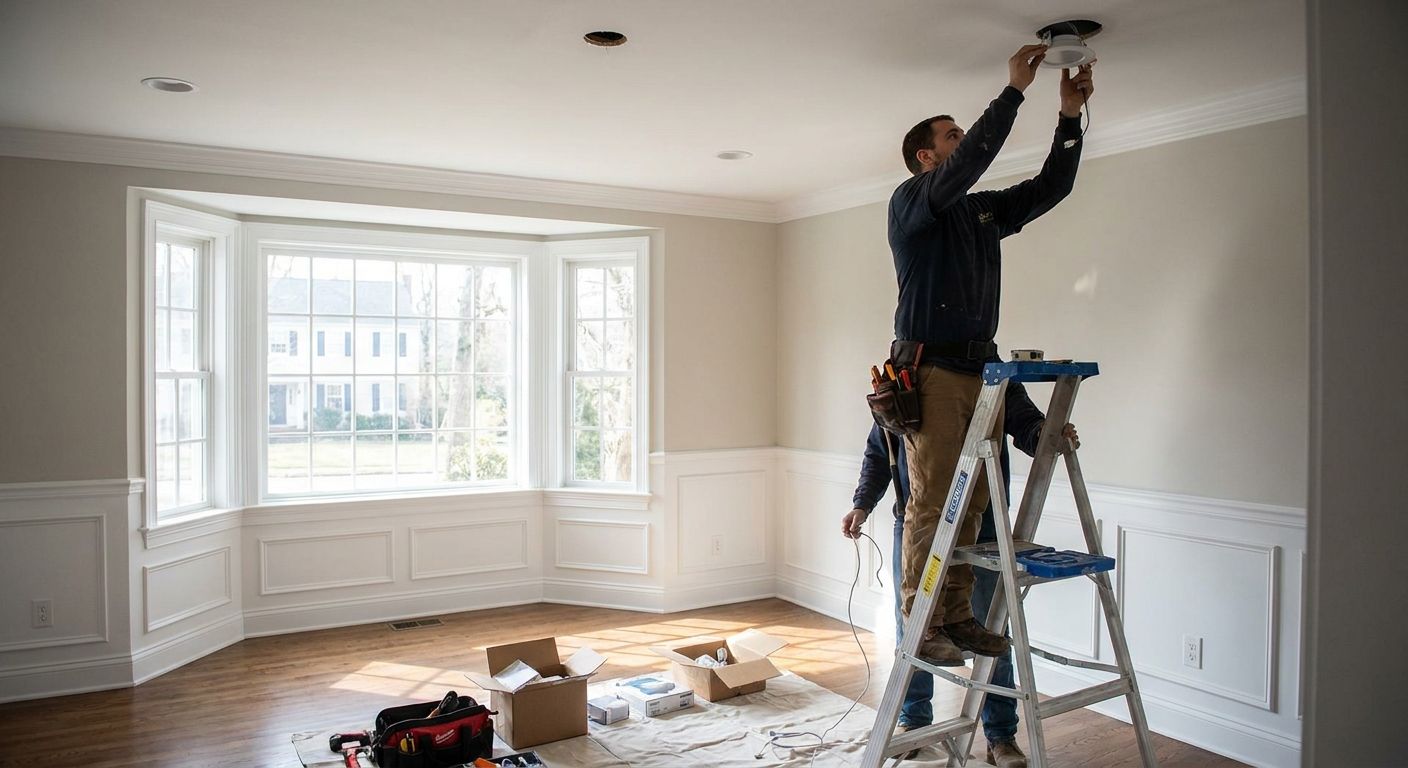
Summit NJ homeowners hire recessed lighting installation to trade boxy ceiling fixtures and dated track lights for flush, code-compliant cans wired into a dedicated circuit sized correctly for the room.
- Recessed lighting installation in Summit NJ needs IC-rated cans in most colonials with insulated attics.
- Union County requires permits for new lighting circuits; unlicensed handyman work won't pass inspection.
- Panel capacity matters before adding six or more new recessed fixtures on one circuit.
- Licensed electrical work in NJ starts at a $229.99 minimum service call before parts.
- Kitchen remodels need tighter fixture spacing than living rooms for even task lighting.
Why this matters for Summit homeowners
Summit's housing stock skews older than a lot of Central New Jersey towns — plaster-and-lath ceilings, finished attics with blown-in insulation added decades after the original build, and center-hall colonials where the original lighting plan was one flush-mount fixture per room. That combination changes how recessed lighting installation gets done here compared to a newer development in Old Bridge or Edison.
Two things drive the Summit job differently: ceiling type and insulation contact. Cutting into plaster without knowing what's behind it cracks more ceiling than it fixes, and dropping a non-IC-rated can into an insulated attic is a fire code violation, not a style choice. Union County inspectors check for IC-rated housings and proper permit sign-off before a job closes out — skip that step and you're re-doing the work.
Update your lighting layout before you touch a ceiling
Start with what you actually need, not what looks good in a showroom photo. A layout built for a 9-foot ceiling in a 1930s colonial doesn't scale to a vaulted family room addition.
- Walk each room and mark where task lighting matters (kitchen counters, home office desk, reading nook)
- Measure ceiling height — spacing rules shift for anything over 9 feet
- Note existing switch locations so new circuits don't require re-routing wall boxes
- Photograph the attic access point if you have one; it tells the installer how hard the pull will be
- Sketch fixture count per room instead of guessing — most living rooms in a 1,800-2,400 sq ft Summit colonial run 6-8 cans, kitchens run more
Check your ceiling type and attic access
What's above the drywall or plaster determines the entire install method. Skip this and the quote you get on the phone won't match the quote you get after someone's actually in the attic.
- Confirm whether the ceiling is plaster-and-lath (older Summit stock) or drywall (additions, remodels)
- Check if there's usable attic access above the room, or if it's a cathedral/vaulted ceiling with no access
- Look for existing insulation type — blown-in cellulose behaves differently than batt insulation around a fixture cutout
- Flag any knob-and-tube wiring nearby; it changes what circuit work is legal to do
Confirm your panel has capacity before adding circuits
Adding six, eight, or a dozen new recessed lights across multiple rooms often means new circuits, not just new fixtures on existing wiring. An older 100-amp panel in a pre-1960s Summit home may already be near capacity once you factor in HVAC, appliances, and anything else added over the years.
- Ask for a load calculation before signing off on a multi-room install
- Check your panel's amperage rating (100A panels are common in older Summit homes, 200A is standard for anything built or upgraded since)
- If the panel is maxed out, panel upgrade work needs to happen before or alongside the lighting install, not after
- Don't let anyone add a new circuit to a panel that's already at its breaker limit
This is where a licensed electrician earns the call instead of a handyman. Spartan Home Pros pulls the permit, does the load calculation, and runs the wiring on payroll technicians — no subcontracted crews showing up to finish someone else's rough-in.
Choose IC-rated fixtures for insulated ceilings
Not every recessed can is rated the same way, and the wrong choice fails inspection in Union County.
- Use IC-rated (insulation contact) housings anywhere insulation touches or surrounds the fixture
- Use IC-AT (air-tight) rated cans where energy efficiency and draft-sealing matter, common in attic-adjacent ceilings
- Confirm trim size matches the room — 4-inch trims for tighter spacing in kitchens, 5-6 inch for living rooms and bedrooms
- Match color temperature across a room (2700K-3000K for living spaces) so fixtures don't look mismatched room to room
Plan dimming and smart control compatibility
Most recessed lighting complaints trace back to a dimmer that wasn't matched to the fixture, not the fixture itself.
- Verify the dimmer is rated for LED loads, not just incandescent-era dimmers left in the wall
- Decide before install whether you want smart switches — retrofitting after drywall patch adds cost
- Group fixtures on separate switches by function (task vs. ambient) instead of one switch for the whole room
- Test dimming range before the electrician leaves — flicker at low settings means a mismatched dimmer, not a bad bulb
Get the permit and schedule a licensed installer
Summit requires permits for new electrical circuits, and skipping that step is the single most common reason a recessed lighting job gets flagged at resale. A licensed electrician pulls the permit as part of the job, not as an add-on fee buried later.
- Confirm the contractor is licensed in New Jersey, not just insured
- Ask whether the crew subcontracts electrical work — many general contractors do, and that breaks the accountability chain
- Get the permit number and inspection date in writing before work starts
- Ask for a flat quote with no hourly meter running once the job begins
Get a recessed lighting quote
Licensed NJ electricians, payroll technicians, no subcontracted crews.
Budget for finish work
Cutting into plaster or drywall means patching, and patching means paint. Factor this into the timeline before the electrician shows up, not after the cans are in.
- Line up a painter or plan to DIY-touch up patched ceiling sections
- Ask the electrician whether they patch drywall cutouts or leave that to you
- Expect plaster ceilings to need a skim coat, not just spackle, for a clean finish
- Budget extra time if the ceiling is textured — matching texture on a patch takes a second visit
Compare your installation options
| Option | Best for | Starting price | Key limitation |
|---|---|---|---|
| DIY recessed light kit | Single-room touch-up in an unfinished basement | Cost of fixtures only | No permit pulled; misses IC-rating requirements and joist conflicts |
| Handyman (unlicensed) | Cosmetic swap of an existing housing | Varies by job | Cannot legally add new circuits or pull a Union County permit |
| General contractor (subs electrical) | Full remodel bundled with other trades | Varies, folded into remodel bid | Electrical work farmed out — no direct accountability for the wiring |
| Licensed electrician (Spartan Home Pros) | Multi-room installs, new circuits, permit-required jobs | $229.99 minimum service call | Scheduling lead time can stretch during peak renovation season |
For any job that adds new circuits or touches more than one room, a licensed electrician is the only option that survives inspection.
Common mistakes Summit homeowners make
- Skipping the permit because the job looks small — Union County still requires sign-off on new circuits, and unpermitted work shows up at resale
- Using standard (non-IC) cans in an insulated attic — a code violation that's cheap to avoid and expensive to fix after drywall is patched
- Assuming plaster ceilings behave like drywall — cutting without checking for lath backing cracks a wider radius than expected
- Overspacing fixtures in high-ceiling rooms — a layout that works at 9 feet leaves dark corners at 11 feet
- Adding a dozen new fixtures without checking panel capacity — a 100-amp panel in an older Summit colonial may need a panel upgrade first
Kitchen remodels change the math
A kitchen recessed lighting job isn't the same spec as a living room. Task lighting over counters needs tighter can spacing, cabinet layout affects where fixtures land, and most kitchen remodels touch the circuit anyway for appliances. If your project is a full kitchen remodel rather than a standalone lighting swap, the kitchen remodel lighting approach covers spacing and circuit planning specific to that scope.
FAQ
How much does recessed lighting installation cost in Summit NJ?
Cost depends on fixture count, whether new circuits are needed, and ceiling type (plaster costs more to patch than drywall). Licensed electrical work in NJ starts at a $229.99 minimum service call before parts and additional labor.
Do I need a permit for recessed lighting in Summit NJ?
Yes, any new electrical circuit requires a permit in Union County. A licensed electrician pulls this as part of the job; unlicensed handyman work typically skips it and fails resale inspection.
How many recessed lights do I need per room?
Most living rooms in a standard Summit colonial run 6-8 cans depending on ceiling height and room size. Kitchens typically need more fixtures because of tighter task-lighting spacing over counters.
Can recessed lights be installed in a plaster ceiling?
Yes, but plaster-and-lath ceilings crack more easily than drywall and often need a skim coat after patching. Check for lath backing before cutting to avoid a wider crack radius.
Is recessed lighting installation different for a kitchen remodel?
Yes. Kitchen layouts need tighter fixture spacing for counter task lighting and usually involve circuit work tied to appliances, unlike a standalone living room swap.
Do older Summit homes need a panel upgrade before adding recessed lighting?
Only if the existing panel is already near capacity. A load calculation before the install tells you whether a 100-amp panel common in pre-1960s Summit homes can handle new circuits.
What's the difference between IC-rated and non-IC-rated cans?
IC-rated (insulation contact) housings are built to touch insulation safely without overheating; non-IC cans require an air gap and fail inspection in most insulated Summit attics.
How long does a recessed lighting installation take?
A single-room job with existing circuit capacity typically finishes in a day. Multi-room jobs with new circuits or panel work take longer and require a scheduled inspection before the job closes out.
One last thing
The detail most homeowners miss: the dimmer switch matters as much as the fixture. A mismatched dimmer on an LED recessed can causes flicker at low settings that gets blamed on the bulb, when the actual fix is a dimmer rated for LED loads — a five-minute swap that solves a problem homeowners live with for years.


