
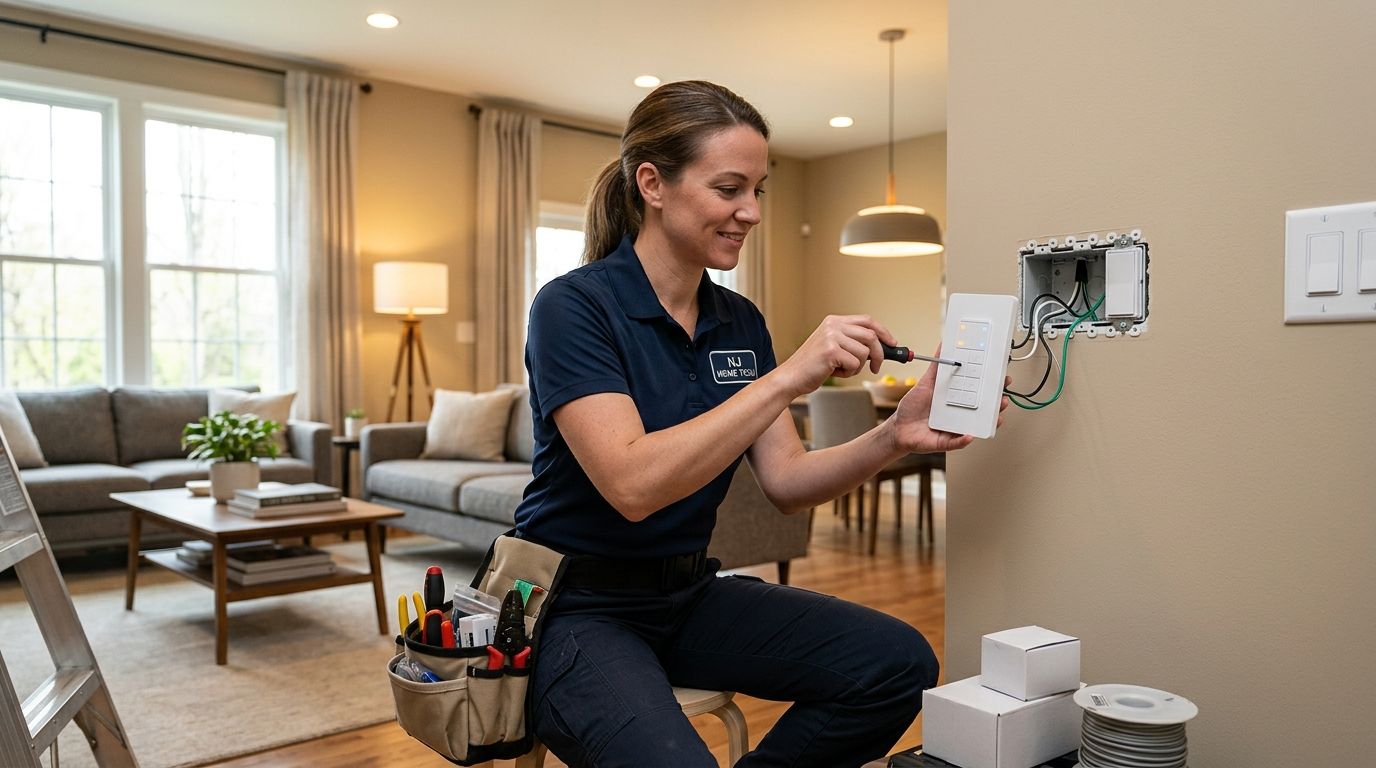
Smart lighting control installation for NJ homes means swapping standard switches and fixtures for app- and voice-controlled circuits, and it only works reliably when the panel behind the wall has room to support it. Central New Jersey homeowners in Monmouth, Middlesex, Somerset, and Union counties run into a specific wall here: older housing stock with missing neutral wires, aluminum branch circuits, or a panel already maxed out by an EV charger or generator transfer switch.
- Smart lighting control installation nj works only when the panel has spare capacity and switch boxes have a neutral wire.
- Lutron Caseta and Wi-Fi switches cover most NJ retrofits; whole-home systems like Control4 need dedicated low-voltage wiring.
- Homes with aluminum branch wiring or two-prong boxes need a licensed electrician before any smart switch goes in.
- Spartan Home Pros checks panel capacity and switch box wiring before recommending a smart lighting control system.
- Skipping the panel check is the top reason 2026 smart lighting installs end in flicker, dropped connections, and callbacks.
Why smart lighting control matters for NJ homeowners
Most smart dimmers on the market require a neutral wire in the switch box, and homes wired before the mid-1980s in Central NJ frequently don't have one. That single detail decides whether a job is a 20-minute switch swap or a rewiring project. Spartan Home Pros treats that check as step one, not an afterthought, because getting it wrong means returning switches and reopening walls.
Panel headroom is the second constraint. A 100-amp panel already carrying a generator transfer switch or an EV charger circuit may not have breaker slots left for a lighting hub or additional dedicated circuits. Homeowners planning a smart lighting control installation in 2026 alongside an EV charger or generator project should get the panel evaluated once, not twice.
Map your lighting zones and control needs
Start with a room-by-room list before buying a single switch.
- List every fixture you want smart — recessed lights, ceiling fans, landscape lighting, exterior floods
- Decide which zones need real dimming versus simple on/off
- Flag any three-way or four-way switch setups; both ends need compatible smart hardware
- Note rooms with existing recessed lighting installation, since retrofit dimmers must match the existing driver type
- Separate "must automate" zones like the entry and kitchen from "nice to have" zones like a guest bedroom
Pick your control protocol before buying anything
The protocol decision locks in everything downstream, so make it early.
- Wi-Fi switches connect straight to the router with no hub, but 15+ of them can crowd a home network
- Zigbee and Z-Wave systems (Lutron Caseta, SmartThings) run on a separate mesh and stay responsive with 30-plus devices
- Hardwired low-voltage systems (Control4, Lutron RA3) route through a central panel and hold up best in full-home installs
- Match the protocol to what's already running in the house — a dedicated hub is wasted money if everything else is Wi-Fi
- Confirm the switches support the bulb type already installed; not every dimmer works with every LED driver
Check your panel capacity and switch box wiring
This is where a licensed electrician earns the call, and it's the step most DIY smart lighting projects skip.
- Open the panel cover and read the amperage stamped on the main breaker — a 100-amp panel already running a generator transfer switch or EV charger circuit may have no headroom left
- Check each switch box for a neutral wire; most non-Lutron dimmers require one, and pre-1980s Central NJ construction often lacks it
- Flag aluminum branch wiring, common in homes built between roughly 1965 and 1973, before installing any smart switch — aluminum needs a licensed electrician to terminate correctly, not a snap-in retrofit
- Confirm GFCI or AFCI protection on circuits feeding bathroom or kitchen smart lighting
- Have an electrician test all of the above in one visit so you know upfront whether it's a straightforward swap or a subpanel job
Get your panel checked first
A licensed electrician confirms capacity and wiring before any smart switch goes in.
Install switches, dimmers, and hubs in the right order
Sequence matters more than most homeowners expect.
- Kill power at the breaker before touching any switch box, every time
- Set up the hub or bridge first and confirm it's on the network before wiring a single switch
- Wire one switch, test it, then move to the next — troubleshooting one dead switch beats troubleshooting twelve
- Label each smart switch in the app by room name as you go, not after the fact
- Cap and tape unused neutral or ground wires per code before closing the box
Set up automation scenes and schedules
Scenes are what make the install feel different from a standard switch swap.
- Build a "leaving" scene that kills every light except the entry and exterior floods
- Set landscape and exterior lighting to trigger off sunset/sunrise instead of a fixed clock
- Create a vacation mode that randomizes on/off timing across zones
- Group recessed lighting circuits by room rather than by physical switch
- Keep the wall switch behavior consistent with app behavior, or the household stops trusting either one
Test dimming and LED compatibility before calling it done
Mismatched dimmers and LED drivers are the most common reason smart lighting installs get abandoned.
- Dim every circuit to its lowest setting and check for flicker, buzz, or a hard floor above 10%
- Swap incompatible bulbs or drivers rather than living with flicker
- Verify three-way switches stay in sync when one end changes state
- Test Wi-Fi switches remotely on cellular data to confirm they actually work away from the house
- Confirm scenes still fire correctly after a router reboot
Integrate with voice assistants and the rest of the smart home
Lighting rarely stays isolated once it's smart.
- Link the hub to Alexa, Google Home, or Apple Home — most Zigbee/Z-Wave hubs support all three
- Pair lighting scenes with existing security camera wiring or a smart thermostat setup so "away mode" covers lights, cameras, and temperature together
- Set voice groups by room name matching what's already labeled in the app
- Avoid stacking automations across three separate apps — pick one hub as the source of truth
Comparison: smart lighting control options for NJ homes
| Option | Best for | Key limitation |
|---|---|---|
| Wi-Fi smart switches | Retrofitting a few rooms without adding a hub | Crowds home Wi-Fi past 10-15 devices |
| Zigbee/Z-Wave (Lutron Caseta) | Whole-house retrofits in homes missing neutral wires | Requires a separate hub or bridge |
| Hardwired low-voltage (Control4, Lutron RA3) | New construction or full rewires | Needs open walls and licensed electrician labor |
| Electrician-managed installation | Homes with aluminum wiring, panel constraints, or mixed old/new circuits | Costs more than a DIY switch swap |
Verdict: for most Central NJ retrofits, Lutron Caseta or a comparable Zigbee/Z-Wave system is the right starting point; homes with aluminum wiring or a tight panel should route the job through a licensed electrician before buying anything.
Common mistakes NJ homeowners make
- Buying smart dimmers before checking for a neutral wire. Half the order gets returned when the switches don't fit boxes wired before 1985.
- Putting a whole-home system on a maxed-out panel. A Lutron RA3 install on a panel already carrying an EV charger and generator transfer switch turns into a second electrical project mid-job.
- Mixing LED bulbs from different manufacturers on one dimmer circuit. The flicker gets blamed on the switch when the actual cause is a driver mismatch.
- Skipping permits on jobs that touch panel wiring. Central NJ townships inspect electrical work tied to permits, and unpermitted panel changes surface at resale.
- Treating aluminum wiring like copper. Snapping in a retrofit switch instead of calling a licensed electrician to terminate aluminum branch wiring correctly is the fastest way to a callback.
FAQ
What's the best smart lighting control system for a NJ home?
Lutron Caseta or a comparable Zigbee/Z-Wave system covers most Central NJ retrofits in 2026 because it doesn't require a neutral wire in every switch box. Whole-home hardwired systems like Control4 fit new construction or full rewires better than retrofits.
Do I need an electrician to install smart switches in NJ?
A licensed electrician is required whenever the job touches panel wiring, aluminum branch circuits, or missing neutral wires. Simple neutral-equipped switch swaps in newer homes can be a DIY job with the right switch.
Can smart lighting work with recessed lighting already installed?
Yes, as long as the existing recessed lighting driver is dimmable and compatible with the smart dimmer's load range. Mismatched drivers are the most common cause of flicker in retrofit installs.
How long does smart lighting control installation take?
A single-room switch swap takes under an hour; a whole-house retrofit with a hub, scenes, and voice integration runs a full day or more depending on how many circuits need panel work first.
Does smart lighting control need Wi-Fi to work?
Wi-Fi switches need a router connection; Zigbee and Z-Wave systems run on their own mesh through a hub and keep working during a Wi-Fi outage, though remote app access still needs internet.
Is Lutron or Control4 better for older Central NJ homes?
Lutron Caseta generally fits older homes better because several of its switches don't require a neutral wire, which older Central NJ wiring often lacks. Control4 is a stronger fit for new construction or full rewires.
Can smart lighting control handle a power outage or generator backup?
Smart switches and hubs run fine on generator or battery backup power as long as the circuit feeding them is on the backed-up panel. The hub itself needs to be on that same protected circuit to stay online.
Does aluminum wiring rule out smart lighting installation?
No, but it changes the job. A licensed electrician needs to terminate aluminum branch circuits correctly before any smart switch goes on that circuit, which usually adds labor and inspection time.
One last thing
Homes in parts of Union and Middlesex counties built between roughly 1965 and 1973 often have aluminum branch wiring on at least some circuits. That's the single biggest reason a smart lighting quote in Central NJ turns into a panel conversation instead of a same-day switch install — check the wiring era before you fall in love with a specific dimmer brand.


