
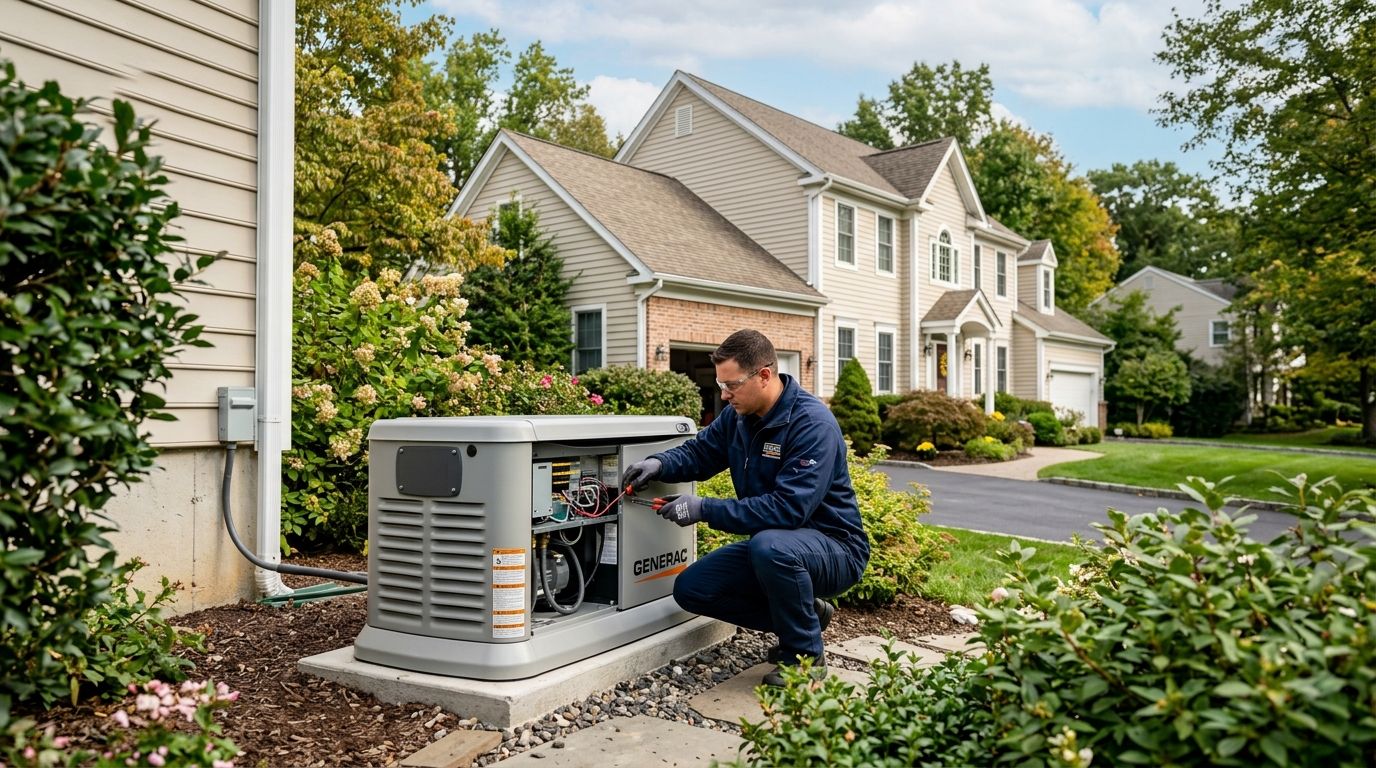
Whole house generator installation for Holmdel NJ homeowners means sizing, permitting, and wiring a standby unit that keeps HVAC, well pumps, and sump pumps running through Monmouth County's storm outages. Holmdel sits on JCP&L's grid, where wooded lots and overhead lines mean multi-day outages after nor'easters and summer thunderstorms are routine, not rare. Larger Colonial and estate-style homes common in Holmdel's Crawfords Corner and Holmdel Village areas need bigger load calculations than a typical 2,000-square-foot townhouse, which is where a lot of DIY sizing guesses go wrong.
- Whole house generator installation in Holmdel NJ usually means a 20kW to 26kW standby unit for average-size homes.
- Spartan Home Pros handles permitting, panel tie-in, and JCP&L coordination so homeowners are not filing paperwork themselves.
- Natural gas and propane are the two fuel paths, and gas line capacity determines which one your property supports.
- Portable generators do not run sump pumps or well pumps continuously, which matters in Holmdel's rural northern sections.
Why whole house generator installation matters for Holmdel homeowners
Holmdel's mix of older overhead utility lines and heavily treed properties makes it more storm-exposed than denser parts of Monmouth County. When a limb takes down a line during a nor'easter, restoration in wooded residential zones typically lags behind commercial corridors.
Homes in the northern and western parts of town still rely on private well water, which means no power equals no running water, not just no lights. A whole house generator installation solves both problems at once because it starts automatically and carries the well pump, HVAC, and refrigeration loads without anyone flipping a switch in the dark.
Spartan Home Pros treats whole house generator installation as an electrical project first, not an appliance drop-off — the transfer switch, panel capacity, and gas or propane line all have to be verified before a unit ever gets set on a pad. That sequence is what keeps a 2026 install from stalling at inspection.
Calculate your home's power load
Start with the manual method before anyone talks you into a bigger unit than you need.
- List the running wattage of your furnace blower, well pump, refrigerator, and sump pump
- Add HVAC startup (surge) wattage, which runs 2-3x higher than running wattage
- Total square footage matters less than which circuits you want covered — essential-only vs whole-home
- Check your existing panel's amperage (100A, 150A, or 200A) since it caps what the generator can feed
- Note any future loads: a planned EV charger or pool equipment changes the math
Pick the right generator size for a Holmdel home
Most Holmdel homes in the 2,500 to 4,000 square foot range land in the 20kW to 26kW standby range once HVAC and well pump loads are included. Smaller capes and ranches under 2,000 square feet can often run essential circuits on 14kW to 18kW.
- A sizing worksheet gets you close, but startup surge from a central AC compressor is the number that trips up self-sizing
- Whole-home coverage (every circuit) needs a bigger unit than essential-circuit coverage (HVAC, well pump, refrigerator, select outlets)
- Homes with a pool pump or hot tub need that load added separately, not estimated
- Spartan Home Pros runs a full load calculation on-site rather than sizing off square footage alone — see how to size a whole house generator for the full breakdown
Choose between natural gas and propane
Fuel type is a Holmdel-specific decision because gas service is not uniform across town.
- Natural gas means no refueling and no tank, but the gas meter and line have to support continuous draw at the generator's BTU rating
- Propane requires an above-ground or buried tank, typically 250 to 500 gallons for whole-home units, and periodic refills
- Homes on the edge of natural gas service areas in Holmdel sometimes default to propane simply because the gas main does not reach the property
- A licensed technician checks existing gas line diameter before assuming natural gas will work — undersized lines choke fuel delivery under load
Check your electrical panel and wiring
The generator connects to your home through an automatic transfer switch wired into your main panel, and an outdated or maxed-out panel changes the scope of the job.
- Panels over 20 years old or rated under 100A often need an upgrade before a transfer switch can be added
- Federal Pacific and Zinsco panels found in some older Holmdel homes are typically replaced outright, not worked around
- The transfer switch has to be sized to match generator output, not just panel capacity
- Grounding and bonding get inspected as part of the same visit — a generator installation is also an electrical safety check
- Full prep steps are covered in preparing your electrical system for a generator
Handle Holmdel permits and utility coordination
New Jersey's Uniform Construction Code requires an electrical permit and inspection for standby generator installations, and Holmdel's building department reviews the transfer switch and gas or propane line separately from the generator unit itself.
- A permit gets pulled before installation, not after — skipping this step is the single most common delay in 2026
- JCP&L needs to be notified for the utility-side interconnection, since the transfer switch isolates your home from the grid during generator operation
- Setback requirements from property lines and windows apply to the generator pad placement
- Propane tank placement has its own fire code distance requirements from the house and any ignition source
- Final inspection has to pass before the unit is authorized to run on generator power automatically
Budget for installation, not just the unit
The generator itself is one line item — site work, electrical, and gas or propane line changes are separate costs that vary by property.
- Concrete pad or composite mounting base, transfer switch, wiring run length, and panel condition all move the total
- Propane tank installation adds cost that natural gas hookups typically avoid
- Permit fees and inspection costs are set by Holmdel's building department, not the contractor
- A full cost breakdown by scope is in how to budget for whole house generator installation
Schedule maintenance after the unit is running
Installation is not the end of the project — standby generators need scheduled maintenance to start reliably when the power actually goes out.
- Oil and filter changes on a schedule set by the manufacturer, typically annually or by run-hours
- Battery checks, since a dead starting battery is the most common reason a standby unit fails to start
- Weekly self-test cycles should be confirmed as active, not assumed
- Propane level checks before storm season if the unit runs on propane
Get your Holmdel property assessed
On-site load calculation and panel review before any generator quote.
Comparing backup power options for Holmdel homes
| Option | Best for | Key limitation |
|---|---|---|
| Whole-home standby generator | Homes with well pumps, HVAC, and multi-day outage risk | Highest installation scope; requires permit and gas or propane line |
| Portable gas generator | Short outages, essential circuits only | Manual startup and refueling; will not run continuously |
| Battery backup system | Shorter outages, quiet operation | Limited runtime without solar input; not sized for HVAC loads |
| Inverter generator | Small essential loads, sensitive electronics | Lower wattage ceiling; not built for whole-home coverage |
A whole-home standby unit is the only option on this list that starts automatically and carries a well pump through a multi-day outage — that is the deciding factor for most Holmdel properties.
The honest downside: a standby generator is the most involved of the four to install, it needs a permit, and it needs annual service. A portable unit costs less to get running and needs no inspection. If your outages last four hours and you are on municipal water, the standby unit is more machine than the problem requires.
Common mistakes Holmdel homeowners make
- Sizing off square footage alone — a 3,500-square-foot Colonial with a well pump and pool needs a different load calculation than a same-size home on municipal water
- Skipping the permit — Holmdel's building department requires inspection before the transfer switch goes live, and skipping it creates problems at resale
- Placing the pad too close to a window or property line — setback violations get caught at inspection and mean moving the unit after it is already set
- Assuming natural gas will work without checking line size — an undersized gas main chokes fuel delivery under full generator load
- Buying a portable unit for a well-water home — portable generators do not run continuously, which fails the exact scenario a well pump outage creates
FAQ
How much does whole house generator installation cost in Holmdel NJ?
Cost depends on generator size, fuel type, panel condition, and site work, and varies enough by property that a fixed number is not useful without an on-site assessment. Spartan Home Pros breaks the cost down by scope in its NJ generator budget guide.
What size generator do I need for a Holmdel home?
Most homes between 2,500 and 4,000 square feet need a 20kW to 26kW standby unit once HVAC startup surge and well pump loads are included. Smaller homes under 2,000 square feet on essential-circuit coverage can often use 14kW to 18kW.
Do I need a permit for a whole house generator in New Jersey?
Yes. New Jersey's Uniform Construction Code requires an electrical permit and inspection for standby generator installations, and Holmdel reviews the transfer switch, pad placement, and gas or propane line separately.
Is natural gas or propane better for a home generator?
Natural gas means no refueling and no tank, but only works if your existing gas line supports continuous draw at the generator's rating. Propane requires a 250 to 500 gallon tank and periodic refills but works where gas service does not reach.
Can a portable generator handle a well pump during an outage?
Portable generators require manual startup and refueling, which fails for continuous loads like a well pump during a multi-day outage. A whole-home standby unit starts automatically and runs the pump without homeowner intervention.
How often does a whole house generator need maintenance?
Standby generators typically need an oil and filter change annually or by manufacturer-specified run-hours, plus battery checks, since a dead starting battery is the most common startup failure. Confirm the weekly self-test cycle is active.
Does JCP&L need to be notified about a generator installation?
Yes. JCP&L is notified for the utility-side interconnection because the transfer switch isolates the home from the grid during generator operation. This is handled with the permit and inspection process, not separately by the homeowner.
How long does a whole house generator installation take in 2026?
The physical installation is short compared with the permitting and inspection sequence around it. Panel condition and whether a propane tank or new gas line is needed are the two factors that extend the timeline most.
One last thing
The detail most Holmdel homeowners skip: a standby generator's weekly self-test can fail silently if the propane tank runs low or the starting battery weakens, and the unit will not announce it until the power actually goes out during 2026's next nor'easter. Checking that self-test log at every service visit is the cheapest insurance in the entire installation.


