
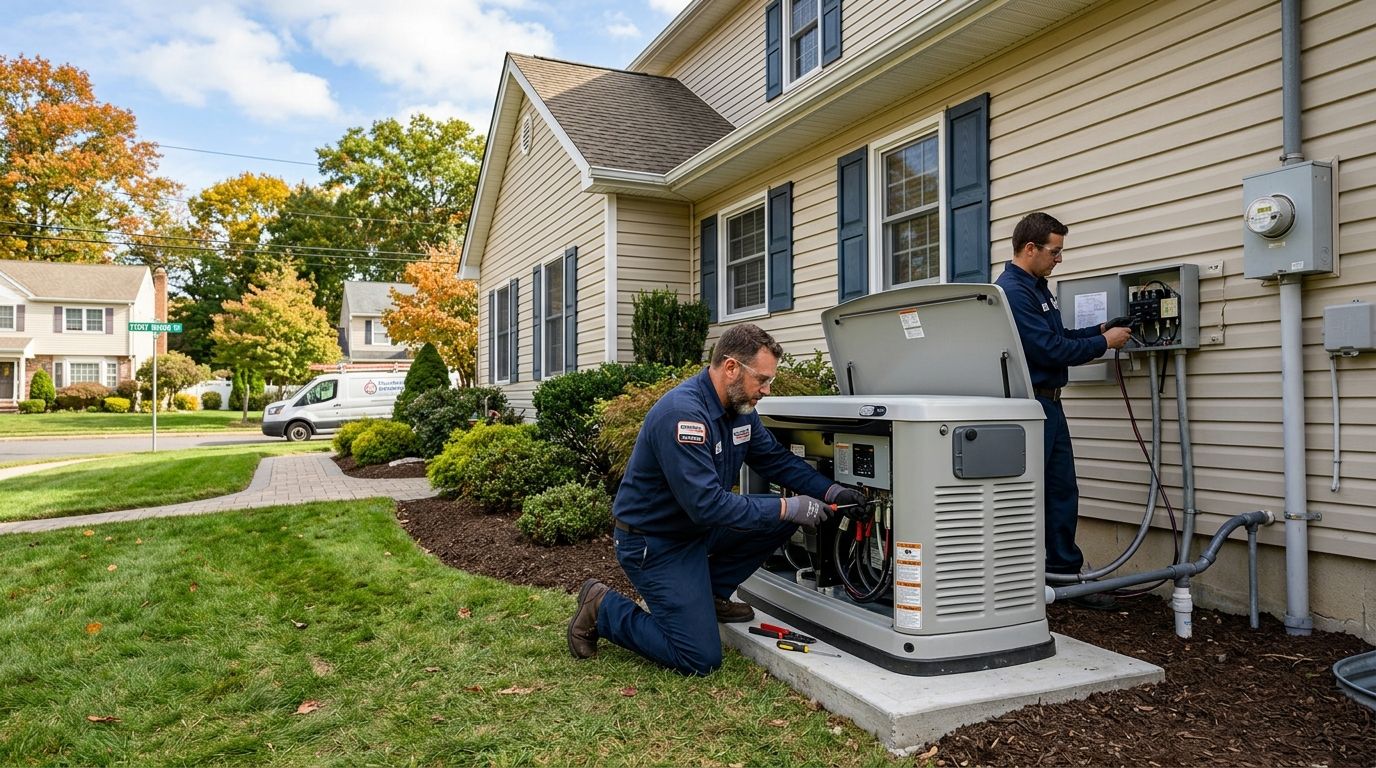
Whole house generator installation for Plainfield NJ homeowners means permanently wiring a standby generator to your electrical panel so it starts automatically within seconds of a utility outage, sized to run your furnace, sump pump, and refrigerator without anyone flipping a switch. Plainfield's mix of early-1900s housing stock and newer additions means panel capacity varies block to block, so sizing and panel readiness matter more here than in a newer subdivision.
- Whole house generator installation in Plainfield NJ starts with a load calculation, not a generator brand pick.
- Spartan Home Pros services Plainfield as part of its Union County coverage area for standby generator installs.
- A 22kW standby generator covers most Plainfield single-family homes; smaller lots often only need 14kW.
- Older Plainfield homes running 100-amp service typically need a panel evaluation before a generator can tie in.
- Automatic transfer switches are standard on 2026 installs — skip anything that still needs a manual switch flip.
Why this matters for Plainfield homeowners
Plainfield sits in Union County, one of the four counties Spartan Home Pros covers directly alongside Monmouth, Middlesex, and Somerset. Storms and grid strain in Central New Jersey put homes without backup power at risk of losing heat, sump pumps, well pumps, and medical equipment for days at a time, not hours.
Homeowners who wait until a storm forecast to call face longer lead times, because installation runs through a permit and inspection cycle — not a same-day drop-off. Getting the panel evaluation and load calculation done in 2026, before the next outage, is what separates a smooth install from a scramble.
How whole house generator installation works, step by step
Confirm your panel can handle a standby generator
A generator is only as reliable as the panel it ties into. Plainfield's older sections still run a fair amount of 100-amp service, and that's the first thing worth checking before anyone talks generator brands.
- Check panel amperage — 100-amp service often needs an upgrade before a 22kW unit can connect safely.
- Look for double-tapped breakers or a Zinsco or Federal Pacific panel — both are automatic red flags for any electrician.
- Confirm your main breaker is rated for an automatic transfer switch tie-in.
- Document available breaker space before ordering equipment.
Spartan Home Pros walks through the full checklist in how to prepare your home electrical system for a generator.
Size the generator to your home's actual load
Square footage tells you almost nothing about generator sizing. What matters is which circuits have to stay live during an outage and how much running wattage they draw together.
- List must-run circuits: furnace blower, sump pump, well pump, refrigerator, medical equipment.
- Add up running watts, not square footage — electric heat pulls far more than gas heat in the same size home.
- Whole-home standby units commonly run 14kW to 26kW; most Plainfield single-family homes land around 22kW.
- Get the load calculation done before comparing any specific brand or model.
The math behind this lives in how to size a whole-house generator for your NJ home.
Pick a mounting location that meets Plainfield code
Where the unit sits matters as much as what unit you buy — clearance violations are one of the most common inspection fails on standby installs.
- Keep the unit at least 18 inches from the house wall and away from windows, doors, and fresh-air intakes.
- Check side-yard setback requirements against Plainfield zoning before pouring a concrete pad.
- Avoid low spots that pool water during heavy rain — a flooded generator won't start when you need it most.
- Route exhaust away from neighboring property lines and shared driveways.
Handle permits and inspection
This is the step homeowners underestimate most. A standby generator install is not a plug-and-play appliance swap — it's an electrical and often a gas or fuel-tank permit.
- File an electrical permit and construction permit with Plainfield's building department before install day.
- Schedule any required utility disconnect/reconnect for the panel tie-in.
- Confirm your installer pulls permits under their own license, not yours — this matters for insurance claims down the road.
- Build inspection wait time into your project timeline, not just install-day scheduling.
Budget for the full installation, not just the generator
The generator itself is one line item. Pad, transfer switch, gas line or fuel tank sizing, and the electrical tie-in are separate costs that add up.
- Get a written scope that separates equipment cost from labor cost.
- Ask whether the automatic transfer switch is included in the quote or priced as an add-on.
- Confirm gas line sizing is part of the estimate if you're running natural gas instead of propane.
- Budget for annual maintenance once the system is live, not just the install.
Full cost breakdowns are in how to budget for whole-house generator installation in NJ.
Schedule installation and transfer switch wiring
An automatic transfer switch is what turns a portable generator problem into a whole-house solution — it senses the outage and shifts your home's load without you touching anything.
- Confirm gas line sizing with your installer before the crew shows up if running natural gas.
- Ask for a startup test the same day as installation, not a follow-up callback.
- Get a walkthrough of the manual shutoff before the crew leaves.
- Verify the transfer switch is rated for your panel's full amperage, not just the generator's output.
Test and maintain the system after install
Installation day isn't the finish line. A standby generator that sits untested for a year is a generator that might not start during the outage that actually matters.
- Let the unit's automatic self-test run on schedule — most standby units test themselves every 7 days.
- Change oil and filters per the manufacturer schedule, generally once a year for typical residential runtime.
- Watch for a battery warning light — a dead start battery is the most common reason a standby unit fails to start during an outage.
- Keep the unit clear of snow and debris heading into winter.
Comparing your backup power options
| Option | Best for | Key limitation |
|---|---|---|
| Portable gas generator | Short outages on a tight budget | Manual setup, limited circuits, needs someone home to run it |
| Inverter generator | Sensitive electronics, quiet operation | Low wattage ceiling — can't cover whole-house loads |
| Whole-house standby generator | Automatic backup during multi-day outages | Higher install complexity — permit, pad, and panel evaluation required |
A whole-house standby generator is the only option that keeps a Plainfield home fully powered without anyone home to run it. Portable and inverter units are stopgaps, not systems.
“If the generator can't run your sump pump and your furnace at the same time, it's not sized right.”
Get your Plainfield generator quote
Panel check, load calculation, and install scope in one visit.
Common mistakes Plainfield homeowners make
- Sizing off square footage instead of a load calculation — leads to units that trip when a well pump and AC start at the same time.
- Skipping the panel check on older homes — a 100-amp panel with double-tapped breakers can't safely feed an automatic transfer switch.
- Placing the unit too close to a bedroom window — violates clearance and fails inspection before it ever runs a cycle.
- Assuming propane and natural gas installs cost the same — line sizing and tank placement differ enough to change the whole scope.
- Waiting until a storm warning to call — permit and inspection cycles in 2026 take longer than any emergency crew can compress.
FAQ
What size whole-house generator do I need for a Plainfield NJ home?
Most Plainfield single-family homes run on a 22kW standby generator, though smaller homes or lighter must-run loads can work with 14kW. The right number comes from a load calculation on your specific circuits, not square footage.
Is whole house generator installation covered under a permit in Plainfield?
Yes — a standby generator install requires an electrical permit and typically a construction permit through Plainfield's building department. Your installer should pull these under their own license, not yours.
Can I install a whole-house generator on a 100-amp panel?
Often not without an upgrade first. A 100-amp panel, common in Plainfield's older housing stock, frequently lacks the capacity for a 22kW generator and automatic transfer switch tie-in.
What's the difference between a portable generator and a whole-house standby unit?
A portable generator requires manual setup and powers a handful of circuits at a time. A whole-house standby unit ties permanently into your panel and starts automatically within seconds of an outage.
Does Spartan Home Pros install generators in Plainfield NJ?
Yes — Plainfield falls within Spartan Home Pros' Union County coverage area, alongside Monmouth, Middlesex, and Somerset counties.
How much maintenance does a whole-house generator need after installation?
Standby generators run a self-test roughly every 7 days on their own, and most need an oil and filter change about once a year under typical residential runtime.
What brands of whole-house generators are best for New Jersey homes?
Brand fit depends on fuel type, panel setup, and local parts availability rather than one universal answer. A side-by-side breakdown for New Jersey homes covers the tradeoffs in detail.
How long does whole house generator installation take?
Install day itself is usually one to two days of on-site work, but the permit and inspection cycle around it adds more time than the physical install.
One last thing
The line item Plainfield homeowners overlook isn't the generator — it's the gas meter. If your existing gas meter and line were sized for a stove and water heater, adding a 22kW generator's demand can require the utility to upsize the meter before your installer can even hook up the unit. Ask about meter capacity before you sign anything in 2026, not after the pad is poured.


