
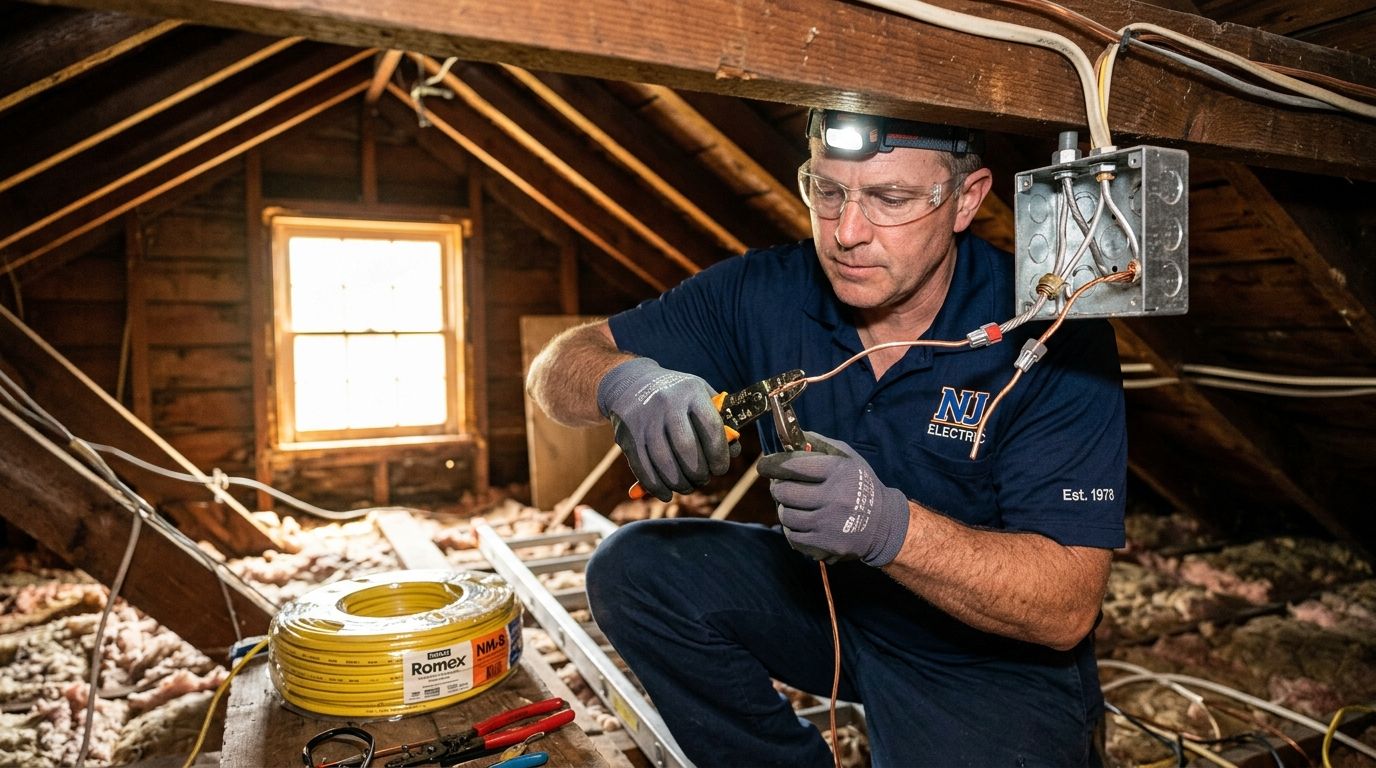
Aluminum wiring replacement in NJ is the process of removing single-strand aluminum branch circuit wiring from a home built roughly between 1965 and 1973 and replacing it with copper, along with the outlets, switches, and splices that wiring feeds. Older NJ homes in Union, Middlesex, and parts of Monmouth County carry more of this wiring than newer construction, and 50-plus years of expansion and contraction changes how it behaves at every connection point.
- Aluminum wiring replacement nj typically means either a full rewire or a remedial fix at each outlet and switch, not always a whole-house tear-out.
- Homes built 1965-1973 are the segment most likely to have single-strand aluminum branch circuits in Central NJ.
- Warm cover plates, flickering lights tied to appliance use, and a burning smell at outlets are the signals that push repair from optional to urgent.
- AlumiConn connectors and COPALUM crimps are the two accepted remedial methods; full rewire with copper removes the issue permanently.
- A licensed electrician - not a handyman - should test every connection before you decide between repair and replacement.
Why this matters for older NJ homes
The U.S. Consumer Product Safety Commission has documented that homes wired with aluminum branch circuits installed in the 1965-1973 window develop fire hazard conditions at connection points - outlets, switches, junction boxes - at a meaningfully higher rate than copper-wired homes of the same age. The mechanism is physical: aluminum expands and contracts more than copper under electrical load, oxidizes at the point of contact, and loosens screws and wire nuts over decades. A connection that was tight in 1968 is not necessarily tight in 2026.
This is not a hypothetical for Central Jersey. Towns like Cranford, Linden, Elizabeth, and parts of Perth Amboy have housing stock from exactly that construction era, which is also when many of the region's electrical panels started needing an upgrade on their own timeline. Aluminum wiring and an aging panel often show up in the same house, which is why an inspection of one should always include a look at the other.
Insurance carriers have caught up to the data. Some NJ homeowners policies now require an inspection report - sometimes called a CPSC-style connection check - before renewal on a home with known aluminum wiring, and a few carriers decline to renew without documented remediation.
Identify if your home has aluminum wiring
Start with what's visible before calling anyone.
- Check the wire jacket at an outlet or the panel for the stamp "AL" or "ALUMINUM," usually silver-gray instead of copper's reddish tone.
- Look at the permit history or listing sheet for a construction date between 1965 and 1973 - the tightest window for single-strand aluminum use.
- Pull a switch or outlet cover plate (power off) and look at the wire color and finish directly.
- Check the electrical panel's wire gauge stamp - aluminum branch circuits are typically 12 or 10 AWG, noticeably thicker-looking than equivalent copper.
- Ask a prior inspection report or home warranty disclosure if the home changed hands recently; aluminum wiring is a standard disclosure item in NJ real estate transactions.
Inspect outlets and switches for warning signs
Aluminum wiring problems show up locally, at the connection, not as a whole-house symptom.
- Warm or discolored cover plates on outlets or switches, especially ones feeding a major appliance.
- A faint burning or plastic smell near a receptacle that isn't tied to anything plugged in.
- Flickering lights that track with a specific appliance turning on, not a general dimming.
- Outlets that have stopped working intermittently, especially ones on the same circuit as a large draw like a dryer or window AC.
- Visible scorching, melted plastic, or a discolored faceplate - these are stop-using-that-outlet-today signals, not wait-and-see ones.
Any one of these justifies a service call. Two or more on the same circuit means don't wait for the next billing cycle to schedule it.
Get a licensed electrician to test connections
This is where a homeowner's own inspection ends and a professional one starts - testing torque and resistance at a live connection isn't a DIY job.
- A licensed electrician checks torque at every accessible connection with a calibrated tool, not a visual guess.
- Thermal imaging during an active load test catches heat buildup before it becomes visible scorching.
- Panel-level inspection confirms whether the aluminum issue is isolated to branch circuits or also touches the main lugs.
- Testing documents which circuits are safe to leave alone and which need immediate attention, so you're not paying to redo work that's already sound.
Spartan Home Pros runs these tests as a licensed electrical contractor working directly, without subcontracting the diagnostic work to a third party - the technician who tests your panel is the one who signs off on it.
Choose a repair method for your budget
There are three accepted paths once aluminum wiring is confirmed, and the right one depends on the scope of the problem, not just the age of the house.
- AlumiConn connectors: a UL-listed twist connector rated for aluminum-to-copper transitions, installed at each individual connection point without pulling new wire.
- COPALUM crimp splices: a permanent, factory-tool-installed splice that fuses aluminum to a copper pigtail; considered the most durable remedial fix by CPSC guidance.
- Full rewire with copper: removes the aluminum entirely and replaces it circuit by circuit, typically bundled with a panel evaluation since the two projects share access points.
- Do nothing: not a method, but the default outcome if a home inspection flags aluminum wiring and nobody acts on it before a sale or insurance renewal.
Budget for full replacement vs. remedial repair
Scope drives cost more than square footage alone. A single-story ranch with a dozen circuits costs less to fully rewire than a two-story colonial with finished walls and a finished basement, because access - not wire length - is the expensive part of the job.
| Option | Best for | Key limitation |
|---|---|---|
| AlumiConn connectors | Homeowners who want each connection fixed without opening walls | Doesn't address wire condition beyond the connector itself |
| COPALUM crimps | Homes needing a permanent remedial fix at accessible points | Requires a licensed tool and trained installer; not all electricians carry the certification |
| Full copper rewire | Owners planning to sell, refinance, or already opening walls for other work | Higher labor cost from wall and ceiling access, especially in finished basements |
| No action | No one - flagged as a risk by CPSC data and most NJ home inspectors | Leaves the fire hazard condition unaddressed and can block insurance renewal |
If a Zinsco panel replacement is already on your radar, the timing question is the same one as aluminum wiring: both are 1960s-70s-era problems that show up together often enough that bundling the assessment saves a second service call.
Get your wiring assessed before you renovate
A licensed electrician checks aluminum wiring and panel condition in one visit.
Schedule the work with your panel upgrade
Aluminum wiring replacement and panel work overlap physically - both require opening the panel and often the same wall cavities.
- Schedule the wiring assessment and panel evaluation as one visit, not two separate service calls.
- Ask whether your project needs a township permit - most Central NJ municipalities require one for branch circuit replacement, not just panel swaps.
- Confirm the crew doing the work is the crew that pulls the permit and passes inspection - not a subcontractor brought in for the day.
- Plan for one to several days of work depending on how many circuits are affected, with power interruptions limited to the circuits actively being worked.
Handle insurance and disclosure requirements
Aluminum wiring is a standard disclosure item in NJ home sales, and it increasingly shows up in insurance underwriting too.
- Ask your carrier directly whether aluminum wiring triggers a non-renewal or rate increase on your current policy.
- Keep documentation of any remedial work (AlumiConn, COPALUM) in case a future buyer's inspector or a new carrier asks for proof.
- If you're selling, a documented repair - even remedial, not full rewire - resolves most buyer objections during attorney review.
- Don't assume a prior owner's disclosure form covers work that was actually done; verify with permit records at the township.
Common mistakes NJ homeowners make with aluminum wiring
- Assuming "not knob-and-tube" means it's fine. Aluminum wiring is a distinct hazard category from knob-and-tube, and treating it as a non-issue because it's not the older problem is the single most common mistake.
- Mixing metals at a wire nut instead of using a rated connector. A standard copper-rated wire nut on an aluminum-to-copper splice is exactly the failure mode CPSC data flags - it needs an AlumiConn or COPALUM-rated connection.
- Waiting for an insurance non-renewal notice to act. By the time a carrier flags it, you're negotiating on their timeline, not yours.
- Skipping the permit to save time. Unpermitted branch circuit work creates a disclosure problem at resale that's worse than the original wiring issue.
- Fixing only the outlets that show symptoms. A warm cover plate on one circuit doesn't mean the other aluminum circuits in the house are fine - they're the same age and installed the same way.
FAQ
What is aluminum wiring and how do I know if my NJ home has it?
Aluminum wiring is single-strand branch circuit wire installed mostly between 1965 and 1973 instead of copper. Check the panel or an outlet for a silver-gray wire stamped 'AL,' or check your home's construction date against that window.
Is aluminum wiring dangerous or just outdated?
It's a documented fire hazard, not just an outdated material - the U.S. Consumer Product Safety Commission has linked it to a higher rate of overheating connections than copper wiring of the same age. Warm cover plates, flickering lights, or a burning smell are signs it needs attention now.
Can aluminum wiring be repaired without a full rewire?
Yes - AlumiConn connectors and COPALUM crimp splices are both accepted remedial fixes that address each connection without pulling new wire through the walls. A full rewire removes the aluminum entirely and is the more permanent option.
How much does aluminum wiring replacement cost in NJ?
Cost depends on the number of circuits affected, whether the panel is replaced at the same time, and how much wall or ceiling access is required. A remedial fix at individual connections generally costs less than a full copper rewire of the house.
Does homeowners insurance require aluminum wiring replacement in NJ?
Some carriers require an inspection or remediation before renewal on a home with known aluminum wiring, and a few decline renewal without documented repair. Check directly with your carrier rather than assuming your current policy is unaffected.
Is Zinsco panel replacement related to aluminum wiring?
They're not the same issue, but they're often found in the same house because both are common in homes built in the 1960s and 1970s. If your home has aluminum wiring, it's worth checking whether the panel is also a flagged brand from that era.
How long does aluminum wiring replacement take?
A remedial fix at individual outlets can often be completed in a single visit, while a full rewire of a multi-story home takes longer depending on wall access. Power is only interrupted on the circuits actively being worked.
Will I need a permit for aluminum wiring replacement in NJ?
Most Central NJ municipalities require a permit for branch circuit replacement work, separate from any panel permit. Skipping it creates a disclosure problem later even if the work itself is done correctly.
One last thing
The CPSC's aluminum wiring data is over 40 years old at this point, and the wiring it studied is now well past its expected service life - the risk profile in 2026 is not the same as it was when the studies were published, it's worse, because every connection has had another four decades of expansion and contraction cycles. A remedial fix bought a home more time in 1995; in 2026, on a 55-plus-year-old connection, a full assessment is the more honest starting point than another patch.


