
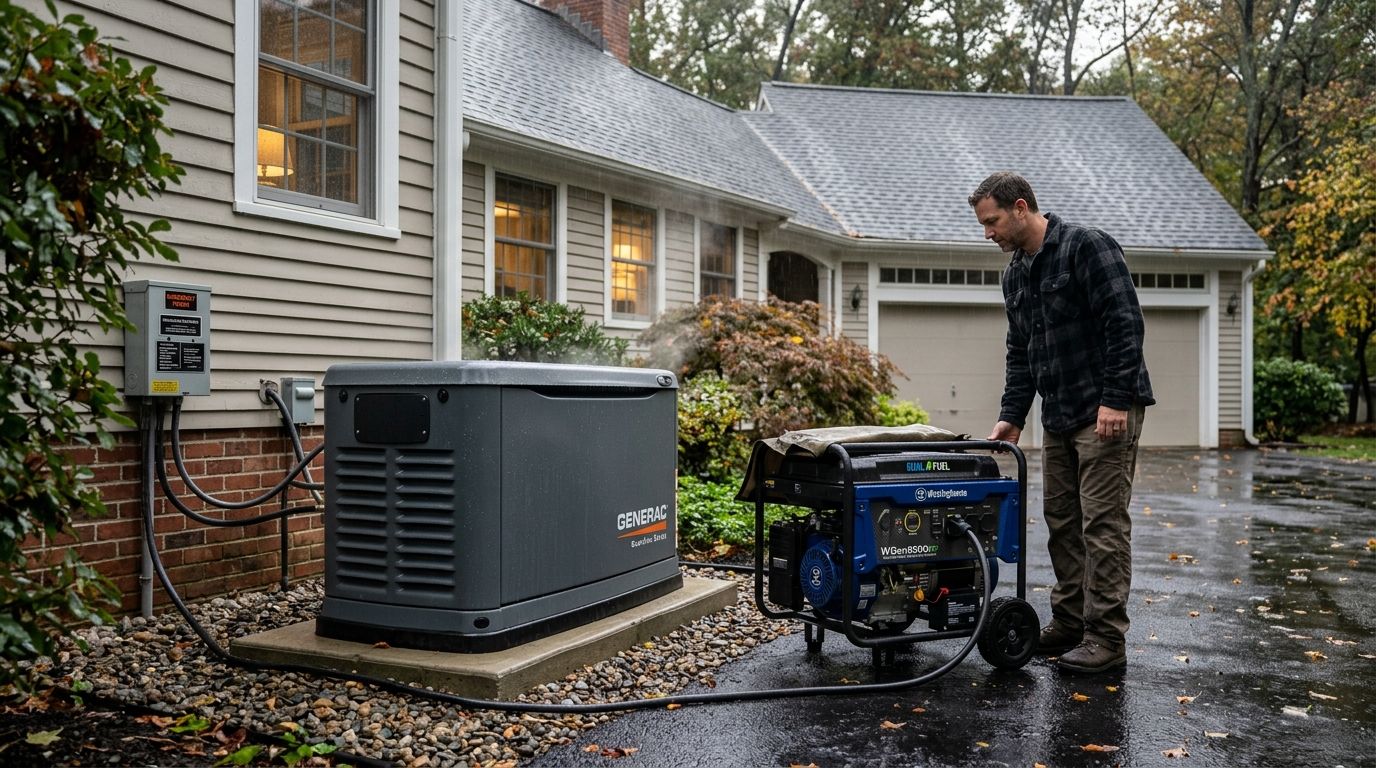
Central New Jersey loses power for days after ice storms, Nor'easters, and hurricane remnants move through Monmouth, Middlesex, Somerset, and Union counties, and picking the wrong backup power option means finding out mid-storm that it can't run your sump pump, your fridge, or your CPAP.
- A whole-house standby generator is the best backup power option for NJ storms because it starts automatically on natural gas or propane.
- Portable dual-fuel generators cost less upfront but need manual startup and fuel runs during multi-day outages.
- Home battery backup runs quiet with zero fuel but has limited capacity without solar to recharge it.
- Homes running CPAP machines, oxygen concentrators, or dialysis equipment need an automatic transfer switch, not a portable unit.
- Portable power stations work for renters and small essential loads with no electrical work required.
Why this matters
Utility crews in Central NJ restore hospitals, water treatment plants, and main feeders before residential side streets, so a downed line on your block can mean a multi-day wait even after the storm passes. Homeowners who assume "the power always comes back by morning" are the ones calling an electrician at 2 a.m. with a freezer full of spoiled food.
The fix isn't complicated, but it does require matching the backup option to the actual load you need to carry. A whole-house generator installation covers the whole panel; a portable unit covers a handful of circuits you plug in manually. Both are valid in 2026 — they just serve different households.
The ranked verdict
Best overall: whole-house standby generator. Best budget option: portable dual-fuel generator. Best for quiet, no-fuel operation: home battery backup. Best for medical equipment reliability: whole-house generator with automatic transfer switch sized for life-support loads. Best for renters and no-install backup: portable power station.
What makes the best backup power option
- Automatic vs. manual start — a transfer switch that kicks in within seconds beats a unit you have to wheel out and start by hand during a storm.
- Runtime under load — how long it carries your fridge, sump pump, and HVAC blower without refueling or recharging.
- Fuel availability — natural gas and propane don't run out at the pump when gas stations lose power too.
- Install complexity and permits — whole-house systems require an electrical permit and inspection in NJ; plug-in units don't.
- Noise output — matters if you have close neighbors or run the unit for days straight.
- Coverage — whole-panel power versus a handful of circuits.
Backup power options at a glance
| Option | Best for | Standout feature | Key limitation |
|---|---|---|---|
| Whole-house standby generator | Whole-home coverage in multi-day outages | Starts automatically within seconds of an outage | Requires a permitted electrical install and gas/propane line |
| Portable dual-fuel generator | Short outages on a budget | Runs on gasoline or propane, whichever is on hand | Manual start, needs extension cords run to the panel |
| Home battery backup | Quiet, no-fuel operation | Silent, no exhaust, works indoors or in a garage | Runtime is capped without solar to recharge it |
| Whole-house generator for medical equipment | CPAP, oxygen concentrator, dialysis reliability | Automatic transfer switch with zero gap for life-support loads | Sizing must account for medical equipment plus HVAC |
| Portable power station | Renters, small essential loads | No electrical work, no permit, plug-and-go | Limited watt-hours, can't run a furnace blower for long |
1. Whole-house standby generator: best overall for storm coverage
A whole-house standby generator ties into your electrical panel through an automatic transfer switch, sits outside on a concrete pad, and starts on its own within seconds of a utility outage. Most Central NJ homes land in the 14-26 kW range depending on square footage and whether the unit carries central air. Spartan Home Pros sizes and installs these systems directly, handling the panel tie-in, gas line coordination, and township permit — no subcontractors on the job.
Whole-house generator pros:
- Covers the entire panel, including HVAC, well pump, and sump pump
- Starts automatically, even if nobody is home
- Runs on natural gas, so it doesn't compete with generators lined up at gas stations after a storm
- Holds value and adds to resale disclosure paperwork
Whole-house generator cons:
- Highest upfront investment of any option on this list
- Requires a permit, inspection, and often a panel evaluation first
- Needs annual maintenance to stay reliable
Before buying on brand alone, check the generator brand comparison for New Jersey homes — fuel type availability and local parts support vary more than the spec sheets suggest. Best for: homeowners who lose power for multiple days at least once a year and want zero manual steps. Verdict: Buy.
2. Portable dual-fuel generator: best budget option for short outages
A portable generator in the 3,000-8,500 watt range powers a fridge, some lights, a sump pump, and a window AC unit through extension cords run from the unit to the house. Dual-fuel models switch between gasoline and propane, which matters when gas stations lose power along with everyone else.
Portable generator pros:
- Lowest cost of entry for meaningful backup power
- No permit or electrician required to buy one
- Portable enough to move between properties or lend to family
Portable generator cons:
- Manual startup means someone has to be home and awake when the power drops
- Extension cords through windows or doors are a safety and security compromise
- Carbon monoxide risk if run too close to the house — outdoor placement only
Best for: homeowners on a tight budget who mainly deal with outages under 24-48 hours. Verdict: Buy for short-term coverage, Hold if you're planning a permanent system within a year or two.
3. Home battery backup: best for quiet, no-fuel operation
A home battery system stores power and discharges it through an inverter when the grid drops, with no exhaust and no fuel to buy. Paired with solar, a system like a Tesla Powerwall (13.5 kWh usable) recharges during daylight and can stretch runtime across a multi-day outage; without solar, it's a fixed reserve that drains and stays drained until utility power returns.
Home battery pros:
- Silent operation, no exhaust fumes
- Can sit indoors, in a garage, or on an exterior wall
- No refueling logistics during a storm
Home battery cons:
- Capacity is fixed unless paired with solar
- Higher cost per kWh of backup than a fuel-powered generator
- Not sized to carry central air or a well pump for days at a time
Best for: homeowners who already have or are adding solar, or who want silent backup for a home office and network gear. Verdict: Hold — strong pick if solar is already in the plan, overkill as a standalone purchase.
4. Whole-house generator for medical equipment: best for life-support reliability
Households running a CPAP machine, oxygen concentrator, or home dialysis equipment need power that never gaps, not power that starts within a minute or two. A generator installation for medical equipment users is sized specifically around those loads plus whatever HVAC and refrigeration the household needs, with the transfer switch tested to close the gap as fast as the equipment requires.
Medical-equipment generator pros:
- Sized around the specific equipment load, not a generic square-footage estimate
- Automatic transfer switch removes the risk of forgetting to start a portable unit
- Coordinated with the equipment supplier's power requirements during installation
Medical-equipment generator cons:
- Costs more than a standard whole-house system due to sizing and testing
- Still requires the same permit and inspection process as any standby generator
Best for: any household where a power gap is a health risk, not just an inconvenience. Verdict: Buy.
5. Portable power station: best for renters and no-install backup
A lithium portable power station has no exhaust, no permit, and no electrician on the job — you charge it off the wall or a solar panel and plug in what you need during an outage. Capacity ranges widely by model, from small units that carry a phone charger and a lamp to larger ones that can run a CPAP machine or a mini fridge for several hours.
Portable power station pros:
- Zero install, zero permit, works in an apartment or condo
- Silent and safe to run indoors
- Recharges from solar panels if the outage runs long
Portable power station cons:
- Can't carry a furnace blower, well pump, or central air
- Runtime drops fast under any real HVAC-adjacent load
Best for: renters, condo owners, and anyone who wants a small safety net without any electrical work. Verdict: Buy as a supplement, not a primary backup plan.
How we ranked these
Each option was measured against the same six criteria: automatic versus manual start, runtime under real load, fuel availability during a regional storm, install complexity and permitting, noise, and how much of the panel it actually covers. The whole-house standby generator wins overall because it's the only option that checks every box at once; everything else trades one advantage for a limitation somewhere on that list.
Get your home ready before the next storm
Licensed NJ electricians handle sizing, permits, and the panel tie-in.
Which backup power option should you choose?
If you lose power more than once a year for longer than a day, a whole-house standby generator is the right call in 2026 — it's the only option that runs the whole house without anyone home to start it. If budget is the deciding factor and outages in your area tend to run under two days, a portable dual-fuel generator gets you through without the upfront cost. Households with medical equipment shouldn't default to portable at all — the gap between outage and restored power is the risk, and only an automatic transfer switch closes it reliably.
FAQ
What's the best backup power option for NJ homeowners during storms?
A whole-house standby generator is the best backup power option for most NJ homeowners because it starts automatically and covers the entire electrical panel. Portable generators and battery backup work as supplements or for shorter outages.
How big of a generator do I need for a whole house in New Jersey?
Most Central NJ homes need a 14-26 kW standby generator, depending on square footage and whether central air is included. A licensed electrician calculates exact sizing from your panel load, not just square footage.
Is a home battery backup better than a generator?
A home battery backup is quieter and needs no fuel, but it has a fixed capacity unless paired with solar. A generator can run indefinitely on natural gas, which matters more during multi-day NJ storm outages.
Do I need a permit for a generator installation in NJ?
Yes, whole-house standby generators require an electrical permit and township inspection in New Jersey. Portable generators and portable power stations don't require a permit since there's no electrical tie-in.
Can a portable generator power my whole house?
No, a portable generator in the 3,000-8,500 watt range covers select circuits through extension cords, not the whole panel. Whole-home coverage requires a standby generator with an automatic transfer switch.
How long does a home battery backup last during an outage?
Runtime depends on the battery's capacity and what's plugged in, and drops fast under HVAC or well-pump loads. A unit like a Tesla Powerwall holds 13.5 kWh usable, enough for lighter loads but limited without solar to recharge it.
What size generator do I need for medical equipment like a CPAP or oxygen concentrator?
Sizing depends on the specific equipment plus whatever else runs during an outage, like refrigeration or HVAC. A whole-house generator installed for medical equipment users is sized and tested around those loads specifically, not estimated from square footage alone.
Is a portable power station enough backup for an apartment or condo?
A portable power station covers small essential loads like a phone, lamp, or CPAP machine for several hours without any electrical work. It can't carry HVAC or a full refrigerator for an extended outage.
One last thing
The transfer switch matters more than the generator brand. A manual transfer switch left un-thrown during a storm is the single most common reason a homeowner who owns a generator still loses power — an automatic switch removes that human step entirely, which is exactly why it costs more.


