
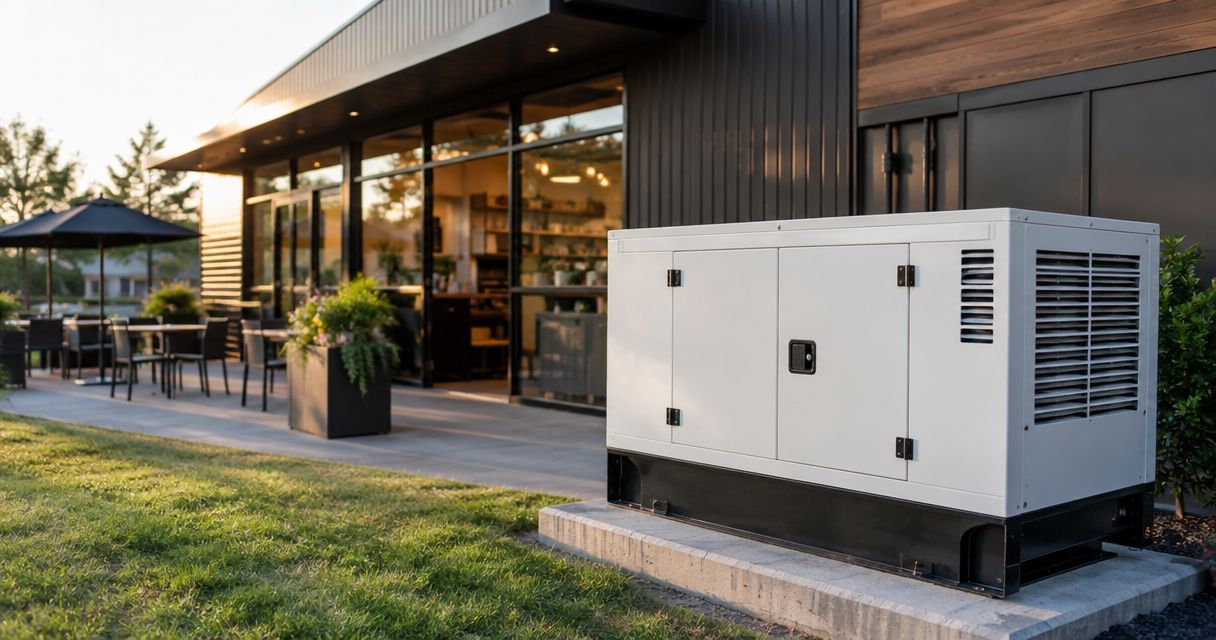
Central New Jersey small businesses lose power the same way homeowners do — ice storms, nor'easters, and grid strain on hot summer afternoons — except a business without backup power loses inventory, appointments, and payroll hours instead of just comfort. This guide ranks the commercial generator types that make sense for small businesses in Monmouth, Middlesex, Somerset, and Union counties in 2026, and tells you which one fits your building.
Best overall: Generac Protector Series standby generator. Best for restaurants and refrigeration-heavy operations: Kohler commercial standby. Best for larger facilities or multi-tenant buildings: Cummins commercial standby. Best budget option: Champion or Briggs & Stratton dual-fuel portable. Best for contractors and mobile crews: a towable PTO generator.
- Generac Protector Series wins overall for NJ small businesses needing automatic, code-compliant backup power in 2026.
- Kohler standby units are the quieter, restaurant-friendly pick when refrigeration and walk-in coolers can't lose power.
- Cummins commercial standby scales to larger kW loads for multi-tenant buildings and campuses.
- Champion and Briggs & Stratton dual-fuel portables are the realistic budget option for occasional-outage retail spaces.
- A towable PTO generator is the only choice on this list built to move between job sites.
Why this matters
A generator is not a purchase you make twice a year, and a wrong-sized or improperly transfer-switched unit either trips your panel or fails to carry your load the one week you actually need it. New Jersey small businesses also face something homeowners don't: commercial electrical service, three-phase loads in some buildings, and permitting through the local construction office before a standby unit gets installed. Generator installation for Franklin Township NJ businesses covers what that permitting and panel work looks like on the ground in Central NJ — worth reading alongside this list before you commit to a brand.
The five options below aren't ranked against each other in a straight line. Each one owns a distinct job: whole-building automatic backup, quiet restaurant-grade backup, large-facility capacity, tight-budget portable coverage, or mobile job-site power. Pick based on your building and load, not brand loyalty.
What makes the best commercial generator for a small business
- Automatic transfer switch compatibility — the unit should switch on within seconds of an outage without anyone flipping a breaker
- Fuel flexibility — natural gas, propane, or diesel availability matters more in NJ than most buyers expect, since gas line capacity varies by town
- kW capacity matched to actual load — refrigeration, HVAC compressors, and POS systems all draw differently at startup versus running
- Run-time and duty-cycle rating — a unit built for occasional home use won't hold up to a multi-day commercial outage
- Local permitting and code compliance — Central NJ municipalities require electrical and sometimes construction permits for standby installs
- Service and parts availability — a generator that's hard to get serviced locally is a liability during the next storm
At a glance: best commercial generators for NJ small businesses in 2026
| Generator | Best for | Standout feature | Key limitation |
|---|---|---|---|
| Generac Protector Series | General small business, offices, retail | Automatic transfer switch, wide NG/LP range | Sizing needs a load calculation, not a guess |
| Kohler commercial standby | Restaurants, refrigeration-dependent operations | Quieter operation for tight commercial lots | Higher upfront commitment than portable units |
| Cummins commercial standby | Larger facilities, multi-tenant buildings | Scales to heavier commercial kW loads | Overkill for a single small storefront |
| Champion / Briggs & Stratton dual-fuel portable | Budget-conscious retail or service businesses | Dual-fuel flexibility, no permanent install | Manual connection, limited run time under heavy load |
| Towable PTO generator | Contractors, mobile crews, job sites | Moves between locations | Not a fixed backup solution for a storefront |
1. Generac Protector Series: best commercial generator for general small business backup
Generac's Protector Series is a liquid-cooled standby generator line built for automatic operation — it senses a utility outage and switches your building over without anyone on-site flipping anything. For an office, retail storefront, or professional practice that just needs the lights, POS system, and HVAC to stay on, this is the default recommendation for 2026.
Generac Protector Series pros:
- Automatic transfer switch triggers within seconds of a utility outage
- Runs on natural gas or propane, giving flexibility where gas lines already exist
- Widely serviced across Central NJ, so parts and technicians aren't hard to find
Generac Protector Series cons:
- Requires an accurate load calculation before sizing — undersizing is the most common mistake business owners make
- Natural gas line capacity in older commercial buildings sometimes needs upgrading before installation
Best for: small businesses that want hands-off, automatic backup without babysitting a portable unit during a storm.
Verdict: Buy — if your building has gas service and you want power to come back on without a phone call, this is the standard-setter.
2. Kohler commercial standby: best commercial generator for restaurants
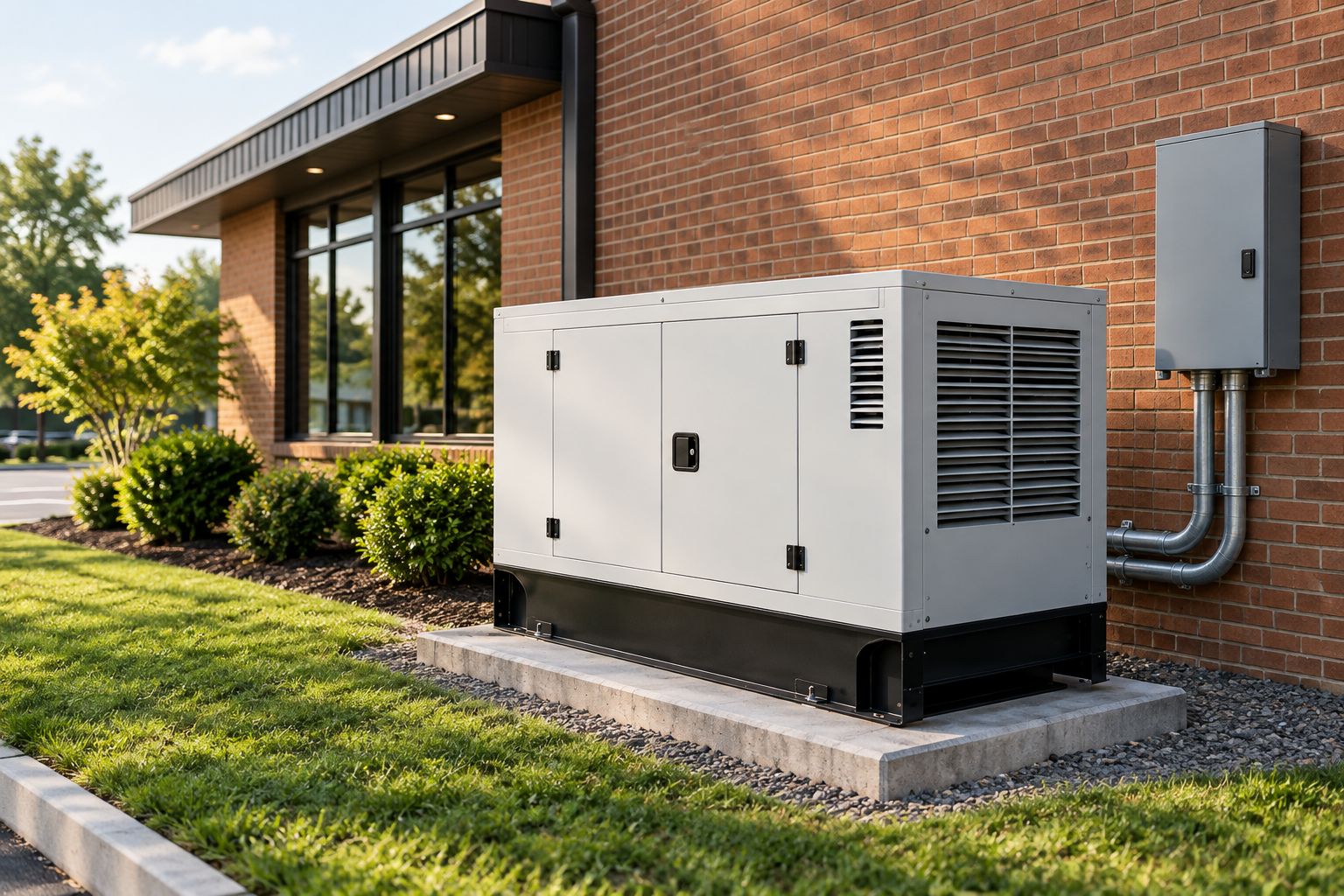
Kohler's commercial standby line has a reputation built on marine and industrial engines, and that shows up as quieter operation — a real factor when your unit sits next to outdoor dining or a shared parking lot. For backup generator installation for NJ restaurants, losing refrigeration or walk-in cooler power for even a few hours means inventory loss, not just inconvenience.
Kohler commercial standby pros:
- Noticeably quieter running profile than comparable standby units
- Built to hold steady loads for refrigeration and kitchen equipment during extended outages
- Automatic transfer switch options match the Generac experience
Kohler commercial standby cons:
- Commercial-grade units represent a bigger commitment than a portable backup
- Sizing for a full commercial kitchen load takes more planning than a simple office setup
Best for: restaurants, cafes, and any business where refrigeration downtime means throwing out product.
Verdict: Buy — restaurants lose money by the hour during an outage, and this is the quieter option for a tight commercial lot.
3. Cummins commercial standby: best commercial generator for larger facilities
Cummins builds commercial and industrial power equipment at a scale most small businesses never need — until they run a multi-tenant office building, a medical practice with equipment loads, or a facility with three-phase service. When the load climbs past what a single-tenant storefront needs, Cummins standby units scale into that range.
Cummins commercial standby pros:
- Handles heavier commercial kW loads than typical single-business standby units
- Built for facilities running multiple HVAC systems, elevators, or shared building loads
- Long track record in commercial and industrial power generation
Cummins commercial standby cons:
- Sized and priced for a bigger footprint than most single small storefronts need
- Installation typically involves more electrical and permitting coordination
Best for: multi-tenant office buildings, medical or professional complexes, and facilities with combined commercial loads.
Verdict: Buy — but only if your building's total load actually justifies commercial-scale capacity; a single retail unit rarely does.
4. Champion / Briggs & Stratton dual-fuel portable: best budget commercial generator
Not every small business needs a permanently installed standby unit. A dual-fuel portable generator from Champion or Briggs & Stratton runs on gasoline or propane and can carry essential circuits — lights, a register, a small refrigerator unit — through a shorter outage without the cost of a permanent install.
Champion / Briggs & Stratton portable pros:
- No permanent installation or standby infrastructure required
- Dual-fuel flexibility means you're not stuck if one fuel source is unavailable
- Lower upfront commitment for businesses testing whether backup power is worth it
Champion / Briggs & Stratton portable cons:
- Manual setup during an outage — someone has to connect it, every time
- Run time and load capacity fall well short of a standby unit under sustained heavy draw
Best for: small retail or service businesses with occasional outages and a tight budget, not businesses that lose real money every hour the power's out.
Verdict: Hold — fine as a stopgap, but if outages cost you inventory or bookings more than once a season, a standby unit pays for itself faster than this option saves money upfront.
5. Towable PTO generator: best commercial generator for contractors and mobile crews
Contractors, landscapers, and trades businesses that move between job sites don't need a fixed backup solution — they need power that travels. A towable PTO (power take-off) generator hitches to a work truck and provides power wherever the crew is working that day, which is a different job entirely from keeping a storefront's lights on.
Towable PTO generator pros:
- Moves between job sites instead of sitting fixed at one address
- No permanent electrical installation or permitting required
- Practical for trades businesses without a single fixed retail location
Towable PTO generator cons:
- Not a backup solution for a fixed storefront or office — it's built for mobility, not standby duty
- Requires a vehicle with PTO capability or a dedicated tow setup
Best for: contractors, landscapers, and mobile trades crews who need power at changing locations, not a fixed address.
Verdict: Buy — for the right business model, this is the only option on the list that actually fits.
How this list was ranked
Each generator earned its slot against the criteria above: transfer switch automation, fuel flexibility, load capacity, duty-cycle durability, NJ permitting realities, and local service availability. No two items compete for the same "best for" slot — a restaurant, a multi-tenant office, a budget-conscious retailer, and a mobile contractor all have different actual requirements, and the ranking reflects that instead of forcing one winner across every use case.
“If an outage costs your business money more than once a season, a portable generator is a stopgap, not a solution.”
Before any standby unit gets installed, the building's electrical panel needs to handle the transfer switch and the generator's output. Electrical panel upgrade for small NJ businesses covers what that panel work looks like and when it's needed ahead of a generator install.
Get a generator sized for your business
Licensed electricians handle sizing, permitting, and installation across Central NJ.
Which commercial generator should you choose?
For most Central NJ small businesses in 2026, the Generac Protector Series is the default pick — automatic operation, wide fuel flexibility, and a service network that doesn't leave you stranded when it breaks. Restaurants and anything refrigeration-dependent should look at Kohler first for the quieter operation. Multi-tenant buildings and larger facilities need Cummins-scale capacity. If budget is the deciding factor and outages are rare, a Champion or Briggs & Stratton dual-fuel portable buys time without a full install. Contractors and mobile crews are the one group that should skip standby units entirely and go towable.
FAQ
What's the best commercial generator for a small business in NJ?
The Generac Protector Series is the strongest overall pick for 2026 because of its automatic transfer switch and natural gas/propane flexibility. Restaurants and refrigeration-heavy operations should compare Kohler's quieter commercial standby line instead.
How big of a generator does a small business need?
Sizing depends on your building's actual load — HVAC compressors, refrigeration, and equipment startup draw all factor in. A load calculation, not a rough guess, determines whether you need a smaller office-scale unit or a larger commercial standby.
Is a portable generator enough for a small business?
A dual-fuel portable from Champion or Briggs & Stratton can carry essential circuits through a short outage, but it requires manual setup and can't sustain heavy commercial loads the way a standby unit can. It works as a budget stopgap, not a permanent solution.
Do commercial generators in NJ need a permit?
Yes — standby generator installations in Central NJ typically require electrical permitting through the local municipality, and sometimes construction department sign-off depending on the town. Permitting is handled as part of a proper installation, not an afterthought.
What's the difference between a standby and portable commercial generator?
A standby generator is permanently installed, wired into an automatic transfer switch, and starts within seconds of an outage. A portable generator has to be manually connected and refueled, and it carries a smaller load for a shorter time.
Can a generator run a restaurant's refrigeration during an outage?
A properly sized standby generator, like Kohler's commercial line, can carry refrigeration, walk-in coolers, and kitchen equipment through an extended outage. Undersized portable units generally cannot sustain that load for long.
How often should a commercial generator be serviced?
Standby generators need regular maintenance checks to stay reliable, since a unit that hasn't been serviced often fails at the exact moment it's needed. If a unit isn't starting or holding load, that's an emergency repair situation, not routine maintenance.
One last thing
The generator brand matters less than the transfer switch and panel work behind it — a top-rated unit wired into an undersized or outdated commercial panel will trip under load the first time it's tested. If your building's panel hasn't been evaluated in the last decade, that's the conversation to have before picking a brand, not after the generator's already on the pad.


