Choosing between natural gas and propane for a home standby generator in Central New Jersey comes down to one question: does your house already have a gas line? If yes, natural gas usually wins. If no, propane is often the only practical option, and it comes with its own tradeoffs.
- Natural gas wins for homes already on a utility gas line — the supply is unlimited and never needs a refill.
- Propane wins for homes off the gas grid or in rural pockets of Monmouth and Somerset counties where no gas main exists.
- Propane packs more energy per cubic foot (about 2,500 BTU vs 1,030 BTU for natural gas), so a generator burns less fuel volume per hour on propane.
- A natural gas vs propane generator decision in 2026 also hinges on tank space, permit rules, and how long you expect outages to last.
Why this matters
A generator is only as reliable as its fuel supply. Pick the wrong fuel type for your property and you end up with a generator that either can't run long enough during a multi-day outage, or one that needed a tank and permit you didn't budget time for.
Central New Jersey sees both scenarios regularly. Towns like Cranford, Westfield, and Middletown have dense gas infrastructure. Parts of Hillsborough, Colts Neck, and Bernards Township don't — some streets simply have no gas main to tap into, which forces the propane decision before the generator conversation even starts.
Before you pick a fuel, it's worth sizing a whole-house generator for your NJ home correctly, since wattage requirements affect fuel draw for either option.
Natural gas vs propane generator: how the two fuels compare
| Factor | Natural Gas | Propane |
|---|---|---|
| Supply | Unlimited, piped from utility | Finite, stored in an on-site tank |
| Energy content | ~1,030 BTU per cubic foot | ~2,500 BTU per cubic foot |
| Fuel consumption (22kW, full load) | ~250 cubic feet/hour | ~3 gallons/hour |
| Refueling | Never needed | Requires tank refills, typically annually or during long outages |
| Upfront setup | Tie into existing gas meter | Requires tank purchase, placement, and delivery setup |
| Availability | Only where a gas main exists | Works anywhere a tank can be sited |
| Best for | Homes on an existing gas line | Homes off the gas grid or wanting fuel independence |
Verdict: natural gas is the better fuel for most Central NJ homeowners on a gas line because it removes refueling from the equation entirely — propane is the right call only when no gas main reaches the property.
Natural gas generators: unlimited runtime, tied to the utility
A natural gas generator connects directly to your home's existing gas meter, the same line that feeds your furnace or stove. As long as the utility keeps delivering gas, the generator keeps running — there's no tank to monitor and no delivery truck to schedule.
The tradeoff is dependency. If the gas utility itself goes down during a severe storm — rare, but not impossible — a natural gas generator loses its fuel source along with the grid. Natural gas also burns at a lower BTU value per cubic foot than propane, so the generator draws a higher volume of fuel per hour to produce the same output.
Best for: homes already on a gas line that want zero refueling logistics. Buy if your street has gas service and your meter can support the added draw.
Propane generators: independent supply, requires a tank
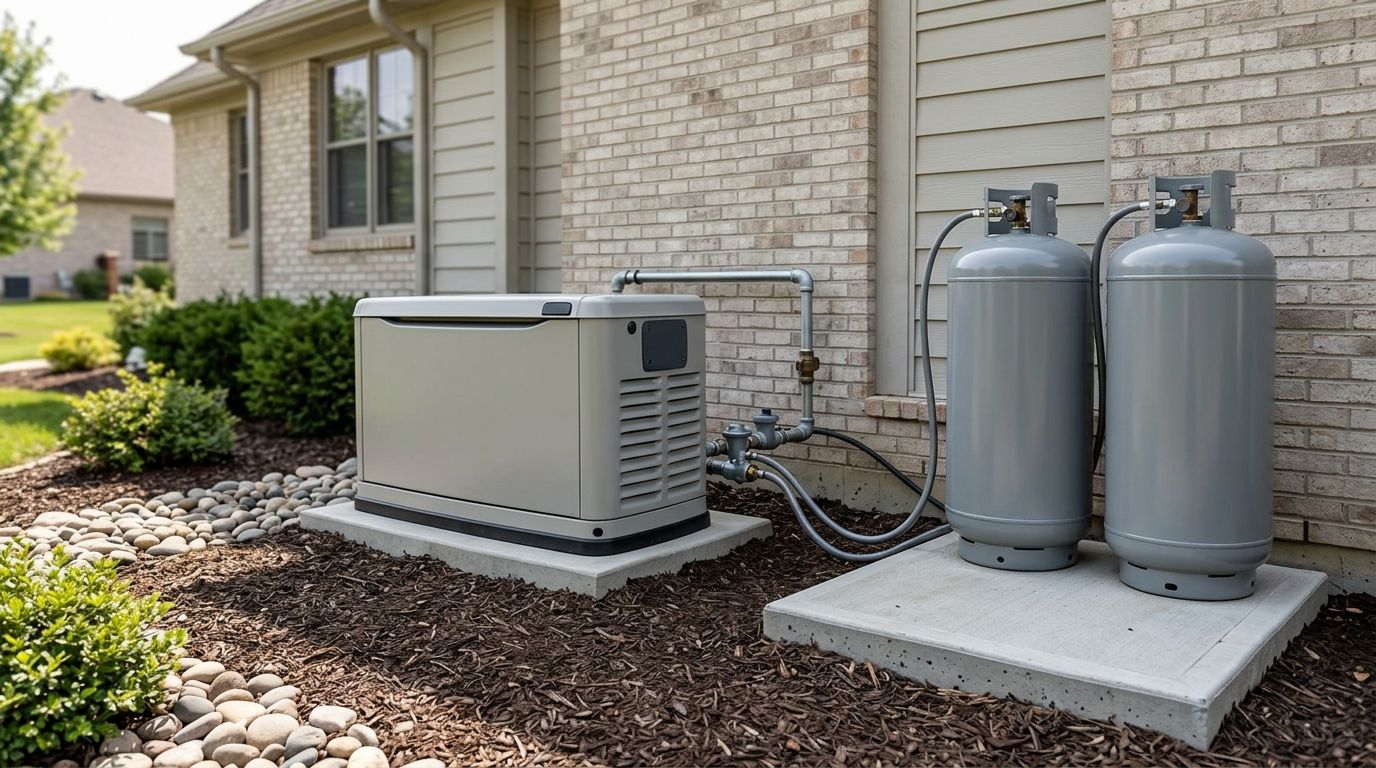
A propane generator draws from a dedicated tank installed on the property — commonly 250-gallon, 500-gallon, or 1,000-gallon sizes depending on generator wattage and expected runtime. Propane's higher energy density (about 2,500 BTU per cubic foot versus natural gas's 1,030) means the generator burns a smaller fuel volume per hour, but the total supply is finite and tied to tank capacity.
Propane makes sense anywhere a gas main doesn't exist, which covers real stretches of Colts Neck, Hillsborough, and parts of Warren Township. The tank itself needs setback clearance from the house and property lines, and NJ municipalities require a permit for tank placement in addition to the electrical permit for the generator.
Best for: homes off the gas grid, or homeowners who want a fuel supply they physically control. Buy if there's no gas main nearby or you want a backup that doesn't depend on utility gas delivery during an outage.
Why the right fuel varies by property
- Existing gas line access — if a gas main already runs to the house, tying in is simpler and cheaper than adding a propane tank.
- Available yard space — propane tanks need setback clearance; small lots in towns like Roselle or Elizabeth may not have room for a 500-gallon tank.
- Generator wattage — larger whole-house units draw more fuel per hour on either fuel type, which affects tank sizing for propane.
- Expected outage length — natural gas has no runtime ceiling; propane runtime is capped by tank size and refill speed.
- Local permitting — propane tank placement typically requires a separate zoning or fire permit on top of the generator electrical permit; natural gas tie-ins usually don't.
- Utility gas reliability history — in areas with a strong track record of gas service continuing through storms, natural gas removes one point of failure; areas prone to gas curtailment lean propane.
Get your generator fuel question answered
A licensed technician can confirm gas line access and size the right system for your home.
Can I convert a natural gas generator to run on propane?
Most standby generator models built since the early 2020s ship with a dual-fuel carburetor kit that lets a licensed technician switch the unit between natural gas and propane, but the conversion still requires re-tuning the fuel regulator and confirming the orifice size matches the new fuel. This isn't a DIY swap — running the wrong orifice size on the wrong fuel damages the engine over time.
Which fuel is better during a long power outage?
Natural gas has no runtime limit as long as the utility keeps delivering gas, which makes it the stronger choice for outages lasting more than a few days. Propane runtime depends entirely on tank size — a larger tank extends coverage, but eventually it needs a refill delivery, which can be delayed during a widespread storm event when every propane truck in Central NJ is booked.
Does NJ require a permit for either fuel type generator install?
Yes, both natural gas and propane generator installations require an electrical permit in New Jersey, and propane tank placement typically adds a separate fire or zoning permit depending on the municipality. A licensed contractor pulls both permits as part of the installation, so the homeowner doesn't have to coordinate directly with the township.
Spartan Home Pros installs both natural gas and propane whole-house generators across Monmouth, Middlesex, Somerset, and Union counties, and pulls the required permits as part of the install — no subcontracted crews, payroll technicians only.
FAQ
Is natural gas or propane better for a home generator?
Natural gas is better if your home already has a gas line, since the supply is unlimited and needs no refueling. Propane is better for homes off the gas grid, since it stores in an on-site tank you control.
How much propane does a whole-house generator use per hour?
A 22kW generator, a common whole-house size for NJ homes, burns roughly 3 gallons of propane per hour at full load. Actual draw depends on how much electrical load the generator is carrying at any given moment.
How much natural gas does a whole-house generator use per hour?
A 22kW generator burns roughly 250 cubic feet of natural gas per hour at full load. Because natural gas has a lower BTU value per cubic foot than propane, it takes a higher fuel volume to produce the same output.
Can a propane generator run out of fuel during a long outage?
Yes, a propane generator's runtime is capped by tank size, and once the tank runs low it needs a refill delivery. During widespread storm outages, propane delivery trucks can be backed up for days across Central NJ.
Do I need a permit to install a propane tank for a generator in NJ?
Yes, propane tank placement typically requires a separate fire or zoning permit in addition to the electrical permit for the generator itself. Permit requirements vary by municipality within Monmouth, Middlesex, Somerset, and Union counties.
Can I switch my generator from natural gas to propane later?
Many standby generator models support dual-fuel conversion kits, but a licensed technician needs to re-tune the fuel regulator and confirm the correct orifice size for propane. Running the wrong fuel setup damages the engine over time.
What size propane tank do I need for a whole-house generator?
Tank sizing depends on generator wattage and how many days of runtime you want stored on-site, with 250-gallon, 500-gallon, and 1,000-gallon tanks being the common options. A licensed installer calculates the right size based on your generator's fuel consumption rate.
Does my street have a natural gas line for a generator hookup?
Not every street in Central NJ has gas main access, especially in parts of Hillsborough, Colts Neck, and Bernards Township. A technician checks gas line proximity and meter capacity before recommending natural gas over propane.
One last thing
The detail most homeowners miss: propane's higher energy density means a propane generator often needs a smaller fuel storage footprint than people expect for the same runtime, while natural gas removes the storage question entirely but ties your backup power to the same utility infrastructure that just failed you in the storm. Neither fuel is universally better in 2026 — the gas main at the curb decides more of this than the generator brand does.