
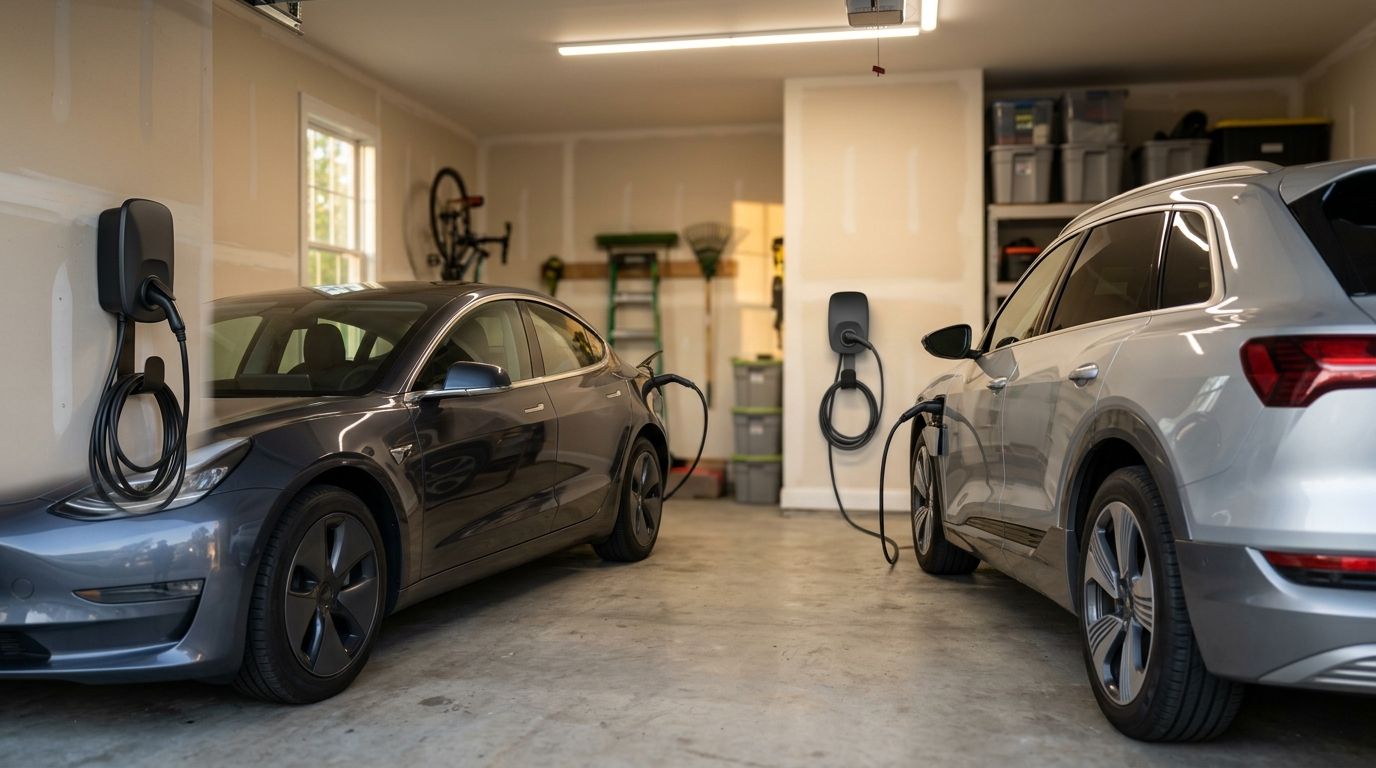
Best overall for a two-car New Jersey garage with staggered charging: one 40-amp charger. Best for charging both cars at once: two coordinated 32-amp chargers with properly configured load management. Best for limited electrical capacity: one 24-amp charger. The best EV charger amperage for two car garages depends on whether both cars need power at the same time—not on the largest charger you can buy.
- One 40-amp charger is the best default for two-car garages where drivers can alternate charging.
- Two coordinated 32-amp chargers are best when both cars need to charge simultaneously.
- A 40-amp charger typically needs a 50-amp circuit; an electrician must assess the home's available capacity.
- Spartan Home Pros handles EV charger installation for Central New Jersey homeowners; confirm the charging plan before selecting hardware.
Why this matters
A second charging position changes the electrical question. You are no longer choosing only how fast one car charges; you are deciding whether two vehicles share a charger, share available circuit capacity, or draw power through separate circuits. The distinction matters when you discuss EV charger installation for two-car NJ households: a charger rating alone cannot establish what your panel can support.
In 2026, start with the drivers' schedules. If one car can charge while the other is parked, a single charger is the simpler choice. If both routinely arrive low and need to leave early, plan for two charging positions and have an electrician calculate the home's existing load before choosing their ratings. Spartan Home Pros provides EV charger installation in Central New Jersey, including Monmouth, Middlesex, Somerset, and Union counties.
What makes the best amperage for a two-car garage?
Use these criteria before comparing charger ratings:
- Departure overlap: Can one car finish or gain enough charge before the other needs the connector?
- Simultaneous demand: Do both vehicles actually need to draw power at once, or do you just need a convenient place to park each one?
- Circuit capacity: A charger is a continuous electrical load. The circuit, conductors, installation method, and equipment must suit its configured output.
- Vehicle acceptance: A charger cannot force a vehicle to accept more AC power than its onboard charger allows.
- Load-management design: A coordinated pair can limit combined output, but its wiring and settings must follow the equipment's listing and installation instructions.
- Garage layout: Connector reach and parking positions can rule out an otherwise sensible single-charger plan.
A 40-amp charging setting generally calls for a 50-amp branch circuit under the continuous-load sizing rule. That is a circuit-sizing relationship, not proof that the home needs a particular service size. The National Electrical Code addresses EV charging as a continuous load in Article 625; the applicable installation must also meet local requirements in effect when the work is permitted.
Two-car garage amperage at a glance
The power figures below use nominal 240-volt charging. They describe charger output, not how many miles a particular vehicle will gain; that depends on the vehicle and its charging conditions.
| Option | Best for | Standout feature | Key limitation |
|---|---|---|---|
| One 40-amp charger | Alternating overnight charging | Up to 9.6 kW at 240 V for the connected car | Only one car charges at a time |
| Two coordinated 32-amp chargers | Both cars needing overnight charging | Two parking positions with managed combined demand | Available power per car falls when sharing is active |
| One 48-amp charger | One driver with greater charging demand | Up to 11.52 kW at 240 V for a compatible vehicle | Does not charge two cars simultaneously |
| Two independent 40-amp chargers | Separate high-demand charging | Up to 19.2 kW combined at 240 V when both operate at full output | Requires a load calculation and suitable electrical capacity |
| One 24-amp charger | Households prioritizing lower circuit demand | Up to 5.76 kW at 240 V | Slower recovery and one connected car at a time |
The table compares operating arrangements, not charger brands. A vehicle's onboard limit, the charger's configured setting, and any active load management can all reduce actual draw below the listed maximum.
1. One 40-amp charger: best for alternating overnight charging
One 40-amp charger is the default when the cars can take turns. At nominal 240 volts, its maximum output is 9.6 kilowatts for the connected vehicle. It needs an appropriately designed circuit; a 50-amp circuit is the standard continuous-load sizing reference for a 40-amp setting.
This arrangement works because two-car ownership does not automatically mean simultaneous charging. You still need to check connector reach from the proposed mounting point to both parking spaces. If switching the connector would require moving a car or routing a cable awkwardly, the layout is a real drawback.
One 40-amp charger pros:
- One charging position to plan and use.
- Full configured output goes to the connected car rather than being split.
- A clear starting point for a household whose departures do not overlap.
One 40-amp charger cons:
- The second car waits until the connector is available.
- Drivers must remember to swap the connector when both cars need charging.
- Connector reach can be a problem in a wide or offset garage.
Best for: Two-car households with staggered schedules. Verdict: Buy if the parking layout works and the electrical assessment supports the circuit. Spartan Home Pros EV charger installation should begin with those two checks, not with a charger selected solely for its advertised maximum.
2. Two coordinated 32-amp chargers: best for simultaneous charging
A coordinated pair gives each parking position a connector. A 32-amp charger can deliver up to 7.68 kilowatts at nominal 240 volts when allowed to draw its full configured output. When a load-management system limits combined demand, each charger receives only the power available under that system's settings.
Do not assume any two chargers can share a circuit or coordinate safely. The specific equipment must support the proposed arrangement, and the circuit design must follow its listing and installation instructions. Ask the installer to explain the maximum combined draw and what happens when both cars plug in.
Coordinated 32-amp charger pros:
- Both cars can remain connected overnight.
- Load management sets a defined ceiling on combined charging demand.
- Drivers do not need to move one connector between cars.
Coordinated 32-amp charger cons:
- Each car can charge more slowly while both are drawing power.
- Compatibility and configuration matter; two ordinary independent chargers are not automatically a managed pair.
- Installation planning is more involved than for one charging position.
Best for: Households whose drivers regularly need both cars connected at the same time. Verdict: Buy when the specified equipment and electrical design support the intended shared limit. In 2026, get that design confirmed before ordering chargers; similar-looking hardware can support different wiring arrangements.
3. One 48-amp charger: best for one high-demand driver
A 48-amp charger delivers up to 11.52 kilowatts at nominal 240 volts when the vehicle accepts that AC input. Under the continuous-load sizing rule, a 48-amp setting generally requires a 60-amp branch circuit. The extra output serves one connected vehicle; it does not create a second charging position.
Choose this route only when the higher setting solves a specific scheduling problem and the home can support it. Check the vehicle's AC acceptance limit first. If the vehicle cannot use the additional output, the larger charger setting does not increase its charging rate.
One 48-amp charger pros:
- Higher maximum output than a 40-amp setting for a compatible vehicle.
- One connector keeps the daily routine straightforward.
- Suits a household where one car needs charging more urgently than the other.
One 48-amp charger cons:
- The other car still waits for the connector.
- A larger circuit does not help a vehicle with a lower onboard AC limit.
- Higher electrical demand can narrow the options available after a home load calculation.
Best for: Two-car households with one car that needs the faster compatible AC charging rate. Verdict: Hold until the vehicle limit, departure schedule, and electrical capacity justify the higher setting. For many drivers, the second connector matters more than another 8 amps of output to the first car.
4. Two independent 40-amp chargers: best for separate high-demand charging
Two independent 40-amp chargers can draw a combined 80 amps when both operate at full output. At nominal 240 volts, that is up to 19.2 kilowatts combined. Those figures describe potential charging demand—not a blanket recommendation for the home's service rating.
This option gives each driver an independent charging position, but it places the greatest simultaneous demand among the arrangements in this comparison. The electrician must assess the service and panel, other household loads, circuit routing, and the applicable installation requirements. A panel upgrade is not automatic, and an empty breaker space is not a load calculation.
Two independent 40-amp charger pros:
- Each car has its own connector.
- Neither charger needs to reduce output just because the other is in use, provided the installation supports full simultaneous operation.
- Drivers can charge on overlapping schedules without connector swapping.
Two independent 40-amp charger cons:
- Full simultaneous output creates substantial combined demand.
- More equipment and circuit planning than a single-charger arrangement.
- Poor fit if the household seldom needs both cars charging at once.
Best for: Households with verified capacity and genuinely overlapping charging needs. Verdict: Wait for a documented load calculation before committing to two independent circuits. If that calculation changes the plan, electrical panel upgrades for EV charger installation in NJ are one topic to assess—not a conclusion to assume.
5. One 24-amp charger: best for lower circuit demand
A 24-amp charger provides up to 5.76 kilowatts at nominal 240 volts. Its standard continuous-load circuit-sizing reference is 30 amps. This is a useful comparison when a 40-amp setting is unnecessary or the electrical assessment points toward a lower-demand installation.
Lower amperage is not a substitute for evaluating the home. Nor does it guarantee that two vehicles with long daily drives can recover the energy they need between departures. Work backward from actual charging windows, then decide whether the slower setting fits.
One 24-amp charger pros:
- Lower configured demand than the other single-charger options listed here.
- A practical match when the cars have enough time to charge in turns.
- Avoids selecting higher output that the household does not need.
One 24-amp charger cons:
- Each car charges more slowly than it would at a compatible 40-amp setting.
- Only one car connects at a time.
- Tight or overlapping departure schedules can make the arrangement inconvenient.
Best for: Two-car households with flexible charging windows and a reason to keep configured demand lower. Verdict: Buy only after checking that both drivers' schedules fit the slower rate. Spartan Home Pros EV charger installation can then be scoped around the selected setting rather than an assumed need for maximum output.
How these options were ranked
The ranking puts the most useful decision first: one connector or two. It then compares simultaneous demand, vehicle compatibility, circuit requirements, and daily convenience. The 40-amp single-charger option ranks first because it gives one connected car a defined 9.6-kilowatt maximum without assuming both cars need power at once; it is not a claim that every New Jersey home can support that circuit.
In 2026, ask for an assessment that covers the existing electrical loads and the proposed charger settings. If someone recommends two circuits based only on open spaces in the panel, ask how the home's available capacity was established. If someone recommends load sharing, ask what combined limit the equipment enforces and how the chargers behave when both vehicles are connected.
Plan both charging positions
Discuss your parking layout, charging schedule, and electrical capacity before choosing amperage.
Which amperage should you choose?
Choose one 40-amp charger if the cars can reliably charge in turns. Choose two coordinated 32-amp chargers if both need connectors overnight and a properly designed load-management arrangement fits the home. Keep 48 amps for a compatible vehicle with a real need for the higher rate; consider two independent 40-amp chargers only after confirming the home can support their combined demand.
For a 2026 installation, tell the electrician where each car parks, when each must leave, and whether either vehicle has an AC charging limit below your proposed charger setting. Those answers determine more than the car count does. Spartan Home Pros serves homeowners across Central New Jersey, where the correct installation decision still starts with the individual home's electrical assessment.
FAQ
What is the best EV charger amperage for two car garages?
One 40-amp charger is the best starting point when the cars can charge in turns. If both need to stay connected, compare a properly configured pair of coordinated chargers instead.
Can two electric cars share one 40-amp home charger?
Yes, two electric cars can use one 40-amp charger at different times. One connector does not charge both vehicles simultaneously, so check parking access and departure schedules.
Is 48 amps better than 40 amps for a two-car garage?
A 48-amp setting is better only when a compatible vehicle needs the additional output and the electrical installation supports it. It does not solve the problem of two cars needing connectors at once.
Can two 32-amp EV chargers operate at the same time?
Yes, two 32-amp chargers can operate together when the installation supports their combined draw or uses properly configured load management. The approved wiring arrangement depends on the specified equipment and the home's electrical assessment.
Does a 40-amp EV charger need a 50-amp circuit?
A 40-amp EV charging setting generally calls for a 50-amp branch circuit under the continuous-load sizing rule. The complete installation must also meet equipment instructions and applicable electrical requirements.
Do two EV chargers mean I need a panel upgrade?
No, two chargers do not automatically require a panel upgrade. An electrician must calculate the home's loads and assess the proposed charging arrangement before determining whether existing capacity is sufficient.
Will a higher-amp charger always charge my car faster?
No, the vehicle's onboard AC charging limit can cap its charging rate below the charger's maximum output. Load-management settings can also reduce available power when two cars charge together.
One last thing
A second connector and a higher amperage setting solve different problems. If the recurring headache is remembering to switch cars, increasing one charger's output will not fix it. In 2026, settle the parking and departure plan before choosing the circuit size.


