
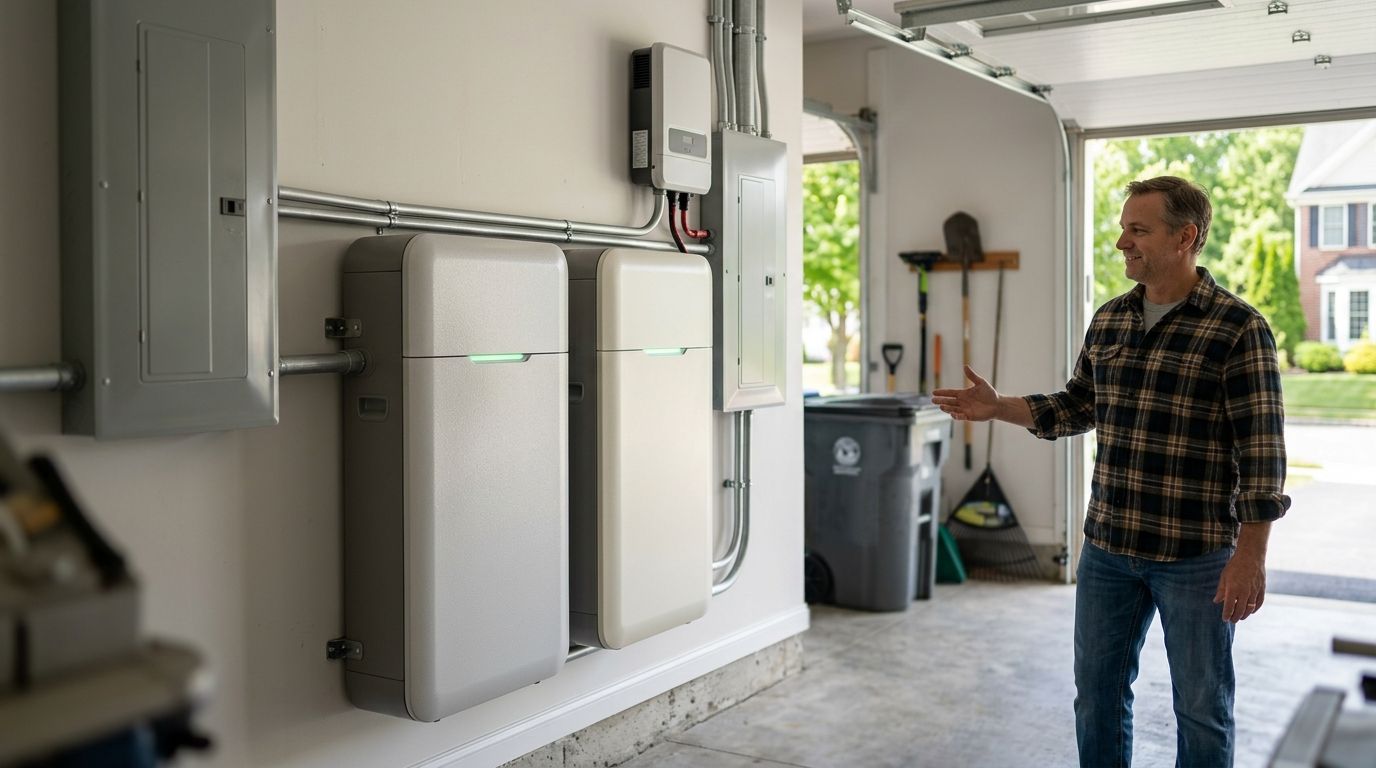
A home battery backup system stores power from the grid or solar panels so your house keeps running during a PSE&G or JCP&L outage, without a generator kicking on. The best home battery backup system for most New Jersey homeowners in 2026 is the Tesla Powerwall 3, followed by the Generac PWRcell for houses already running a Generac standby generator, the Enphase IQ Battery 5P for smaller homes that want to add capacity in stages, and the FranklinWH aPower for anyone who needs the longest possible runtime through a multi-day storm outage.
- Tesla Powerwall 3 is the best home battery backup system overall for solar-paired NJ homes in 2026 — 13.5 kWh usable capacity.
- Generac PWRcell pairs directly with existing Generac standby generators for hybrid battery-plus-generator backup.
- Enphase IQ Battery 5P stacks in 5 kWh units, the best fit for homes that want to scale capacity over time.
- FranklinWH aPower holds the largest single-unit capacity of this group at 13.6 kWh, built for extended storm outages.
Why this matters
Central New Jersey loses power every year to nor'easters, summer thunderstorms, and the remnants of Gulf hurricanes moving up the coast. A whole-house generator burns fuel and needs a transfer switch; a battery system runs silently on stored energy and, if you have solar, recharges itself during daylight even mid-outage.
The catch: not every panel can support a battery inverter without an upgrade, and installation requires a licensed electrician pulling a permit through your township. Home battery backup installation in Monmouth, Middlesex, Somerset, and Union counties runs through the same inspection process as a panel upgrade or generator tie-in — it is not a plug-and-play appliance.
What makes the best home battery backup system
- Usable capacity — how many kWh you can actually draw before recharge
- Continuous power output — whether it can run a well pump, HVAC, and refrigerator at once
- Stackability — can you add units later without replacing the whole system
- Solar compatibility — does it integrate with existing or planned rooftop solar
- Panel compatibility — does your existing panel support the inverter, or does it need an upgrade first
- Warranty and cycle life — how many charge cycles the manufacturer backs
At a glance
| System | Best for | Standout feature | Key limitation |
|---|---|---|---|
| Tesla Powerwall 3 | Solar-paired homes | Built-in solar inverter, 11.5 kW continuous output | Requires Tesla app account and Wi-Fi for full functionality |
| Generac PWRcell | Pairing with a Generac generator | Modular 9-18 kWh range, hybrid with fossil-fuel backup | Needs a compatible Generac ecosystem to unlock hybrid mode |
| Enphase IQ Battery 5P | Phased or smaller-home installs | Stacks in 5 kWh units, microinverter-based | Lower per-unit capacity means more units for whole-home coverage |
| FranklinWH aPower | Longest single-unit runtime | 13.6 kWh per unit, aggregation across multiple units | Newer to the US market, fewer long-term field records than Tesla or Generac |
1. Tesla Powerwall 3: best home battery backup system for solar-paired homes
Tesla's Powerwall 3 holds 13.5 kWh of usable capacity and outputs up to 11.5 kW continuously, enough to run central AC, a refrigerator, and general household circuits at once. It includes a built-in solar inverter, so homes adding rooftop solar alongside the battery skip a separate inverter purchase.
Tesla Powerwall 3 pros:
- Highest continuous power output in this comparison
- Integrated solar inverter simplifies a combined solar-plus-battery install
- Units can be paired for expanded capacity
Tesla Powerwall 3 cons:
- Full monitoring and scheduling depend on the Tesla mobile app
- Best value comes when installed alongside solar, not as a standalone battery
Best for: homeowners planning solar and battery together, or already running rooftop solar. Verdict: Buy if solar is part of the plan.
2. Generac PWRcell: best for homes pairing battery with a whole-house generator
Generac's PWRcell is modular, built in 3 kWh increments from 9 kWh up to 18 kWh per cabinet. For homeowners who already have — or are installing — a whole-house generator brand from Generac, the PWRcell integrates into the same ecosystem for hybrid backup: battery first, generator as the deeper reserve.
Generac PWRcell pros:
- Modular capacity lets you size up without replacing the base unit
- Works as a hybrid system alongside a Generac standby generator
- Familiar brand for NJ homeowners who already own Generac equipment
Generac PWRcell cons:
- Hybrid mode benefits shrink if you're not already in the Generac ecosystem
- Multiple cabinets take up more wall space than a single Powerwall unit
Best for: households layering a battery on top of an existing or planned Generac standby generator. Verdict: Buy for hybrid setups, Hold if you have no Generac generator and no plans for one.
3. Enphase IQ Battery 5P: best for phased or smaller-home installs
The IQ Battery 5P stores 5 kWh per unit and uses Enphase's microinverter architecture, the same technology behind its solar microinverters. Homes with smaller electrical loads, or owners who want to start with one unit and add more later, get a lower entry point than a single large cabinet system.
Enphase IQ Battery 5P pros:
- Add units incrementally as budget or needs grow
- Microinverter design pairs cleanly with Enphase solar systems
- Smaller physical footprint per unit
Enphase IQ Battery 5P cons:
- Whole-home backup for a larger house means stacking several units
- Less continuous output per unit than Powerwall 3 or PWRcell
Best for: smaller homes or phased budgets that want to start small and expand. Verdict: Buy for incremental installs, Wait if you need full-home coverage on day one.
4. FranklinWH aPower: best for the longest single-unit storm runtime
FranklinWH's aPower holds 13.6 kWh per unit and is built for aggregation — multiple units link together for extended outage coverage, which matters most during multi-day storm events common along the NJ coast in Monmouth County.
FranklinWH aPower pros:
- Highest per-unit capacity in this comparison
- Designed for stacking units for extended, multi-day backup
- Works with or without paired solar
FranklinWH aPower cons:
- Fewer years of field data in the US than Tesla or Generac
- Installer availability is more limited than for the more established brands
Best for: homeowners in storm-prone areas prioritizing runtime over brand history. Verdict: Buy for maximum runtime, Hold if you weight installer track record higher than raw capacity.
How this list was ranked
Each system was scored against the six criteria above — usable capacity, continuous output, stackability, solar compatibility, panel compatibility, and warranty terms — with the ranking order matching real installation scenarios: solar-first homes, generator-owning homes, budget-phased homes, and storm-heavy coastal properties.
Which home battery backup system should you choose?
If you already have or plan to install rooftop solar, the Tesla Powerwall 3 is the default pick for 2026 — it is the only system here with a built-in solar inverter. If a Generac generator is already on your property, the PWRcell keeps everything on one brand's app and hardware. Everyone else should get a load calculation done before choosing anything, because your panel's capacity decides which of these systems it can actually run.
Get a battery backup load assessment
Licensed NJ electricians check panel capacity before any battery install.
A battery system draws through your main panel just like a generator transfer switch does. If your panel is older than 2000 or already at capacity with an EV charger, hot tub, or central AC, the battery install may need to happen alongside a panel upgrade — get that checked before you commit to a specific brand. Homeowners weighing a battery against a fuel-burning generator should also review backup power options for NJ storms side by side before deciding.
FAQ
What is the best home battery backup system for NJ homeowners in 2026?
The Tesla Powerwall 3 is the strongest overall pick for 2026, with 13.5 kWh usable capacity and a built-in solar inverter. Homes already running a Generac generator often do better with the Generac PWRcell for hybrid backup.
Is a home battery backup system better than a whole-house generator?
A battery runs silently and recharges from solar, while a generator burns fuel but delivers unlimited runtime as long as fuel supply holds. Many NJ homes run both together, using the battery for short outages and the generator as backup for extended ones.
Does my electrical panel need an upgrade for a home battery?
Older panels, especially those installed before 2000 or already near capacity, often need an upgrade before a battery inverter can be added safely. A licensed electrician checks panel amperage and available breaker space before recommending a specific battery system.
Can a home battery backup system run my whole house?
A single Tesla Powerwall 3 or FranklinWH aPower unit can cover most essential circuits, but a full whole-house load, including central AC, usually needs two or more units. A load calculation determines exactly how many units your home requires.
How long does a home battery backup system last during an outage?
Runtime depends on capacity and what's running — a single 13.5 kWh Powerwall 3 covers essential loads for roughly a day without solar recharge, longer if paired with solar panels during daylight hours.
Do I need a permit to install a home battery in New Jersey?
Yes. NJ townships require electrical permits and inspection for battery backup installs, the same as for panel upgrades or generator transfer switches. A licensed electrician pulls the permit as part of the install.
Can I add a home battery to an existing solar panel system?
Most battery systems, including the Powerwall 3 and Enphase IQ Battery 5P, are designed to integrate with existing rooftop solar. Compatibility depends on your current inverter brand, which an electrician verifies before installation.
What size home battery do I need for my house?
Sizing depends on square footage, appliance load, and whether you want whole-home or essential-circuits-only coverage. A load calculation, the same process used for sizing a whole-house generator, determines the right capacity.
One last thing
Most homeowners shopping battery backup systems skip the panel check entirely and pick a brand first — that's backwards. Get the generator sizing logic applied to your battery decision instead: total your essential circuit loads first, then match capacity to that number, not to whichever brand a neighbor mentioned. A 13.5 kWh Powerwall 3 sized for the wrong load profile leaves you short exactly when a 2026 storm outage hits.


