
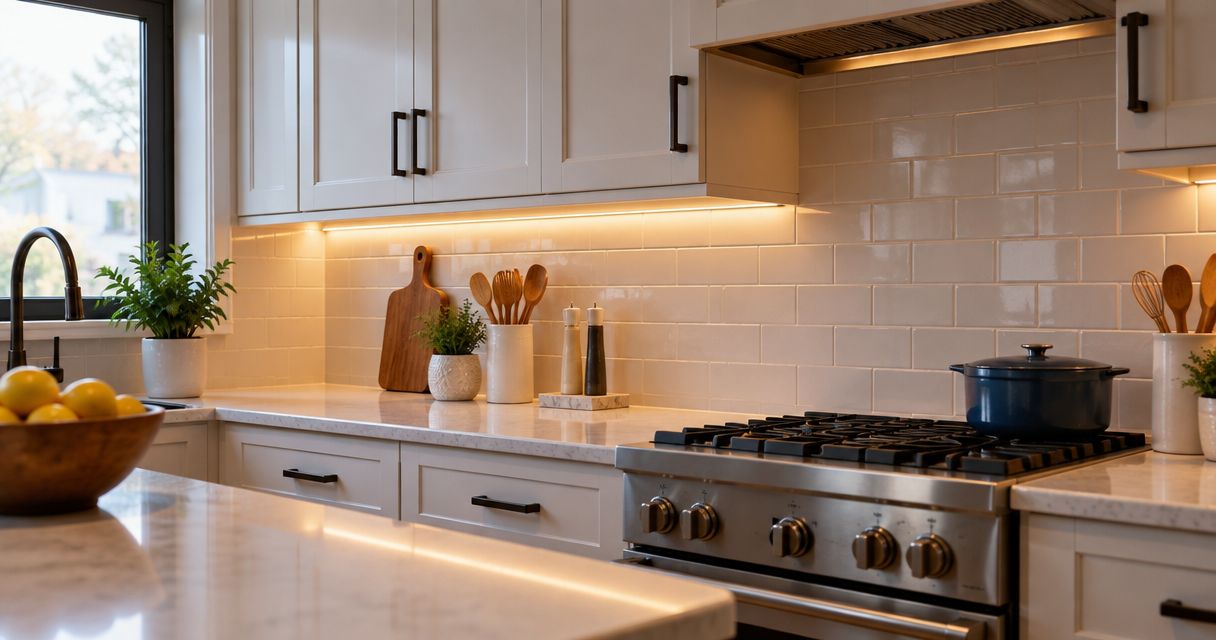
Hardwired LED strip lighting is the best overall under-cabinet lighting fixture for NJ kitchens in 2026 because it runs on a dedicated switched circuit and disappears completely under the cabinet. Plug-in LED strip lighting wins for renters and no-rewire kitchens. LED puck lights win for spotlighting a single feature like a coffee station. Dimmable smart LED strips win for kitchens already running smart lighting control elsewhere in the house.
- Hardwired LED strip lighting is the best under-cabinet lighting fixture for a full NJ kitchen remodel in 2026.
- Plug-in LED strips work without an electrician but need a GFCI-protected outlet under every cabinet run.
- LED puck lights spotlight a coffee station or open shelf; they leave gaps for actual counter prep light.
- Look for 90+ CRI and a 2700K-3000K color temperature to match most NJ kitchen cabinet finishes.
- NEC code requires GFCI protection on any outlet within 6 feet of a kitchen sink, plug-in or otherwise.
Why this matters
Overhead kitchen lights throw your own shadow across the cutting board every time you lean in. Under-cabinet fixtures put light exactly where the knife and the stove are, and in a 2026 remodel that fixture choice affects wiring, permits, and whether the light still works in ten years.
A licensed electrician handling the under-cabinet lighting installation ties the new circuit into code the first time, instead of splicing off an existing outlet and hoping the inspector doesn't notice. That distinction is the difference between a fixture that passes inspection in Monmouth, Middlesex, Somerset, or Union County and one that gets flagged.
What makes the best under-cabinet lighting for NJ kitchens
- Color temperature and CRI — 2700K-3000K reads warm against maple and cherry cabinets; 90+ CRI keeps countertop colors true instead of washed out.
- Power source — hardwired ties into house wiring on its own switch; plug-in relies on an existing GFCI-protected outlet.
- Dimming and smart control — a fixture that dims cleanly on a standard dimmer, or integrates with existing smart lighting control, earns its keep longer.
- Fixture depth and mounting profile — a strip or bar that sits flush under the cabinet lip stays invisible from standing height.
- Code compliance — any new kitchen circuit or countertop-area outlet has to meet NEC GFCI rules regardless of fixture type.
- Long-term reliability — LED chips are generally rated 25,000 to 50,000 hours before noticeable dimming, so a cheap driver is the actual failure point, not the LED itself.
Under-cabinet lighting at a glance
| Fixture type | Best for | Standout feature | Key limitation |
|---|---|---|---|
| Hardwired LED strip lighting | Full kitchen remodels | Wired to its own switch, no visible cord | Requires a licensed electrician |
| Plug-in LED strip lighting | Renters, no-rewire kitchens | Install in minutes, no wiring | Cord routing and outlet placement |
| LED puck lights | Spotlighting a coffee station or shelf | Cheap to add one at a time | Leaves shadow gaps on a long run |
| Linkable bar-style LED fixtures | Deep upper cabinets | Rigid bar won't sag over long runs | Visible seams between bars |
| Dimmable smart/RGB LED strips | Smart-home kitchens | Tunable white and app control | Costs more to wire a smart driver |
1. Hardwired LED strip lighting: best under-cabinet lighting for NJ kitchen remodels
Continuous LED tape runs the length of the cabinet base, fed by a low-voltage transformer tucked inside the cabinet and wired into house power on its own switch or dimmer. It's the fixture most Central New Jersey kitchen remodels land on because it disappears once the cabinet door closes.
Hardwired LED strip pros:
- Even light across the whole counter, no dark gaps
- Runs on a dedicated switch, not an outlet you have to find room for
- Dims smoothly with a compatible dimmer
- No cord, no visible fixture lip
Hardwired LED strip cons:
- Requires a licensed electrician to pull wire and tie into a circuit
- Adds a line item to the remodel budget beyond the fixture itself
- Not something you unplug and take when you move
Best for: full kitchen remodels and homeowners staying in the house long term. Verdict: Buy.
2. Plug-in LED strip lighting: best under-cabinet lighting for renters and no-rewire kitchens
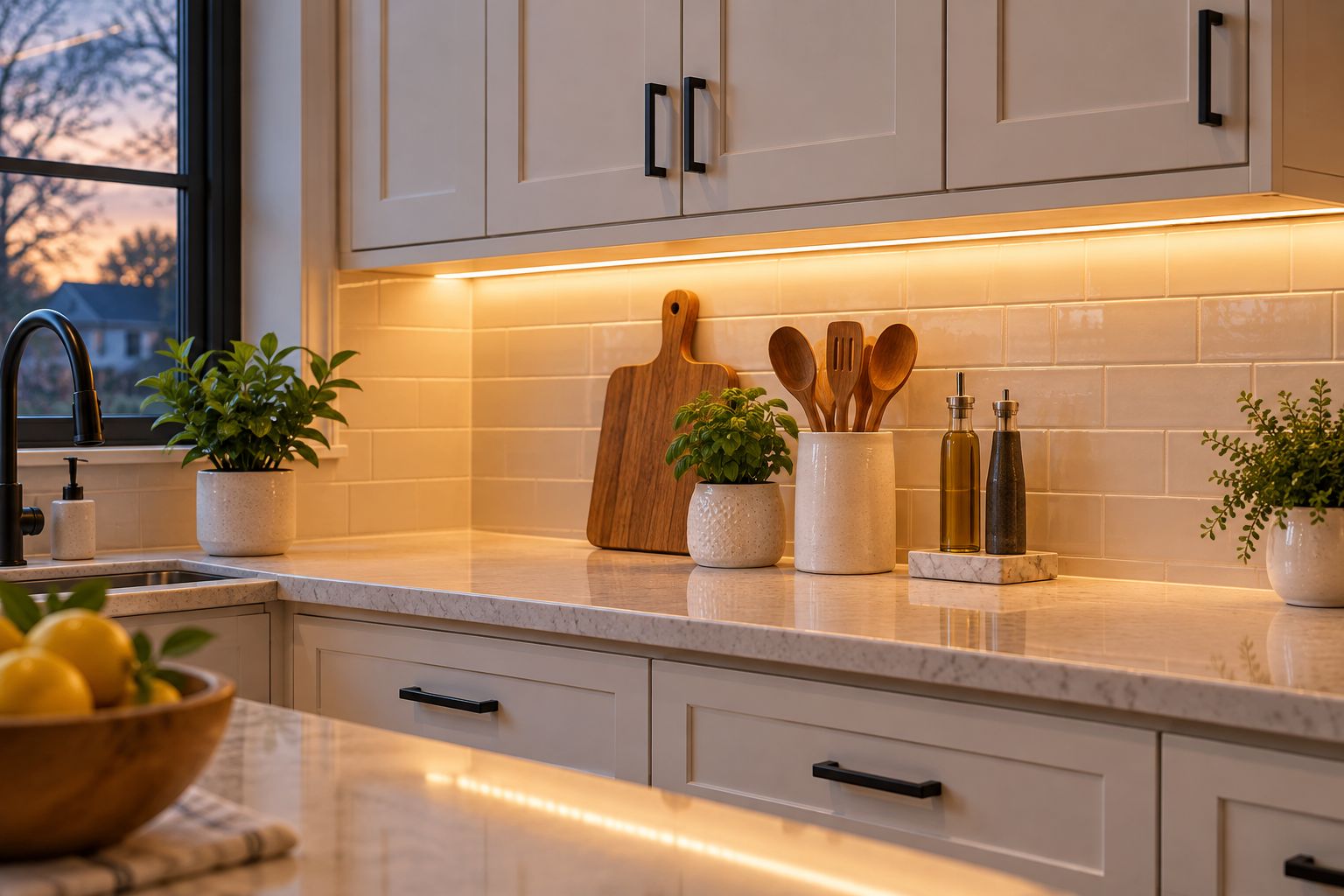
Adhesive LED tape or short bar fixtures run off a wall adapter into an existing outlet, often daisy-chained from one cabinet to the next. No electrician touches the wall for this one — the fixture itself is the entire install.
Plug-in LED strip pros:
- No electrician needed for the light
- Installs in minutes with adhesive backing
- Moves with you if you're renting
Plug-in LED strip cons:
- Cord and adapter are visible unless routed inside the cabinet
- Depends on an outlet nearby, and any outlet within 6 feet of a kitchen sink has to be GFCI-protected under NEC rules
- Daisy-chaining too many runs off one adapter dims the far end of the strip
Best for: renters, apartments, and kitchens where a rewire isn't in the 2026 budget. Verdict: Buy — check the outlet is GFCI-protected first.
3. LED puck lights: best under-cabinet lighting for spotlighting a coffee station or open shelf
Individual round fixtures, hardwired or battery-powered, aimed at one spot instead of the whole counter. They're an accent tool, not a task-lighting system.
LED puck light pros:
- Cheap to add one fixture at a time
- Battery versions need zero wiring
- Good for a backsplash tile, a wine rack, or a coffee bar
LED puck light cons:
- Leaves shadow gaps between fixtures on a long run
- Battery pucks need periodic battery swaps
- Not a substitute for continuous prep lighting
Best for: accenting a single feature, not covering the whole counter. Verdict: Hold — pair with strip lighting elsewhere rather than relying on pucks alone.
4. Linkable bar-style LED fixtures: best under-cabinet lighting for deep upper cabinets
Rigid bars, typically 12 to 24 inches, connect end-to-end and hardwire into a single power source and switch. The rigid housing sits flat against deeper cabinet bottoms without the slight sag tape can show over long spans.
Linkable bar pros:
- Rigid bar sits flush without sagging
- Higher per-foot output than tape in some models
- One switch controls the whole connected run
Linkable bar cons:
- Connectors between bars can show as a visible seam
- Fixed bar lengths mean cutting a run short or leaving a gap
- Still needs a licensed electrician for a clean hardwired install
Best for: kitchens with upper cabinets deep enough to hide a rigid bar cleanly. Verdict: Buy for deep cabinets; Skip for shallow cabinets where low-profile tape looks cleaner.
5. Dimmable smart/RGB LED strips: best under-cabinet lighting for tunable white and smart-home control
LED tape wired to a smart driver that adjusts color temperature or color through an app or wall control, sometimes tied into an existing smart lighting control setup elsewhere in the house.
Smart LED strip pros:
- Warm task light at night, daylight white for morning prep, one fixture
- Integrates with existing smart lighting control
- Dims without flicker on a compatible driver
Smart LED strip cons:
- Costs more to wire in a smart driver and compatible switch
- Troubleshooting a driver issue takes longer than swapping a standard dimmer
- Overkill for a small galley kitchen with one counter run
Best for: kitchens already running smart lighting control, or a remodel where the electrician is already pulling new circuits. Verdict: Buy if smart lighting is already in the house; Wait if this would be the first smart fixture.
How we ranked
Each fixture type is scored against the same six criteria: color accuracy, power source, dimming and smart compatibility, mounting profile, code compliance, and long-term reliability. Hardwired LED strip lighting wins on five of six because the only real downside is needing an electrician — which is exactly why it's ranked first for anyone doing a full 2026 remodel rather than a quick fix.
For placement math that carries over from room to room, the recessed lighting layout guide walks through the same spacing and circuit logic that applies to under-cabinet runs.
Which under-cabinet lighting should you choose?
If you're doing a kitchen remodel in 2026 and staying in the house, hardwired LED strip lighting is the default choice — it's invisible, dims cleanly, and needs no maintenance beyond an occasional wipe. Renting or not ready to open the wall this year? Plug-in LED strip lighting gets you 90% of the same light with none of the electrical work, as long as the outlet is GFCI-protected. Puck lights and bar fixtures fill specific gaps — a coffee station here, a deep cabinet there — but neither replaces continuous task lighting as the main system.
Get under-cabinet lighting wired right
Licensed electricians serving Monmouth, Middlesex, Somerset, and Union counties.
FAQ
What's the best under-cabinet lighting fixture for a NJ kitchen remodel in 2026?
Hardwired LED strip lighting is the best choice for a full kitchen remodel because it runs on a dedicated switch and stays invisible under the cabinet. It requires a licensed electrician to install correctly.
Is plug-in LED strip lighting as good as hardwired?
Plug-in LED strip lighting gives similar light output but relies on a nearby outlet and visible cord routing. It's the better choice for renters or kitchens skipping electrical work this year.
How much CRI do I need for under-cabinet lighting?
Look for 90 or higher CRI so food and countertop colors read accurately. Anything below 80 CRI tends to wash out true color under the fixture.
Do I need a permit for under-cabinet lighting in NJ?
A new hardwired circuit for under-cabinet lighting typically requires a permit and inspection in most Central NJ towns. Plug-in lighting on an existing outlet usually does not.
What color temperature is best for kitchen task lighting?
2700K to 3000K reads warm against most wood and painted cabinet finishes. Some homeowners prefer 3500K to 4000K for a brighter, more daylight-like prep light.
Can I install under-cabinet lighting myself?
Plug-in LED strip lighting is a straightforward DIY install with adhesive backing. Hardwired LED strip lighting needs a licensed electrician to tie into house wiring safely and pass inspection.
Do LED puck lights give enough light for meal prep?
No — puck lights are spaced too far apart to cover a full counter evenly and work best as accent lighting. Pair them with continuous strip lighting for actual task light.
How long does LED under-cabinet lighting last?
LED chips are generally rated for 25,000 to 50,000 hours before noticeable dimming. The driver or transformer, not the LED itself, is usually what fails first.
One last thing
The most common failure isn't the fixture — it's the circuit behind it. A hardwired under-cabinet run spliced off an existing kitchen outlet instead of its own dedicated circuit is one of the more frequent things that gets flagged during a 2026 inspection in Central NJ. Pulling a permit and running a proper circuit the first time costs less than redoing it after a failed inspection.


