
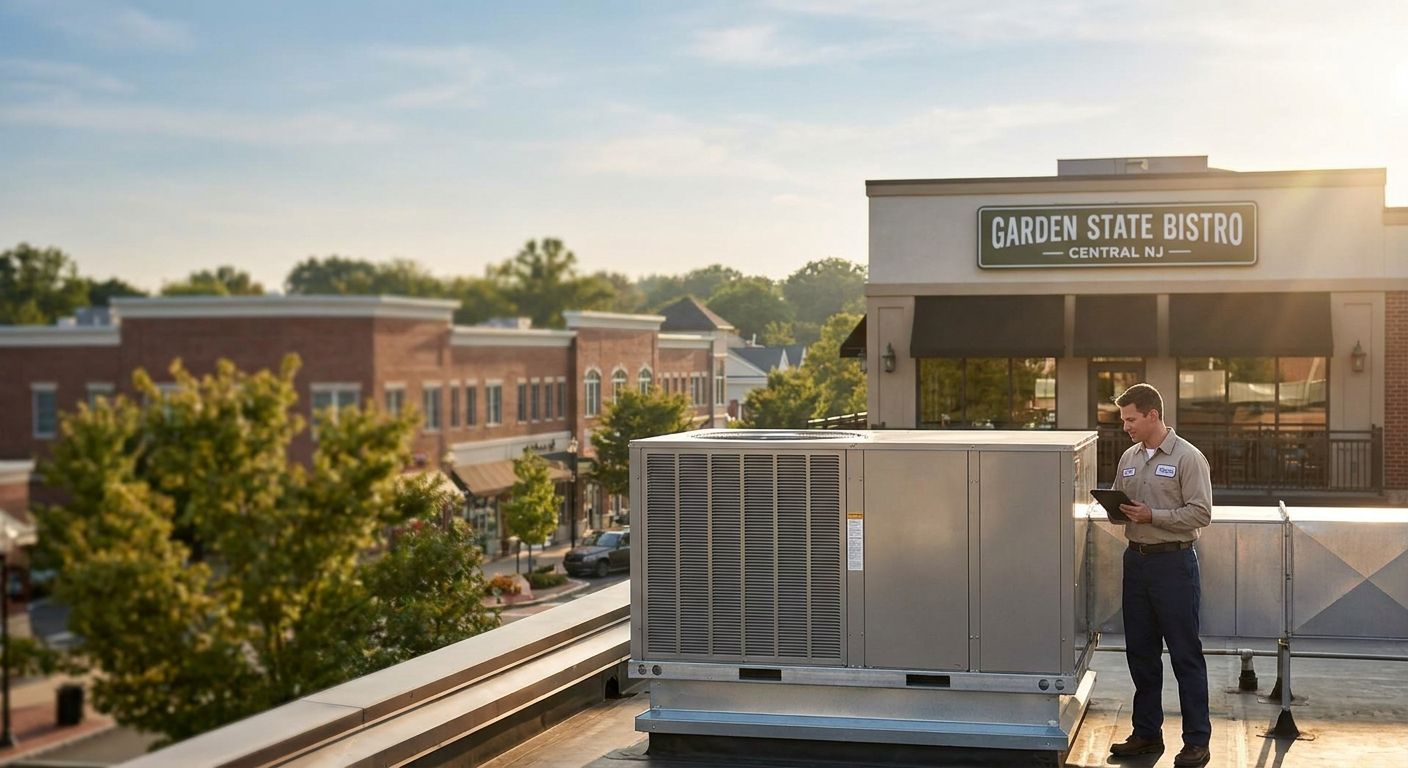
Restaurant commercial HVAC in Central New Jersey means sizing equipment for kitchen heat loads, exhaust hood makeup air, and health-code temperature control that a typical retail store or office space never has to solve. A pizzeria in New Brunswick and a fine-dining kitchen in Westfield fight the same problem: the line throws off more heat than the dining room can absorb, and undersized equipment shows up as a sweating staff, a warm walk-in, or a health inspector citation.
- Commercial HVAC restaurant NJ projects start with a load calculation built around kitchen equipment heat, not square footage alone.
- Spartan Home Pros treats makeup air and hood exhaust as one system — sizing one without the other causes negative pressure and pilot light problems.
- Packaged rooftop units (RTUs) are the standard pick for most Central NJ restaurants in 2026 because they zone kitchen and dining separately.
- Backup power for walk-in coolers and refrigeration matters more than backup power for dining room lighting.
Why commercial HVAC matters for restaurants
A restaurant kitchen generates heat that a Manual J calculation built for retail square footage will not catch — fryers, flat-tops, and a walk-in compressor rejecting heat into the room all add load a standard commercial HVAC system for small businesses was never sized against. Get a commercial HVAC system built for a small business baseline right, then adjust up for kitchen-specific load, and the equipment stops running nonstop just to hold even.
Health code adds a second layer most office buildings never face. The FDA Food Code sets a 41°F holding limit for cold storage, and a walk-in that drifts past that number during a busy Saturday is both a spoiled-inventory problem and a citation risk. NFPA 96 governs hood exhaust and makeup air — get that ratio wrong and doors start sucking shut, pilot lights won't stay lit, and a health inspector notices before the owner does.
Central Jersey's climate compounds both problems. Humid summers push dining room dehumidification loads up while the kitchen is already running hot, and cold winters demand heat that a straight-air makeup unit will fight against all season. Commercial HVAC for a restaurant in Central NJ is a kitchen-load problem first and a comfort problem second.
Calculate your kitchen's actual heat load
Most load calculation mistakes start here — treating a restaurant like an office with a bigger stove.
- Line equipment (fryers, ranges, flat-tops) throwing off BTUs a square-footage estimate misses entirely
- Walk-in cooler and freezer compressor heat rejected straight into the kitchen space
- Occupancy swings between an empty dining room at 3pm and a full dinner rush at 7pm
- Hood exhaust volume, since it drives how much conditioned air the kitchen loses every hour
- Existing ductwork condition — undersized returns choke even a correctly sized unit
Match makeup air to your hood exhaust
Hood exhaust and makeup air are one system. Size them separately and the kitchen fights itself.
- Confirm your hood's CFM rating against the makeup air unit feeding it, per NFPA 96
- Check for negative pressure symptoms: doors that suck shut, pilots that won't stay lit, a burnt smell that lingers instead of clearing
- Decide whether makeup air should be tempered (heated or cooled) or straight outside air, based on how much a NJ winter heating bill can absorb
- Keep makeup air ducting separate from the dining room's return air path
- Retest the balance after any equipment swap — a new hood or an added fryer changes the math
Zone the dining room separately from the kitchen
One thermostat for a whole restaurant means one group is always uncomfortable.
- Run the dining room off its own thermostat and, ideally, its own unit or zone damper
- Set kitchen temperature targets around staff and equipment tolerance, not customer comfort
- Add a dedicated bar or private-room zone if service style differs by area
- Use a commercial-grade thermostat rated for continuous cycling, not a residential unit
- Confirm dining room humidity control keeps pace with Central Jersey's July and August dew points
Set a walk-in-safe temperature monitoring routine
A dial thermometer checked once a shift misses a slow drift until product is already lost.
- Install a remote temperature alarm on walk-in coolers and freezers, not just a wall dial
- Log temps at open and close so drift shows up before product spoils
- Match monitoring thresholds to the FDA Food Code's 41°F cold-holding limit
- Route alarm alerts to a manager's phone, not a panel nobody checks after close
- Clean walk-in condenser coils twice a year minimum — grease and dust cut cooling capacity fast in a kitchen environment
Schedule maintenance around your slow season
A compressor failure on a Friday night in July costs more than a spring tune-up ever will.
- Book coil cleaning and belt inspection during known slow weeks, not mid-summer rush
- Replace grease-rated filters on a set schedule — kitchen filters clog faster than office building filters
- Have a licensed technician check refrigerant charge before peak cooling season starts
- Keep a written maintenance log; some NJ health inspections ask for HVAC service records tied to kitchen ventilation
- Compare a commercial HVAC maintenance plan for a retail-style business against paying per breakdown call
Add backup power for refrigeration first
Inventory loss during a summer outage costs more than a lost dinner shift.
- Prioritize walk-in coolers, freezers, and reach-ins on a generator transfer switch
- Size the generator for kitchen equipment startup surge, not just running wattage
- Confirm the transfer switch covers HVAC controls so the dining room doesn't go dark and hot at the same time
- Check PSE&G and JCP&L outage history for your block before choosing portable versus standby
A backup generator built for NJ restaurants is the step most owners push to last and regret pushing.
Upgrade the electrical panel before the HVAC
A new rooftop unit ordered before the panel is checked is a install-day problem waiting to happen.
- Confirm open breaker space and amperage headroom for a new rooftop unit or compressor
- Older Central NJ commercial buildings often carry 100-amp or 150-amp service that can't support a modern RTU plus kitchen equipment in 2026
- Get the load calculation done before ordering equipment, not after delivery
- Ask whether the new unit needs a dedicated circuit or shares a subpanel with kitchen line equipment
Get a restaurant HVAC load check
Licensed NJ techs, no subcontractors, no hourly meter.
Comparison: restaurant HVAC options in Central NJ
| Option | Best For | Key Limitation |
|---|---|---|
| Packaged rooftop unit (RTU) | Full-service restaurants needing separate kitchen/dining zoning | Needs roof structural capacity and a crane for installation |
| Split system with ductless heads | Small counter-service spots with limited roof access | Hard to zone a large open kitchen with a single indoor head |
| Heat pump system | Year-round comfort through NJ's mixed winters and summers | Loses efficiency below freezing without a backup heat strip |
| Window or PTAC units | Short-term fix for a single problem room | Not built for continuous kitchen-adjacent heat and grease exposure |
Verdict: a packaged rooftop unit wins for most full-service Central NJ restaurants in 2026 — it separates kitchen and dining zones without eating floor space, and it's the configuration local health inspectors see most often.
Common mistakes restaurants make
- Sizing for square footage, not kitchen load — leads to a system that runs nonstop and still loses the fight during a lunch rush
- Skipping makeup air until an inspector flags negative pressure — a hood venting 3,000 CFM needs that air replaced somewhere
- Treating a warm walk-in as a low-priority repair call — a warm walk-in on a Saturday night is a health-code violation and a stocked-inventory loss in the same event
- Delaying a panel check before adding a second compressor or a bigger RTU — breakers trip mid-service and nobody diagnosed why beforehand
- Running one thermostat for the whole building — dining room comfort and kitchen equipment tolerance are not the same target
“A walk-in cooler survives a dinner rush without air conditioning. It does not survive four hours without the compressor running.”
FAQ
What is the best commercial HVAC system for a restaurant in Central NJ?
A packaged rooftop unit (RTU) is the standard pick for full-service restaurants in Central NJ in 2026 because it separates kitchen and dining zones without taking up floor space. Small counter-service spots with limited roof access often do better with a ductless split system instead.
How much makeup air does a restaurant kitchen need?
Makeup air volume has to match the hood's exhaust CFM rating under NFPA 96 — the exact ratio depends on hood type and kitchen layout. A licensed technician measures the hood's exhaust rate on site before sizing the makeup air unit.
Do restaurants need a backup generator for HVAC?
Restaurants need backup power for refrigeration and walk-in coolers before dining room HVAC, since spoiled inventory during an outage costs more than a warm dining room for a few hours. Sizing the generator for equipment startup surge, not just running wattage, keeps compressors from tripping the unit.
How often should restaurant HVAC get serviced?
Restaurant HVAC needs service at least twice a year, more often than a typical office building, because grease and dust load clog filters and foul coils faster in a kitchen environment. Coil cleaning on walk-in units should happen on the same twice-yearly schedule.
Can a walk-in cooler share an electrical panel with kitchen equipment?
A walk-in cooler can share a panel with kitchen equipment only if there's enough open breaker space and amperage headroom for both loads. Older Central NJ commercial buildings on 100-amp or 150-amp service often need a panel upgrade before adding a walk-in compressor circuit.
Is a heat pump good for a NJ restaurant kitchen?
A heat pump works well for dining room comfort through most of a Central Jersey winter but loses efficiency below freezing without a backup heat strip. Kitchens with high internal heat loads from equipment usually need less supplemental heat than the dining room does.
What's different about commercial versus residential HVAC maintenance for restaurants?
Restaurant HVAC maintenance uses grease-rated filters changed on a tighter schedule and requires condenser coil cleaning on walk-ins that residential systems never need. A written service log also matters more, since some NJ health inspections ask about HVAC and ventilation records.
How much does commercial HVAC installation cost for a NJ restaurant?
Cost depends on square footage, whether the roof needs structural work for an RTU, and whether existing ductwork can be reused. A site visit and load calculation gives an exact number — restaurant installs vary too much by kitchen size and equipment to quote a flat figure.
One last thing
Most restaurant owners in Central NJ plan HVAC around the dining room and treat the kitchen as an afterthought — it should be the other way around. The kitchen's heat load, makeup air balance, and walk-in refrigeration drive the whole system's sizing in 2026, and getting those three right before touching the dining room thermostat is the difference between a system that keeps up and one that runs constant and still loses ground during service.


