
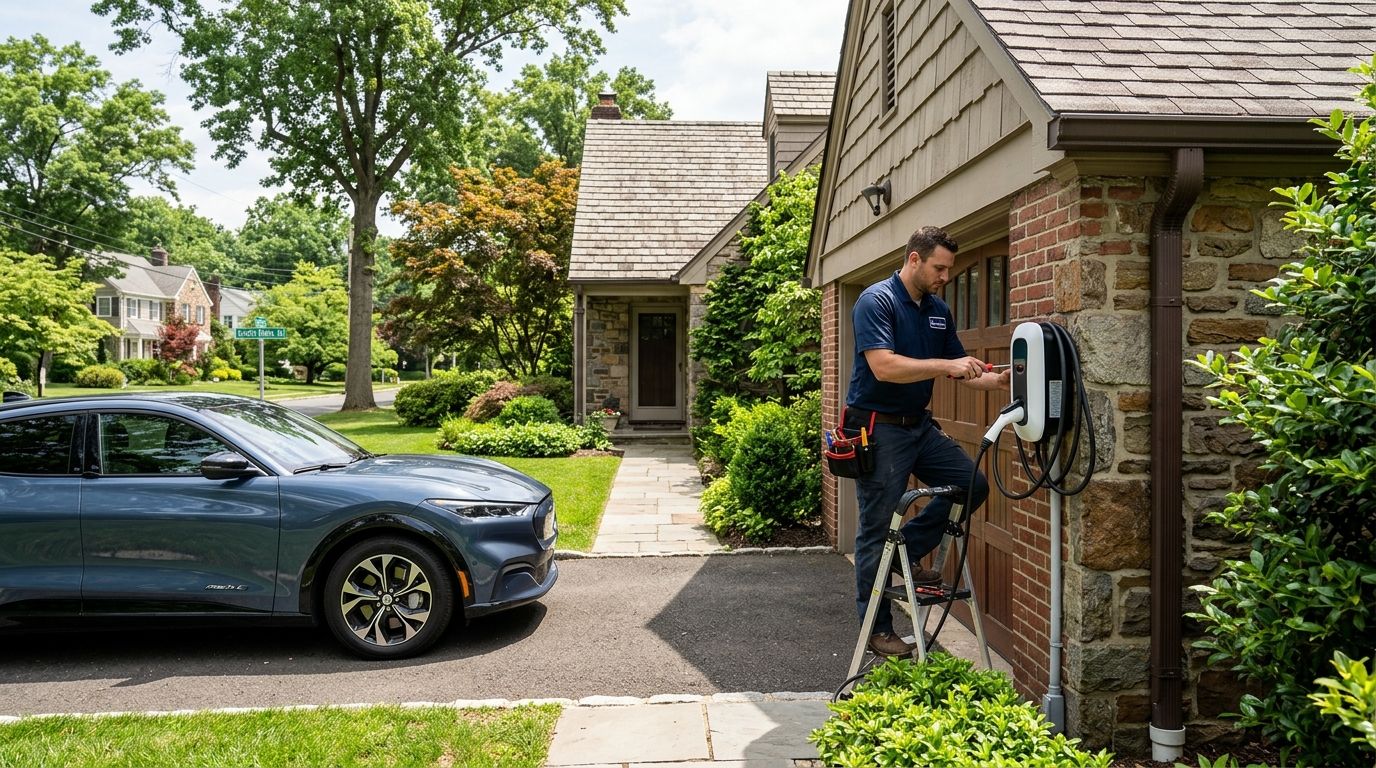
EV charger installation for Scotch Plains homeowners means adding a dedicated 240-volt circuit and Level 2 charging station sized to your car's onboard charger and your panel's spare capacity. Scotch Plains' housing stock leans toward 1950s-1970s colonials and split-levels, and a lot of them are still running 100-amp panels that were never built to carry a 40-amp charging circuit on top of central air, an electric range, and a pool pump.
- EV charger installation in Scotch Plains, NJ requires a Union County electrical permit for any new circuit tied to your panel.
- Homes still on 100-amp panels usually need an upgrade before adding a Level 2 charger — verify with a load calculation first.
- NEC 625.41 caps continuous charger draw at 80% of the breaker rating, so a 50-amp breaker only delivers 40 amps to the car.
- Spartan Home Pros pulls the permit, runs the load calculation, and hardwires most Level 2 installs above 32 amps.
Why EV charger installation matters for Scotch Plains homeowners
Scotch Plains sits in Union County, and every township here requires an electrical permit for any new circuit tied to your home's panel, EV chargers included. Skip the permit and you've got an uninspected 240-volt circuit sitting in your garage — that becomes a problem at resale, and it can complicate an insurance claim if something goes wrong later.
The bigger issue in this town specifically is panel age. A lot of Scotch Plains housing predates the 200-amp panel becoming standard, and adding a 40-amp EV circuit to a panel that's already carrying central air, an electric dryer, and a range can push you past what NEC load calculations allow. That's not a guess — it's math a licensed electrician runs before any wire gets pulled, and it's why panel upgrades for EV charger installation get bundled into so many of these jobs in Central NJ.
Verdict: if your Scotch Plains home still has a 100-amp panel, budget for a panel upgrade alongside the charger — don't assume the charger install stands alone.
Step-by-step: installing an EV charger at your Scotch Plains home
Assess your panel's amperage and spare capacity
Start here before you buy anything. A charger picked before the panel is checked is the most common reason installs stall mid-project.
- Find your main breaker rating on the panel door — 100A, 150A, and 200A are the common sizes in this area
- Count existing 240-volt loads: range, dryer, central AC condenser, pool pump
- Run a load calculation per NEC 220 before assuming there's room
- Flag Federal Pacific or Zinsco panels immediately — those get replaced, not added to
- If spare capacity comes in under 40 amps, plan the panel upgrade first
Pick the right charger amperage and connector
Charger shopping without a panel number in hand leads to buyer's remorse. Match the amperage to what your circuit can actually deliver.
- Level 2 chargers draw anywhere from 16 to 48 amps continuously
- NEC 625.41 caps continuous charger draw at 80% of the breaker rating
- J1772 connectors fit most non-Tesla EVs on the road in 2026
- Tesla owners need either a Tesla Wall Connector or a J1772 adapter
- Check your EV's onboard charger max acceptance rate — a 48-amp charger is wasted on a car that only accepts 32
See the full breakdown on the best home EV chargers for New Jersey homeowners before you buy hardware.
Map the charger location and conduit run
Where the charger mounts drives labor cost more than almost any other decision.
- Measure the distance from your panel to the garage or driveway parking spot
- Exterior-mounted chargers need a NEMA 3R weatherproof rating
- Route conduit through an unfinished basement or crawlspace first — it's cheaper than fishing through finished walls
- Confirm the charger's cable length reaches the vehicle's charge port without the car needing to park at an odd angle
Get the Scotch Plains township permit and inspection
This step is non-negotiable, not paperwork theater.
- Union County towns require an electrical permit for any circuit added to the panel
- Permit review checks the load calculation, breaker size, and disconnect location
- Inspection happens after rough-in, before drywall or siding closes up the run
- Keep the inspection card — it matters at resale and for insurance
Decide hardwired vs. NEMA 14-50 outlet
Both are code-compliant. The right choice depends on charger amperage and how often you expect to swap equipment.
- Hardwired connections remove a plug/receptacle failure point — standard for chargers above 32 amps
- A NEMA 14-50 outlet lets you unplug and swap chargers if you change EVs later
- Outlet installs run less in labor but need a weatherproof cover outdoors
- Most manufacturers recommend hardwiring for continuous 32-48 amp draw
Schedule licensed installation and any panel work
- Confirm the electrician pulls the permit under their own license number
- Ask whether panel upgrade work is bundled with the charger install or billed as a separate job
- Verify grounding and bonding meet current NEC 250 requirements
- Get a written scope before work starts, not a verbal estimate
Spartan Home Pros does not subcontract this work — the electrician who runs the load calculation is the same one who pulls the permit and does the install.
Test, register, and monitor the charger
- Run a full charge cycle and check breaker temperature after 30 minutes
- Register the charger with the manufacturer for warranty and firmware updates
- Set scheduled charging for off-peak utility hours if your PSE&G plan has time-of-use rates
- Log any tripped breaker or GFCI fault immediately — don't just reset it and move on
Get your panel checked first
A load calculation tells you if your Scotch Plains panel is ready for a Level 2 charger.
Comparing EV charging options for Scotch Plains homes
| Option | Best for | Key limitation |
|---|---|---|
| Level 1 (120V trickle) | Plug-in hybrid owners with low daily mileage | Adds only 3-5 miles of range per hour |
| Level 2, existing panel capacity | Homes with 150-200 amp panels and an open breaker slot | Needs a double-pole slot with spare capacity confirmed by load calc |
| Level 2 with panel upgrade | 100-amp homes adding EV charging plus other 240V loads | Requires permit, inspection, and utility coordination |
| Tesla Wall Connector | Tesla-only households wanting the fastest onboard charge rate | Non-Tesla EVs need a J1772 adapter to use it |
Verdict: most Scotch Plains homeowners land on Level 2, and the panel — not the charger — decides whether that's a same-week install or a two-phase project. Tesla owners specifically should compare notes with EV charger installation guidance for Tesla owners in NJ before picking hardware.
Common mistakes Scotch Plains homeowners make
- Assuming an existing garage outlet handles Level 2 draw. A standard 120V receptacle isn't rated for 240V charging, period.
- Skipping the township permit to save a week. It resurfaces at resale inspection and can complicate insurance claims.
- Running the load calc without the pool pump or second AC unit counted. Undersized calculations are the top reason installs get rejected at inspection.
- Buying a 48-amp charger for a panel with only 30 amps of spare capacity. Amperage mismatches force a return trip and a second invoice.
- DIY hardwiring without updating GFCI/AFCI protection. This voids most manufacturer warranties outright.
FAQ
How much does EV charger installation cost in Scotch Plains, NJ?
Cost depends mainly on whether your panel has spare capacity or needs an upgrade, plus wire run length and hardwired vs. outlet install. A licensed electrician gives an exact number after running the load calculation on your specific panel.
Do I need a permit to install an EV charger in Scotch Plains?
Yes, any new circuit tied to your home's panel requires an electrical permit in Union County, including EV charger circuits. Skipping it creates problems at resale and can complicate an insurance claim later.
What size electrical panel do I need for an EV charger?
Homes with a 200-amp panel and spare breaker capacity can usually add a Level 2 charger without an upgrade; homes still on a 100-amp panel typically need one first. A load calculation confirms this before any hardware gets recommended.
Is a hardwired EV charger better than a plug-in charger?
Hardwired connections are standard for chargers pulling 32 amps or more because they remove a plug/receptacle failure point. A NEMA 14-50 outlet works for lower-draw chargers and lets you swap units later.
Can I install a Tesla Wall Connector if I don't own a Tesla?
Yes, the Tesla Wall Connector charges any EV with a J1772 adapter, though non-Tesla drivers typically get equal function from a universal Level 2 charger. Households planning a second EV often pick the universal option instead.
How long does EV charger installation take?
Installation itself typically runs half a day to a full day depending on the conduit run length, with panel upgrades adding another day. Township permit review and inspection scheduling add time on top of the physical work.
Will an EV charger overload my home's electrical system?
A single Level 2 charger adds 16 to 48 amps of continuous draw, which is why the load calculation checks it against your other 240-volt appliances. That calculation, not a guess, determines whether your existing panel can handle it.
Do condos and HOA communities in Scotch Plains allow EV chargers?
Rules vary by association and often require board approval plus a licensed electrician's install plan. Check your HOA's specific bylaws before scheduling any electrical work.
One last thing
Most homeowners assume the charger's amperage rating is what their car actually gets — it isn't. NEC 625.41's 80% continuous-load rule means a 50-amp breaker only delivers 40 amps to the vehicle, and a 60-amp breaker delivers 48. If a quote doesn't mention this derating, ask about it before signing off on breaker size.


