
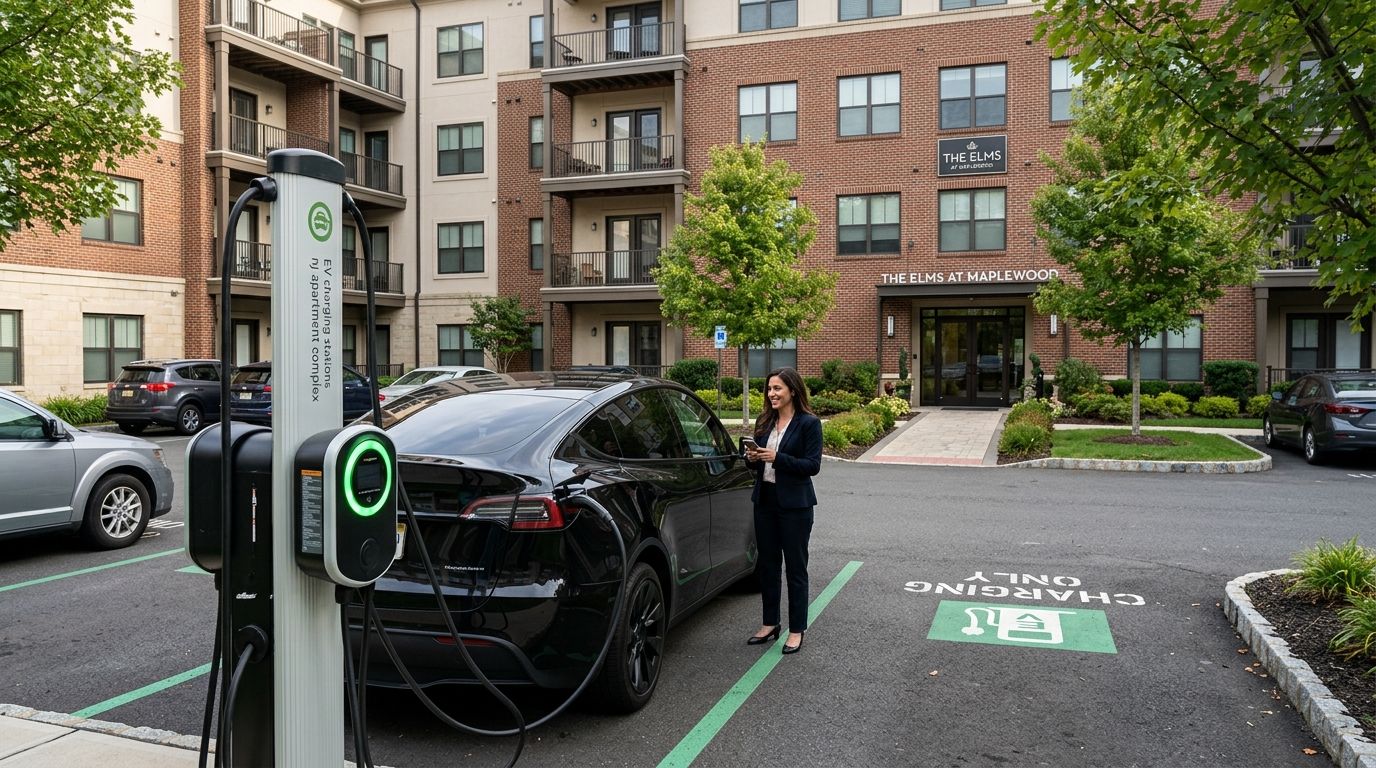
EV charging stations for NJ apartment complex owners are dedicated Level 2 charging ports installed in shared parking areas, sized and metered so a handful of tenants can charge overnight without tripping the building's main service. A single-family homeowner adds one charger to one panel. An apartment owner adds charging infrastructure to a shared electrical system that also runs hallway lighting, laundry rooms, and every unit's HVAC — and has to decide who pays for the electricity.
- EV charging stations for NJ apartment complex owners start with a load study, not a charger order — undersized service kills the project before installation begins.
- Networked Level 2 chargers with per-tenant billing beat unmetered chargers for any complex over roughly 8 to 10 units.
- A dedicated subpanel is usually required before the first charger goes in — most Central NJ apartment services were sized for lighting and AC, not EV load.
- Spartan Home Pros handles the electrical side — panel upgrades, dedicated circuits, and permits — for properties in Monmouth, Middlesex, Somerset, and Union counties.
Why EV charging matters for NJ apartment complex owners
Multifamily properties don't get to treat EV charging as a one-off homeowner project. Every added charger draws load off a shared service, and every added tenant expects the same reliability as their in-unit outlets. Get the electrical planning wrong and you're looking at breaker trips, an inspection failure, or a charger bank that works for the first three tenants and stalls for everyone after.
The decision isn't just electrical, either. Property owners have to pick a billing model, decide how many spaces get converted, and figure out who's liable if a charger damages a resident's vehicle. None of that gets solved by buying a charger off a shelf — it gets solved by panel upgrades for EV charger installation done before a single charging port is mounted.
The apartment owners who get this right treat it as an electrical infrastructure project first and an amenity second.
The steps to install EV charging stations at a NJ apartment complex
Audit your electrical service before you spec chargers
Start with a load study on the building's main service and any subpanels feeding the parking area. This tells you how much capacity is actually available before you commit to a charger count.
- Pull the panel schedule and confirm the rated amperage of the main service
- Check whether the parking area already has a subpanel or runs off the main building panel
- Measure existing peak load during evening hours, when charging demand overlaps with resident usage
- Flag any aluminum wiring, fuse panels, or older Zinsco/Federal Pacific equipment feeding the site — these often need replacement before any new circuit gets added
- Get a written capacity number, not a guess, before you talk to charger vendors
Pick a charger and network model that fits multi-tenant billing
A charger that works fine for one homeowner's driveway doesn't work for 40 units sharing four spaces. Decide between a simple Level 2 unit and a networked charger before you install anything.
- Unmetered Level 2 chargers work for small complexes offering charging as a flat-fee amenity
- Networked chargers with RFID cards or app access let you bill tenants per kWh used
- Load-managed charger banks share available amperage across multiple ports automatically, avoiding a full service upgrade
- Confirm the charger's connector type matches what most residents drive — Tesla, CCS, or both
Map out parking allocation and accessible spaces
Which spaces get converted determines both cost and fairness. Charging spots closest to the electrical room cost less to wire; spots farther away mean longer conduit runs and higher labor cost.
- Identify spaces within 50 to 75 feet of the electrical room first — shorter runs, lower install cost
- Confirm at least one charging space meets accessible parking requirements
- Decide whether charging spots are reserved for EV owners only or shared with general parking
- Plan for future expansion — run larger conduit now even if you only install two chargers in 2026
Coordinate permits and utility service
Every EV charger installation on a commercial or multifamily property in Central NJ requires an electrical permit, and a service upgrade may require utility coordination with PSE&G or JCP&L depending on your township.
- Pull an electrical permit before work starts — inspectors will fail unpermitted installs
- Contact the utility early if the load study shows you need a service upgrade, not just a panel change
- Confirm your municipality's setback and signage requirements for EV parking spaces
- Keep permit documentation on file — lenders and insurers ask for it during refinancing or claims
Install dedicated circuits and charging hardware
This is where most of the cost sits: conduit runs, breaker installation, and the physical charger mounts. A licensed electrician who won't subcontract the work out keeps accountability with one crew from panel to parking spot.
- Run dedicated circuits sized to the charger manufacturer's spec, not the minimum code allows
- Install a subpanel near the charging area if the main panel doesn't have room for new breakers
- Weatherproof all outdoor equipment rated for exposure
- Test each circuit under load before turning chargers over to tenants
Set up tenant billing and access control
Once power is live, decide how tenants get billed and how you prevent non-residents from using the chargers.
- Assign RFID cards or app logins tied to unit numbers
- Set per-kWh rates that cover electricity cost plus a service margin
- Restrict access hours if demand exceeds available ports
- Route billing data into your existing rent or utility software where possible
Maintain and monitor the installed stations
Chargers left unmonitored fail quietly — a stuck connector or tripped GFCI outlet doesn't get reported until three tenants complain in the same week.
- Check networked chargers' uptime dashboard monthly
- Inspect connectors and cables for wear each quarter
- Keep a service contact on file who answers when a charger goes down, not a call center
- Log every service call so you can spot a pattern before it becomes a full outage
Comparison: EV charging options for NJ apartment complexes
| Option | Best for | Key limitation |
|---|---|---|
| Unmetered Level 2 charger | Small complexes (under 8-10 units) offering charging as a flat amenity | No usage tracking — owner absorbs electricity cost regardless of use |
| Networked Level 2 with per-kWh billing | Mid-size to large complexes that want fair, usage-based billing | Requires an ongoing software subscription and reliable connectivity |
| Load-managed charger bank (shared circuit) | Properties with limited panel capacity and multiple charging spaces | Chargers share available amperage, so charging speed drops during peak demand |
| DC fast charger | Mixed-use or retail-adjacent properties with visitor turnover | High install cost and often a transformer upgrade — overkill for overnight resident charging |
For most Central NJ apartment complexes, a networked Level 2 charger with load management is the right call — it bills fairly and doesn't force a full service upgrade on day one.
Common mistakes NJ apartment owners make with EV charging
- Ordering chargers before the load study. The charger arrives, the panel can't support it, and the install stalls for weeks waiting on a service upgrade that should have been step one.
- Skipping a billing plan. Owners who install unmetered chargers as a "free amenity" end up eating an electricity cost that grows every time another tenant buys an EV.
- Treating one charger as enough for the whole complex. A single charging spot for 40 units generates more tenant complaints than it solves — plan capacity for growth, not the current EV count.
- Ignoring accessible parking requirements. Retrofitting a compliant space after the fact costs more than planning for it in the first design pass.
- Skipping permits to save time. An unpermitted install fails inspection, and insurers can deny claims tied to unpermitted electrical work.
Get your property's load study done
Licensed electricians for panel upgrades and EV charger installs across Central NJ.
FAQ
What does it cost to install EV charging stations at a NJ apartment complex?
Cost depends on charger count, distance from the electrical room, and whether a panel or service upgrade is needed. Get a written quote after a load study, not before — every property's electrical starting point is different.
How many EV charging stations does an apartment complex need in 2026?
There's no fixed ratio, but planning for growth beyond current EV ownership avoids a second construction project within a few years. Run larger conduit during the first install even if only two chargers go in initially.
Can my apartment complex's electrical panel handle EV chargers?
Only a load study on the existing panel and service tells you for certain. Many Central NJ apartment buildings were wired for lighting and AC loads, not EV charging, and need a subpanel or service upgrade first.
Who pays for electricity at apartment EV charging stations?
That depends on the billing model you choose. Networked chargers with per-kWh billing pass the cost to the tenant using the charger; unmetered chargers put the cost on the property owner.
Do NJ apartment complexes need accessible EV charging spaces?
Yes, at least one charging space should meet accessible parking requirements as part of the site plan. Planning for this during initial design costs less than retrofitting later.
Is a networked charger better than a standard Level 2 charger for apartments?
For complexes over roughly 8 to 10 units, yes — networked chargers let you bill tenants fairly per kWh used instead of absorbing electricity cost as a flat amenity.
How long does EV charger installation take at a multi-unit property?
Timeline depends on permit turnaround and whether a service upgrade is required. A load study and permit pull happen before any physical installation begins.
Does Spartan Home Pros install EV charging stations for NJ apartment complexes?
Yes — Spartan Home Pros handles panel upgrades, dedicated circuits, and charger installation for multifamily properties across Monmouth, Middlesex, Somerset, and Union counties.
One last thing
Most Central NJ apartment complexes built before 2000 were never wired with EV load in mind — the first charger installed often forces a subpanel or service upgrade that the second and third chargers then ride on for free. Owners who spend the money on that first-charger infrastructure upgrade in 2026 avoid paying for it twice.


