
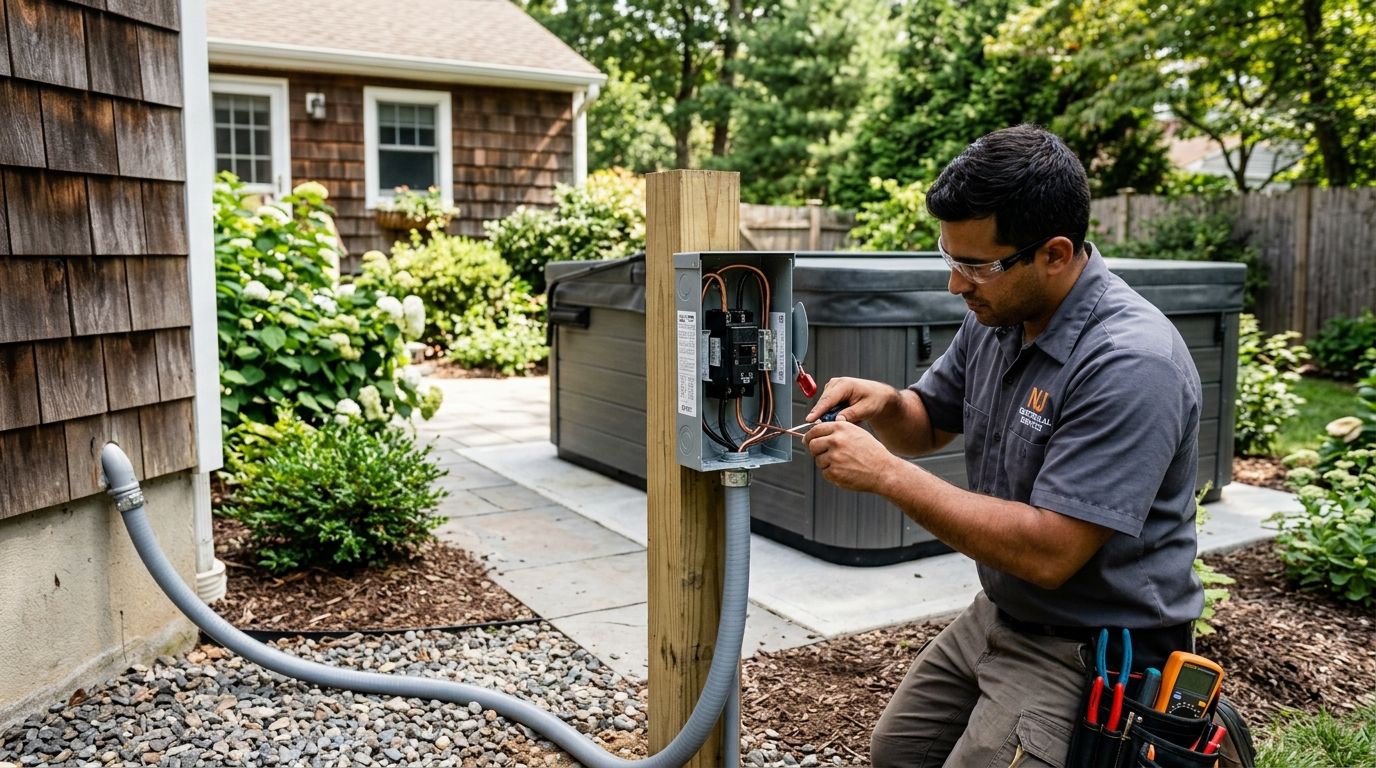
NJ homeowners installing a hot tub need a dedicated 240-volt GFCI-protected circuit sized to the spa's amperage draw, bonded and permitted under NEC Article 680, with the goal of passing inspection the first time and never tripping a breaker mid-soak. Unlike a kitchen outlet upgrade, this wiring runs outdoors, often 40 to 60 feet from the panel, near standing water, and most 100-amp panels in older Central Jersey homes don't have a free double-pole slot left for it.
- Most 240V hot tubs need a dedicated 50-amp GFCI circuit — check your panel capacity before you buy the spa.
- NEC Article 680 requires bonding, GFCI protection, and set clearance distances from the water's edge.
- A panel upgrade in NJ runs $2,000 to $7,000 installed; a subpanel is often the cheaper fix if slots are the only problem.
- Spartan Home Pros does not subcontract hot tub electrical wiring in Monmouth, Middlesex, Somerset, or Union counties.
- Skipping the permit on hot tub electrical wiring NJ inspectors check is the fastest way to fail a resale inspection later.
Why hot tub electrical wiring matters for NJ homeowners
A plug-in inflatable spa and a hardwired 240V hot tub are not the same electrical job, and mixing them up is where most DIY hot tub installs go wrong. Central Jersey's housing stock skews older, and a lot of homes in Monmouth, Middlesex, Somerset, and Union counties are still running 100-amp service from the 1970s or 1980s — fine for a house, tight for a house plus a 50-amp spa breaker.
Townships in this part of NJ also enforce NEC Article 680 closely because hot tub inspections are a known failure point: missing bonding wire, GFCI breakers rated wrong for the load, or disconnects placed too close to the water. Get the electrical panel upgrade for hot tub and pool installation right before the spa arrives, and the inspection is a formality. Get it wrong, and you're paying for a second site visit.
Check your existing panel's amperage and open slots
Before anything else, look at what you actually have. A hot tub needs a full double-pole breaker slot reserved for it — not a shared circuit, not a tap off an existing 240V line.
- Read the amperage rating stamped on the main breaker or panel door — most older NJ homes show 100A, newer ones 150A or 200A
- Count open breaker slots; a 240V hot tub needs two adjacent open slots for a double-pole breaker
- Note the panel's age — panels older than 25 years or brands like Zinsco and Federal Pacific carry known failure risks
- Check if your panel is already running close to capacity with AC, EV charger, or electric range loads
Confirm your hot tub's actual electrical requirements
Spa manufacturers publish the exact amp draw and voltage on a data plate near the equipment pad — never guess this number. A plug-and-play spa typically runs on a 120V, 15- or 20-amp GFCI-protected outlet. A hardwired hot tub, which is what most in-ground and larger above-ground spas require, runs on 240V and commonly needs a 40- to 60-amp dedicated circuit.
- Pull the amp and voltage rating off the manufacturer's spec plate before ordering any wire or breaker
- Confirm whether the unit is plug-and-play (120V) or hardwired (240V) — this changes the whole scope
- Match the breaker size exactly to the manufacturer's minimum circuit ampacity, never round down
- Factor in pump, heater, and blower loads together, not just the heater alone
Install a dedicated GFCI-protected 240V circuit
Once you know the draw, the circuit itself has to run alone from panel to spa pad — no shared loads, no daisy-chaining off another 240V appliance. This is the step where a licensed NJ electrician, not a general handyman, needs to be involved because the GFCI breaker rating has to match the spa's exact load.
- Run the circuit in rigid conduit or approved UF cable rated for outdoor, below-grade use
- Install a GFCI breaker at the panel sized to the manufacturer's spec, not a generic 50A breaker
- Terminate at a weatherproof, lockable disconnect within sight of the spa but at least 5 feet from the water's edge
- Confirm wire gauge matches breaker amperage — undersized wire on a 50A breaker is a fire risk, not a shortcut
Meet NEC 680 bonding and clearance requirements
Bonding is the single most common reason NJ hot tub inspections fail on the first attempt. Article 680 requires an equipotential bonding grid connecting all metal components around the spa — pump housing, ladder, any metal within 5 feet — even on installs where the wiring itself is done correctly.
- Bond all metal parts within 5 feet of the spa to a common grounding point using #8 copper wire
- Keep the disconnect switch visible from the spa but never within 5 feet of the water
- Maintain the code-required distance from overhead power lines above the spa location
- Use only GFCI-protected outlets for any 120V equipment near the spa pad, including pool GFCI outlets for lighting
If your bathroom or kitchen outlets near an attached spa area still run on standard duplex receptacles, GFCI outlet installation should happen at the same time — inspectors check adjacent wet-area circuits, not just the spa line itself.
Pull the permit and schedule the inspection before backfilling
Every NJ township requires an electrical permit for hot tub wiring, and most require the trench or conduit run to stay open for inspection before it's covered. Skipping this step to save a week is the most expensive mistake on this list — a failed resale inspection years later costs far more than the permit fee ever would.
- File the electrical permit with your township before any wire goes in the ground
- Leave trenches and conduit runs uncovered until the rough-in inspection passes
- Schedule the final inspection only after the bonding grid and disconnect are fully installed
- Keep permit and inspection paperwork on file — buyers' attorneys ask for it at closing
Upgrade the panel or add a subpanel if you're out of capacity
If step one showed a full panel or an undersized 100A service, you have two paths: a full panel upgrade or a dedicated subpanel just for the spa and other outdoor loads. A subpanel is often the cheaper move when the main panel's capacity is fine but the physical slots are gone.
- A full panel upgrade in NJ runs $2,000 to $7,000 installed, driven by amperage size, panel brand, and permit complexity
- A subpanel adds breaker capacity near the spa without touching the main panel's service size
- Subpanel installation makes sense when you're also planning a generator, EV charger, or pool equipment down the line
- A 100A panel running an electric range, central AC, and a hot tub is usually undersized — plan for 150A or 200A if you're upgrading anyway
Hire a licensed NJ electrician for the final hookup
Everything above can be scoped and planned by a homeowner, but the actual wire pull, breaker install, and bonding work in NJ has to be done and signed off by a licensed electrician — it's not a permit a handyman can pull. Spartan Home Pros runs hot tub electrical wiring NJ homeowners need as a licensed job start to finish, with no subcontracted crews and a stated minimum service call of $229.99.
Get your hot tub circuit scoped
Panel check, permit, and GFCI hookup — one licensed crew, no subcontractors.
Comparison: how NJ homeowners get hot tub wiring done
| Option | Best for | Starting price | Key limitation |
|---|---|---|---|
| DIY conduit run + township permit | Handy homeowners with panel capacity already | Materials only, varies | No license — a failed inspection means starting the wiring over |
| General handyman | Cosmetic trim work near the spa pad | Varies by contractor | Not licensed to pull a 240V spa permit in NJ |
| Licensed electrician, panel has open capacity | Homes with a panel under 10 years old and open slots | $229.99 minimum service call | Doesn't cover a panel replacement if slots are short |
| Licensed electrician, panel or subpanel upgrade required | Homes on 100A service or a full panel | $2,000 to $7,000 installed | Adds 1-2 days to the install timeline |
Verdict: if your panel already has two open slots and modern capacity, a licensed electrician's service call covers the hot tub hookup alone — skip the upgrade. If it doesn't, price the subpanel or panel upgrade in before you order the spa, not after.
Common mistakes NJ homeowners make with hot tub wiring
- Buying the spa before checking the panel. The hot tub shows up, the installer opens the panel, and there's no room for the breaker — now it's a delayed project and an emergency electrician visit.
- Plugging a 240V spa into an extension cord or shared outlet. This isn't a shortcut, it's a fire hazard and an automatic inspection fail.
- Skipping the permit to save a week. Township inspectors and home-sale attorneys both check for permit records on spa electrical work; unpermitted wiring is a disclosure problem at resale.
- Ignoring the bonding grid. Wiring can be perfect and the bonding still missing — this is the single most common reason hot tub inspections fail in NJ.
- Assuming a general handyman can do the hookup. NJ requires a licensed electrician's signature on the permit; a handyman's work won't pass, no matter how clean it looks.
FAQ
What size electrical service does a hot tub need in NJ?
Most hardwired hot tubs need a dedicated 240V circuit rated between 40 and 60 amps, sized exactly to the manufacturer's spec plate. Plug-and-play spas run on a 120V, 15- or 20-amp GFCI outlet instead.
Can I plug a hot tub into a regular outlet?
Only if it's a plug-and-play model rated for 120V and the outlet is GFCI-protected and dedicated to the spa alone. Hardwired 240V hot tubs cannot be plugged into any standard outlet.
Do I need a permit for hot tub wiring in New Jersey?
Yes, every NJ township requires an electrical permit and inspection for hot tub wiring before the trench or conduit is covered. Skipping it creates a disclosure problem when you sell the home.
How much does it cost to wire a hot tub in NJ?
If your panel already has capacity, expect the licensed electrician's minimum service call of $229.99 plus materials. If a panel upgrade is needed, that runs $2,000 to $7,000 installed.
Does my hot tub need its own breaker?
Yes, a hot tub requires a dedicated breaker sized to the manufacturer's amp rating — never shared with another appliance or circuit.
How far does a hot tub electrical disconnect need to be from the water?
NEC Article 680 requires the disconnect to be visible from the spa but installed at least 5 feet from the water's edge.
Can an unlicensed handyman wire my hot tub?
No, NJ requires a licensed electrician to pull the permit and sign off on hot tub electrical work. A handyman's wiring will not pass township inspection.
What happens if I skip the electrical permit for a hot tub?
The install can fail inspection later, and unpermitted electrical work is a common issue that surfaces during a home sale attorney review or appraisal.
One last thing
Most hot tub electrical failures in NJ aren't wiring mistakes at all — they're bonding mistakes. The wire gauge is right, the breaker is right, and the inspection still fails because nobody ran the #8 copper bonding grid around the equipment pad. Check that detail before you check anything else.


