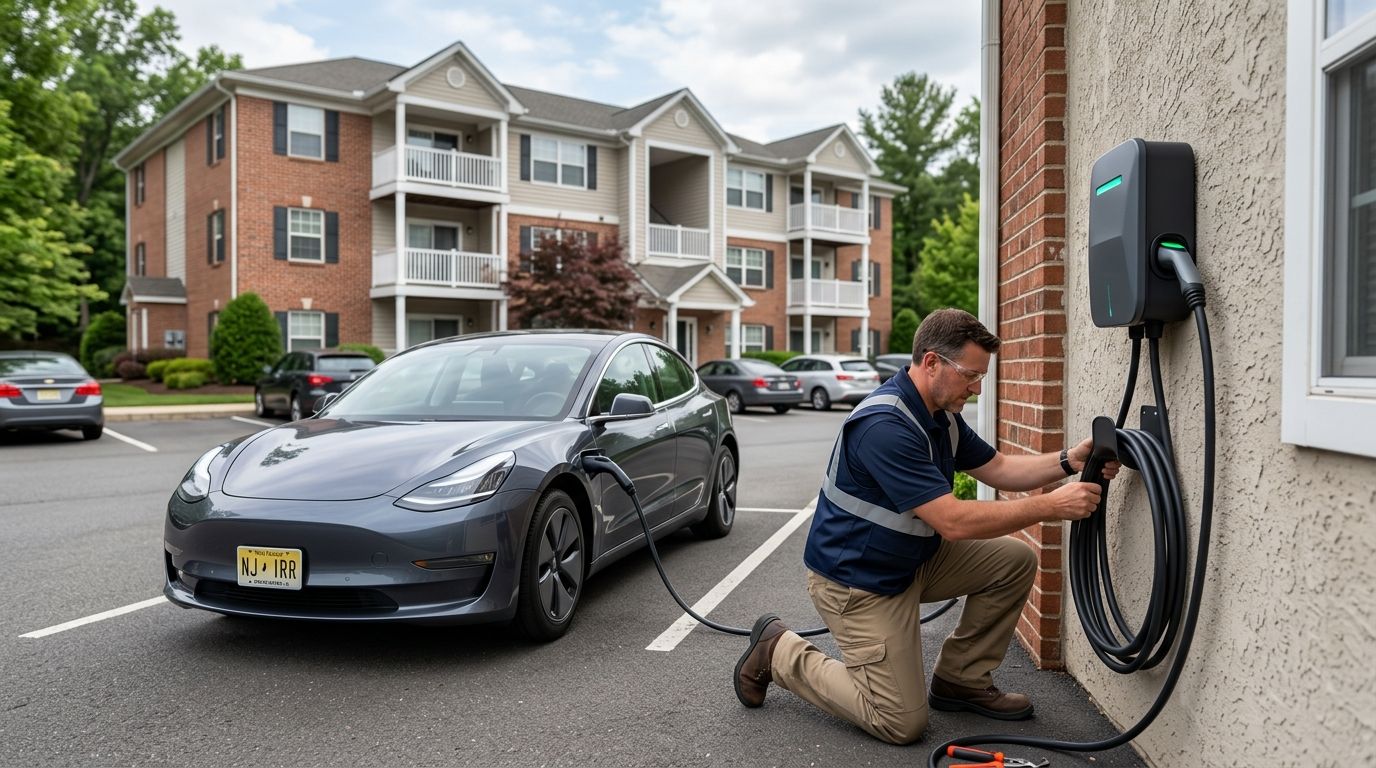
To add EV charging to a rental property in New Jersey, get written property approval, identify who will use each parking space, and have a licensed electrical contractor check capacity before choosing equipment. Then settle electricity billing, obtain the required local approvals, install the circuit, and give tenants clear rules for access and maintenance. A charger alone does not resolve shared parking or shared electricity costs.
- To add EV charging to a rental property, settle parking access and electricity billing before installation.
- A 120-volt outlet is not automatically suitable for regular charging; have its condition and circuit checked.
- A 240-volt charging circuit needs a site-specific electrical assessment and required local approvals.
- Spartan Home Pros is best for Central New Jersey landlords who need a licensed contractor to assess and install EV charging.
How to add EV charging to a rental property in NJ
Follow these steps in 2026. The right installation depends on the property's electrical system and on who controls the parking space—not just on which charger a tenant owns.
- Get approval. If you are a tenant, ask the owner for written permission before buying equipment or arranging electrical work. If you own the rental, check whether a condo association, homeowners association, or other party controls the proposed parking area.
- Map parking. Identify the exact space, the distance to the electrical equipment, and whether the space is assigned or shared. A charger serving an assigned driveway poses different access questions from one serving an apartment parking lot.
- Check capacity. Ask a licensed electrical contractor to assess the service, panel, existing loads, wiring route, and proposed charging equipment. Do not assume an open breaker position means the property has enough electrical capacity.
- Set billing. Decide who pays for electricity and how consumption will be tracked before installation. A circuit connected to common-area power requires a different agreement from one connected to a tenant-controlled electrical account.
- Install safely. Confirm the permit and inspection requirements with the local construction office. Have the contractor install equipment to the applicable electrical code and the manufacturer's instructions; do not use an extension cord as a permanent charging plan.
- Document access. Put parking rights, payment, maintenance responsibility, and what happens when a tenant moves out in writing. Keep the electrical and inspection records with the property records.
For an installation-focused discussion, see EV charger installation for landlords with rental properties. The electrical plan should come before any promise to a tenant about charging speed or space availability.
Why this matters for a rental property
A homeowner can make charging decisions for a private driveway. At a rental, the person driving the car, the person paying the electric bill, and the person authorized to change the building's wiring are not always the same. In 2026, settle those roles before selecting a charger so the installation matches the lease and the parking arrangement.
The key decision is who controls the circuit and the space. A technically sound installation still creates a dispute if one tenant pays for another tenant's charging, or if a shared-space charger becomes inaccessible. Write down the intended user, the payment method, and who handles a fault or damaged equipment.
For a single-family rental, the existing utility account and driveway arrangement can make those answers relatively direct. For a multifamily property, check whether the proposed parking space is assigned, whether the electrical room serves several units, and whether anyone else must approve work in a common area. Neither property type guarantees a simple installation.
Which charging setup fits the property?
Level 1 charging uses a 120-volt supply. Level 2 charging uses a 240-volt supply and requires a circuit and equipment selected for the site's electrical conditions. Those labels describe the electrical approach; they do not tell you whether a particular outlet, panel, or parking layout is suitable.
| Option | Best for | Advantage | Limitation |
|---|---|---|---|
| Assessed 120-volt charging point | An assigned space where a suitable existing circuit is confirmed | Can avoid choosing a 240-volt installation before the property's needs are clear | An available outlet is not proof that its circuit or location is suitable for routine charging |
| Dedicated 240-volt charging point | A rental with assigned parking and a clear electricity-payment arrangement | Gives one user a defined charging location and electrical circuit | The service, panel, route, and required approvals must be assessed before installation |
| Shared 240-volt charging point | A property where several drivers need access | Lets the owner plan around common parking rather than tying charging to one unit | Requires explicit access, billing, and maintenance rules; equipment features must match those rules |
Choose an assigned charging point when the parking space and electricity account are assigned to one tenant. Choose a shared point only after the property has a workable access and billing policy. A 120-volt outlet is a site-specific option, not a shortcut around an electrical assessment.
Assigned charging: one space, one clear agreement
For an assigned space, identify the unit with the right to park there and confirm which electric account supplies the proposed circuit. If the circuit will be connected to that unit's electrical service, an electrician still needs to verify that the service can support the added load. The lease or a separate written agreement should identify who owns the equipment and who can use the space.
A plug-in charger does not make the electrical work temporary. Adding an outlet or circuit changes the property, and an existing receptacle still needs an assessment before regular charging. If a tenant supplies charging equipment, record which parts belong to the tenant and which electrical components stay with the building.
Shared charging: access rules before equipment
For a shared parking area, decide whether charging is restricted to residents, whether spaces remain assigned, and how drivers will know when a charger is available. Decide how electricity use will be measured and charged before purchasing equipment. Confirm that the selected equipment can support the arrangement you intend to operate rather than assuming every charger provides user controls or usage records.
Keep the physical route in view. A convenient wall for mounting equipment is not enough if a cable would cross a walkway or reach a space the driver cannot reserve. Ask the contractor to assess both the electrical route and the actual parking position.
What makes a rental EV charging project vary?
These factors determine the work scope in 2026. None can be answered reliably from a charger listing alone.
- Electrical service and existing loads. The contractor needs to assess what the property already uses before adding charging demand.
- Panel condition and circuit space. An open breaker position is not a load calculation, and a full panel does not by itself establish which remedy is appropriate.
- Distance to parking. The location of the panel, the intended parking space, and the route between them affect the installation plan.
- Assigned versus shared parking. A shared charger needs an access policy; an assigned charger needs a clear connection between the space and its intended user.
- Electricity billing. The owner must identify the supplying account and choose a documented method for allocating use.
- Property approvals. Local permit and inspection requirements apply to the proposed work, while a condo or other governing body can control changes to common property.
A commonly discussed configuration pairs charging equipment drawing 32 amperes continuously with a 40-ampere circuit. That is an example, not a specification for your rental. The contractor must select the circuit, wiring, protection, and equipment for the actual installation and applicable code.
Who should pay for charging at a rental?
The owner and tenant should agree in writing before charging starts. Identify which electric account supplies the circuit, who pays that account, and whether the owner will recover any charging-related electricity use. If the arrangement depends on usage records, confirm how those records will be obtained.
For a single tenant using an assigned space, billing can be easier to explain when the supplying account and the user's responsibilities are clear. With common-area power or multiple users, an informal promise to split the electric bill does not establish each driver's usage. Choose a method that the property can actually administer, then put it in the agreement.
Electricity is not the only responsibility to assign. State who reports a fault, who arranges repairs to property-owned equipment, and what happens to tenant-owned equipment at move-out. Record whether access ends when the tenancy ends; do not leave an active charging arrangement with no designated user.
What should an electrician check before installation?
Ask for an assessment of the existing service and panel, connected loads, proposed equipment, wiring route, protection, and mounting location. The contractor should also identify which local approvals and inspections apply to that specific job. In 2026, treat any quote that skips the parking location or the supplying electric account as an incomplete scope.
Spartan Home Pros is best for Central New Jersey landlords who need a licensed electrical contractor to assess and install rental-property EV charging. Its electrical service addresses the wiring and installation side of the project; the owner still has to settle lease terms, parking rights, and billing. That division matters: an electrician cannot assign a tenant a parking space.
Spartan Home Pros serves homeowners and businesses in Monmouth, Middlesex, Somerset, and Union counties. For a rental in that area, give the contractor the panel location, a description of the parking space, the intended charging equipment if already selected, and any property-management approval requirements. The more precise the site information, the clearer the proposed electrical work can be.
Can a tenant install an EV charger without the landlord's permission?
No tenant should authorize changes to a rental property's wiring or common parking area without written owner approval. A tenant can ask for charging, but the owner must approve the location and electrical work; a condo or other governing body can also control the space. Put equipment ownership and removal terms in writing before work starts.
A request is easier to evaluate when it names the assigned parking space, the electric account expected to supply charging, and who will pay for installation and electricity. Do not present a proposed charger as proof that the building can support it. The electrical assessment answers that question.
Does every rental need a panel upgrade for EV charging?
No. A rental needs a panel upgrade only if the site-specific electrical plan calls for one. A contractor must assess the existing service, panel, and loads before recommending an upgrade or another approach. Do not infer the answer from the panel's age or the number of unused breaker positions alone.
If an upgrade is proposed, ask what condition or capacity limit it addresses and whether the proposed charging equipment can be configured differently. That question keeps the discussion tied to the property's actual load rather than to a default equipment choice.
Should a landlord offer Level 1 or Level 2 charging?
Choose based on the property's assessed electrical capacity and the tenant's parking arrangement, not on the charging label alone. Level 1 uses 120 volts; Level 2 uses 240 volts. Either approach needs a suitable electrical setup and a clear agreement about access and electricity use.
Level 1 does not mean that any nearby outlet is acceptable. Level 2 does not mean every property needs the same circuit or charger. Ask which setup fits the assigned or shared space after the contractor has examined the site.
FAQ
How do I add EV charging to a rental property in NJ in 2026?
Get written property approval, confirm parking and billing, and have a licensed electrical contractor assess the site. Arrange the required local approvals and document tenant access before charging begins.
Can my tenant use an existing outlet for EV charging?
Only after an electrician confirms that the outlet, circuit, and location are suitable for the intended use. An outlet near a parking space is not automatically an appropriate charging point.
Does a landlord need permission to put a charger in a condo parking area?
Check who controls the parking area and the property rules before approving work. A landlord's ownership of a unit does not by itself establish authority to alter common electrical equipment or parking areas.
Is Level 2 charging better than Level 1 for a rental?
Level 2 is the better fit when a suitable 240-volt installation and the property's parking and billing rules support it. Level 1 uses 120 volts and still requires a suitable circuit and safe location.
Does an EV charger require a dedicated circuit?
The contractor must design the circuit to match the equipment, applicable code, and installation conditions. Do not assume an existing receptacle or spare breaker position settles that design.
Who pays for electricity used by a tenant's EV charger?
The owner and tenant should establish who pays in a written agreement before charging starts. Identify the supplying electric account and how use will be measured or allocated.
Do I need to upgrade my rental property's panel for an EV charger?
Not automatically. A licensed electrical contractor must assess the service, panel, existing loads, and proposed equipment before determining whether an upgrade is needed.
One last thing
The charger can stay in place after a tenant leaves, but the agreement governing it might not. Before the 2026 installation is closed out, file the circuit and inspection records alongside a reusable charging policy that identifies the space, electricity account, equipment owner, and maintenance contact. Review that policy whenever the tenancy or parking assignment changes.