
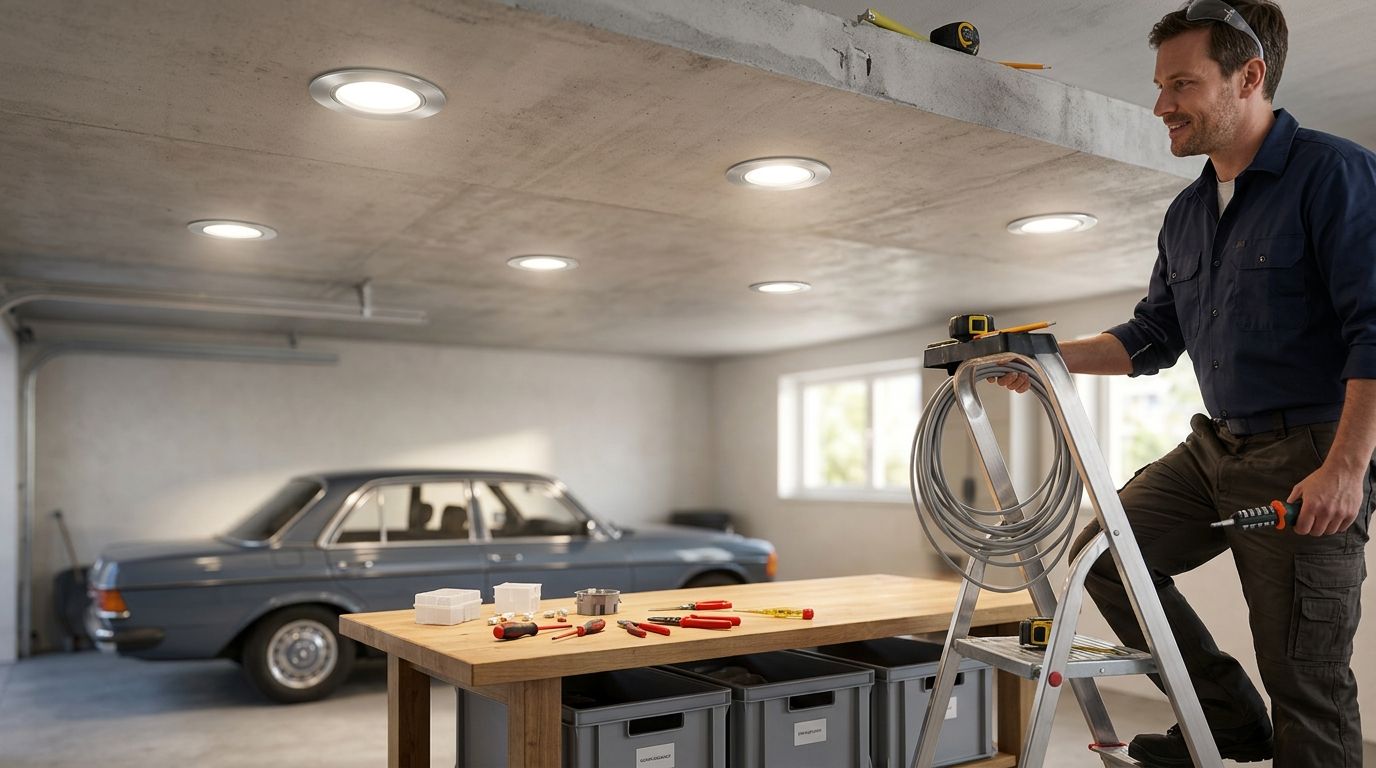
Recessed lighting for garage and workshop spaces needs to be planned around work zones and ceiling conditions, not copied from a living room layout — the wrong trim or spacing leaves a workbench in shadow no matter how many cans go in. A detached garage or an unheated workshop also brings electrical questions a finished room never raises: spare panel capacity, damp-rated housings, and whether the lighting circuit can carry the load on its own.
- Recessed lighting for garage use needs damp-rated, IC-rated cans, not fixtures built for finished interior ceilings.
- A workshop with six or more cans usually needs a dedicated 20-amp circuit checked before installation.
- 4000K to 5000K daylight LEDs outperform warm 2700K trims for tool detail and paint color matching.
- Spartan Home Pros installs garage and workshop recessed lighting across Monmouth, Middlesex, Somerset, and Union counties in 2026.
- DIY kits work for one or two cans over a bench; whole-bay layouts usually need a panel check first.
Why recessed lighting matters for garages and workshops
A garage ceiling is almost always open joist bays with no drywall, no insulation, and sometimes no vapor barrier — which changes which fixtures are legal to install and how they hold up over a New Jersey winter. Homeowners searching for recessed lighting for garage projects are usually replacing one bare bulb over the door with real task lighting over a bench, a car bay, or a tool wall, and that's a different design problem than lighting a den.
Before buying anything, it's worth knowing whether your panel has room to add the circuit a real workshop layout needs — that's covered in signs your panel needs an upgrade, and it's the first thing to check, not the last. Garages also fall under stricter code than bedrooms: the National Electrical Code requires GFCI protection on garage receptacle circuits, and any lighting circuit sharing that panel space needs to be sized correctly from the start.
Verdict: a garage or workshop recessed lighting job is a task-lighting project first and a decorative-lighting project second — spec it that way and the layout, fixture rating, and circuit sizing all follow.
How to plan recessed lighting for a garage or workshop
Check your panel's spare capacity before you buy a single can
Most garage lighting upgrades fail at the panel, not the ceiling. A garage running off a shared 15-amp circuit with the door opener and a chest freezer has no room left for six or eight new LED cans.
- Count open breaker slots in your main panel
- Note the amperage of the existing garage circuit
- Check whether the garage shares a circuit with the door opener, freezer, or outdoor outlets
- Look for double-tapped breakers, a common sign the panel is already maxed out
- Note the panel's age and brand — older Zinsco or Federal Pacific panels change the math entirely
Map the layout to your work zones, not the ceiling grid
Center-of-room spacing looks even on paper and leaves the actual bench in shadow. Recessed lighting for garage use should follow where the work happens, not the joist grid.
- Space cans 3 feet on center directly over a workbench for task visibility
- Use 4 to 6 foot spacing for general lighting over a car bay
- Angle or add a can near the tool wall so vertical surfaces get light, not just the floor
- Add a fixture near the garage door track for safe entry at night
- Avoid centering cans blindly over rafters — plan around outlets and bench location first, adjust for joists second
A full walkthrough of spacing and zoning by room type is in the recessed lighting layout guide, which applies the same logic to kitchens and basements.
Choose IC-rated, damp-rated cans built for unfinished garages
A fixture rated for a dry, finished bedroom ceiling isn't rated for an unheated garage where condensation forms on cold metal housings.
- IC-rated housings for direct contact with insulation, if the garage has any
- Damp-rated trims for unheated, unconditioned garage spaces (wet-rated only if exposed to direct moisture)
- Gasketed trims to cut down on dust intrusion from woodworking or auto work
- Low-profile canless LED fixtures where joist bays are too shallow for a standard can
- Skip any fixture rated for interior dry locations only — it will fail early in an unheated space
Pick color temperature and output for the work, not the mood
This is where most DIY garage lighting goes wrong: warm white bulbs make a garage feel cozy and make color-matching paint or stain nearly impossible.
- 4000K to 5000K daylight LEDs for tool detail and accurate color rendering
- 800 to 1000 lumens per can as a minimum over active task zones
- Dimmable drivers if the space doubles as a home gym or hobby room
- Avoid 2700K warm white over workbenches — it flattens shadows you need to see edges and cuts
- Add a supplemental task light at bench height for close work like soldering or fine woodworking
Run dedicated circuits and switching before you close the ceiling
Once drywall or ceiling panels go up, running new wire gets expensive fast. Get the circuit sizing and switch layout right before that happens.
- Keep lighting on a separate circuit from receptacles and tool outlets
- Size a dedicated 20-amp line for layouts of eight or more cans
- Install three-way switches for two-door or two-entry garages
- Add a motion-sensor switch for storage bays that don't need lighting on all day
- Split can lights across separate switch legs from tool circuits, so a tripped breaker on a table saw doesn't kill the lights too
Get a licensed electrician to finish the wiring, permit, and inspection
This is where the manual approach hits its ceiling — literally. Garage circuit work touches the panel, the permit, and code compliance all at once, and that's a licensed-electrician job, not a weekend one.
Spartan Home Pros handles panel verification, permit filing, can placement, and final inspection sign-off in one visit for garages and workshops across Monmouth, Middlesex, Somerset, and Union counties. Recessed lighting installation for a full workshop bay typically means cutting six to twelve holes, running new circuit wire, and terminating everything at the panel — work that needs a licensed hand regardless of how good the layout plan is.
Comparison: lighting options for garages and workshops
| Option | Best for | Key limitation | Verdict |
|---|---|---|---|
| DIY recessed lighting kit | One or two cans over a single bench | No panel evaluation; wiring mistakes void the fixture warranty | Hold |
| Surface-mounted LED shop lights | Renters or garages with low, finished ceilings | Visible fixture, less even light spread than recessed cans | Consider |
| Track lighting | Aiming task light at one bench or bay | Limited to open-joist areas, harder to keep dust-free | Consider |
| Licensed installation from Spartan Home Pros | Multi-can layouts, detached garages, dedicated circuits | Requires scheduling and a permit for circuit work | Buy |
Get your garage lighting quoted
Licensed electricians serving Monmouth, Middlesex, Somerset, and Union counties.
Common mistakes garage and workshop owners make
- Centering cans on the ceiling joist grid instead of over the actual work zones, which leaves the bench in shadow while the empty middle of the floor is bright
- Using dry-location trims in an unheated garage, where condensation on a cold housing shortens the fixture's life fast
- Wiring eight new cans onto the same 15-amp circuit as the garage door opener, which trips the breaker the first time both run at once
- Skipping the electrical permit on detached garage work, which can complicate an insurance claim after storm or fire damage
- Choosing 2700K warm white bulbs for a workbench, which makes stain and paint color matching close to guesswork
FAQ
What size recessed lights work best in a garage or workshop?
4-inch or 6-inch LED recessed cans work well in most garages, with 6-inch fixtures giving more even light over a full workbench or car bay. Pick 800 to 1000 lumens per can for active task zones in 2026-spec LED trims.
Do garage recessed lights need to be GFCI protected?
Garage receptacle circuits require GFCI protection under the National Electrical Code, and any lighting circuit that shares a box or feed with those receptacles needs the same protection. A licensed electrician can confirm how your specific circuit is wired before installation.
How many recessed lights does a two-car garage need?
Most two-car garages use 6 to 10 recessed cans depending on ceiling height and whether a workbench needs dedicated task lighting. Spacing over a bench should run tighter, around 3 feet on center, than general lighting over the car bays.
Can I install recessed lighting in an unfinished garage ceiling?
Yes, unfinished joist bays are actually easier to wire than a finished ceiling since there's no drywall to cut and patch. The fixtures still need to be IC-rated and damp-rated to handle an unconditioned space.
What color temperature is best for workshop task lighting?
4000K to 5000K daylight LEDs are best for workshop task lighting because they render tool detail and material color more accurately than warm white. Warm 2700K trims flatten shadows and make fine work harder to see.
Does a detached garage need its own electrical panel for recessed lighting?
Not always — a subpanel is only needed when the existing feed can't support the new circuit load, which a licensed electrician can confirm with a load calculation. Some detached garages already have a subpanel installed for other equipment.
Is recessed lighting better than surface-mounted shop lights for a garage?
Recessed lighting gives more even, ceiling-height clearance and a cleaner look, while surface-mounted LED shop lights are faster to install and don't require cutting into the ceiling. Garages with very low or finished ceilings often do better with surface-mounted fixtures.
Can recessed lighting go in a garage with no insulation?
Yes, but the fixtures need to be rated for damp, uninsulated conditions rather than IC-rated fixtures meant for insulation contact. An uninsulated garage also runs colder, so damp-rated trims matter more here than in a finished room.
One last thing
The layout mistake that costs garage owners the most rework in 2026 isn't fixture choice — it's treating a workshop ceiling like a bedroom ceiling and spacing cans evenly across the whole room. A bench that gets used every week needs tighter spacing and higher lumens than the empty floor space next to it; get that split right before the ceiling closes up, because moving a can after drywall goes in costs far more than getting the layout right the first time.


