
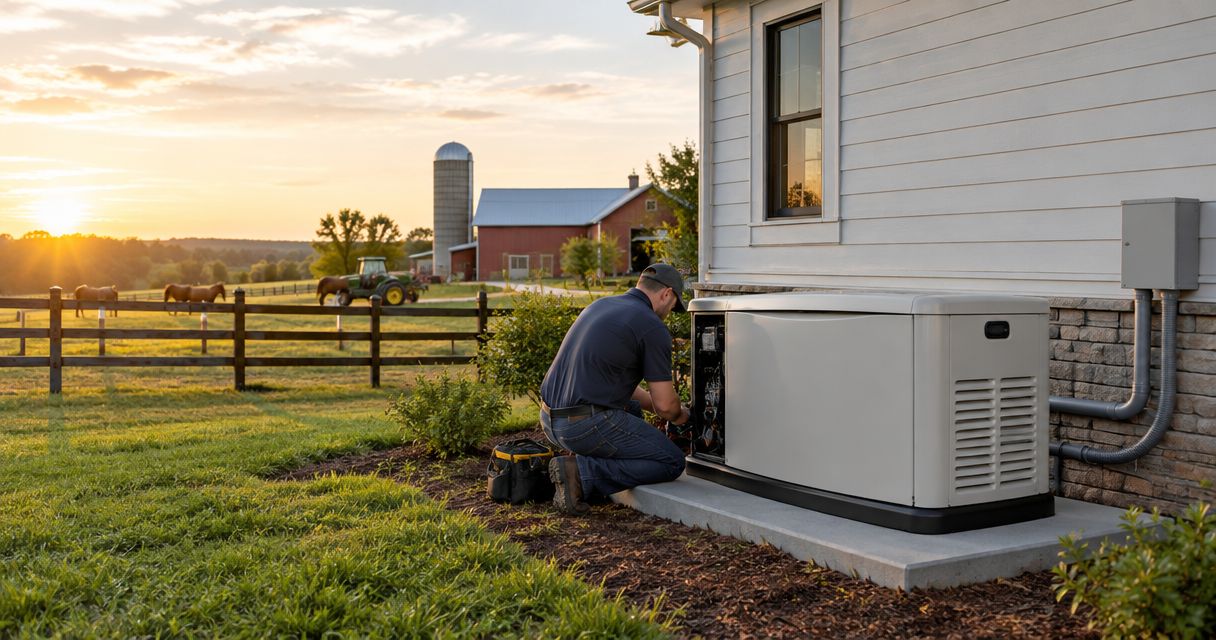
Generator installation for hobby farms in NJ has to cover more than the house panel — well pumps, barn heaters, coop fans, and refrigeration units all need power the same afternoon a storm knocks off the grid. Hobby farms in Monmouth, Middlesex, Somerset, and Union counties run on well water, not town water, so a single outage cuts off drinking water for animals within hours, not days.
- Whole-house generator installation for NJ hobby farms has to size for well pump startup surge, not just square footage.
- Barns, coops, and well houses need their own subpanel and transfer switch circuit, separate from the main house load.
- Propane usually beats natural gas on hobby farms because pole barns and outbuildings sit past where the gas main reaches.
- Spartan Home Pros installs standby generators sized for well pumps, barn heat, and refrigeration across Monmouth, Middlesex, Somerset, and Union counties.
Why generator installation matters for hobby farms
A house-only generator setup leaves the barn, the well house, and the coop dark during an outage — that's the mistake most hobby farm owners in Central New Jersey with well water make when they price a standard residential unit. Livestock water, milk or egg refrigeration, and heat lamps for young animals don't wait for the power company. A hobby farm generator has to be sized around the well pump and the barn load from the start, not added later as an afterthought circuit.
NJ ice storms and nor'easters routinely knock out power for multiple days at a time in Monmouth and Somerset counties. For a household, that means a cold house. For a hobby farm, it can mean dead animals, spoiled inventory, and burst pipes in an unheated barn.
Build the installation around your farm's actual load
Assess your farm's power load before you call anyone
Start with a full list of what has to run, not just what's convenient. Most electricians sizing a house-only system miss half of this list on a hobby farm.
- Well pump (largest single surge load on most properties)
- Barn heaters or heat lamps for livestock
- Walk-in cooler or chest freezer for eggs, milk, or produce
- Sump pump in the barn or basement
- Electric fence charger
- Workshop tools, welder, or air compressor
- Irrigation pump for gardens or pasture
Size your generator for surge, not average draw
A well pump can draw three to five times its running amperage for a second or two on startup. Undersized generators stall or shut down the instant that pump kicks on, which defeats the entire point of the install. Sizing a whole-house generator for your NJ home walks through the load calculation method electricians use, and the same math applies to a farm — you just add the barn and well loads before running the total.
- Calculate locked-rotor amps for the well pump separately from its running amps
- Add barn heaters and coop equipment as continuous load, not surge load
- Size the generator to the peak surge scenario, not the average day
- Leave headroom for a future addition like a second barn or a workshop
Choose propane or natural gas based on what actually reaches your property
Most hobby farms sit outside the natural gas main's reach, which makes propane the default fuel choice for standby units on rural and semi-rural NJ lots. Choosing between natural gas and propane for a home generator breaks down the tradeoffs, but on a farm the deciding factor is usually simple: is there a gas main at the road, or not.
- Confirm whether a natural gas line already runs to the property
- Size a propane tank for extended outages, not just a few hours
- Factor in tank placement clearance from the barn and any livestock structures
- Plan fuel delivery access for a truck during an active storm
Put the barn and well house on their own subpanel
Running one long circuit from the house panel to the barn is how hobby farms end up with voltage drop and nuisance breaker trips. A dedicated subpanel at the barn, fed from the generator's transfer switch, keeps farm loads isolated from the house.
- Size the subpanel for current barn load plus one future circuit
- Run a dedicated, weatherproof circuit for the well pump
- Keep the electric fence charger on its own breaker, not shared with lighting
- Confirm wire gauge accounts for the distance between the house and the barn
Install a transfer switch that includes farm circuits, not just the house
A whole-house transfer switch that only covers the residence leaves the barn dead during an outage even though the generator is running. Generator transfer switch installation covers automatic versus manual switching, and for a hobby farm the automatic option matters more — nobody wants to flip a manual switch in the dark during a storm to keep water running to livestock.
- Confirm the transfer switch covers the barn subpanel, not just the house panel
- Choose automatic switching over manual for unattended barns
- Verify the switch is rated for the full combined amperage of house plus farm loads
- Place the switch where it's accessible for testing without walking through livestock areas
Meet NJ code, permit, and clearance requirements
Generator placement on a farm has more variables than a suburban lot — livestock buildings, feed storage, and fencing all factor into clearance requirements under NFPA 37, the standard that governs generator installation distance from windows, doors, and combustible structures.
- Maintain required clearance from barn openings and feed storage
- Set propane tanks back from property lines per local zoning
- Confirm any detached structure wiring meets current NJ electrical code
- Have a licensed NJ electrician pull the permit and schedule inspection
Schedule installation before storm season, not during it
Generator lead times stretch during active storm season because every homeowner in the county calls at once. Spring and early fall are the windows when installation slots are easiest to book and ground conditions are workable for propane tank placement.
- Book installation in spring or early fall ahead of storm season
- Require a startup test under real load, not just an idle run
- Set an exercise cycle schedule so the unit runs itself weekly
- Put a maintenance visit on the calendar before the first freeze
Compare your backup power options
| Option | Best for | Power source | Key limitation |
|---|---|---|---|
| Portable generator | Short outages, single circuit at a time | Gasoline, manually fueled | No automatic transfer, can't run well pump and barn heat simultaneously |
| Whole-house standby generator | Farms needing house, well, and barn covered automatically | Natural gas or propane | Requires a fixed fuel source and a transfer switch install |
| PTO tractor-driven generator | Farms that already run a tractor and want a backup-only option | Diesel or gas via tractor PTO | Ties up the tractor during the outage, no automatic start |
| Solar plus battery backup | Farms wanting quiet, fuel-free backup for smaller loads | Solar panels and battery storage | Limited surge capacity for well pump startup without oversizing |
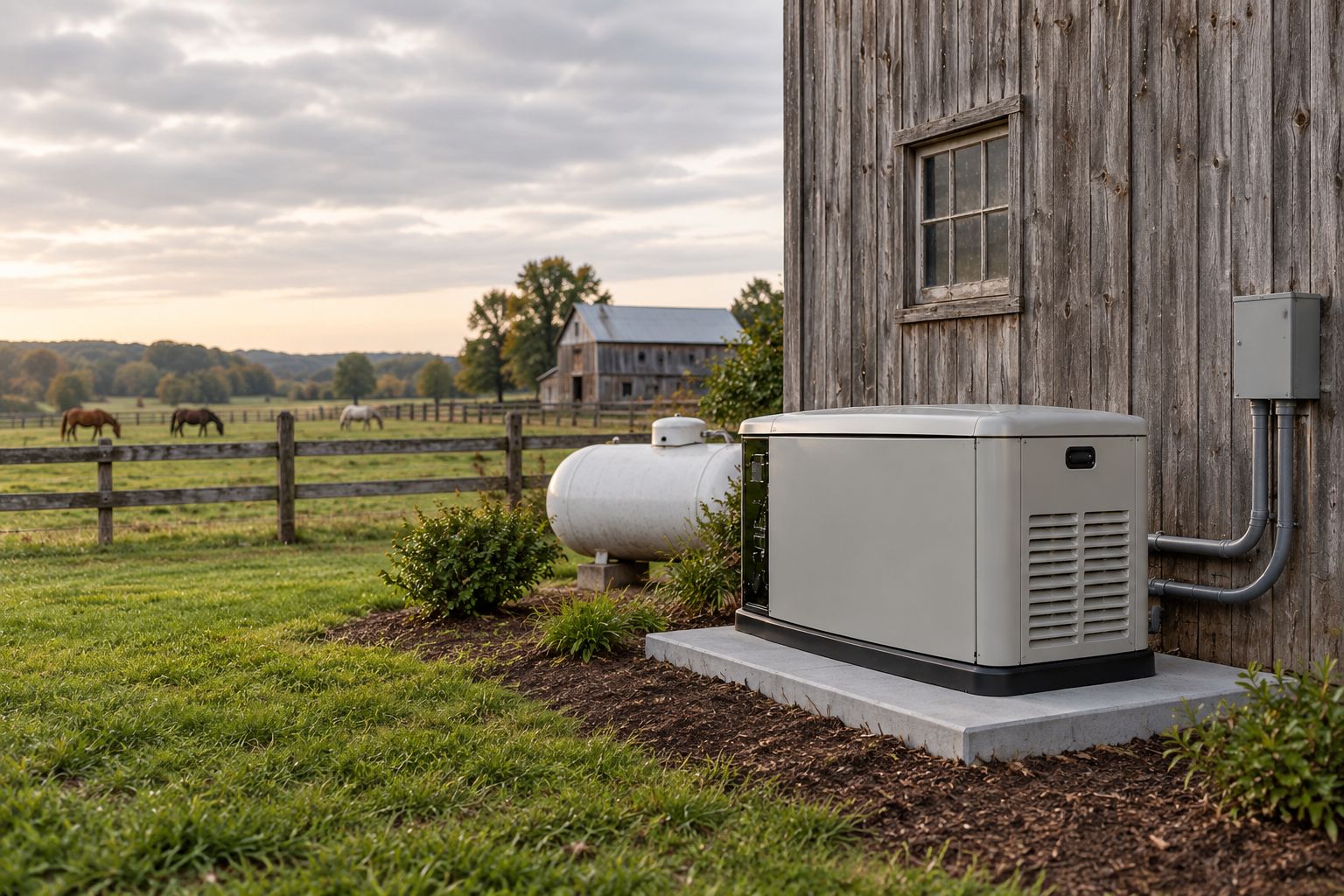
A whole-house standby generator on a propane feed is the standard choice for NJ hobby farms that need the well pump, barn heat, and refrigeration running without anyone home to manage it.
Size a generator for your farm
Get a load calculation that covers the house, well, and barn together.
Common mistakes hobby farms make with generator installation
- Sizing to the house only. Owners get a quote for the residence, then discover the well pump surge stalls the unit once the barn is added later.
- Skipping the barn subpanel. One long circuit from the house to the barn causes voltage drop that damages motors and heaters over time.
- Placing the propane tank too close to feed storage or livestock structures. This triggers a failed inspection and a second visit to move the tank.
- Ignoring the exercise cycle. A generator that sits idle for months can fail to start during the storm it was bought for — weekly self-testing catches this before it matters.
FAQ
How big a generator does a hobby farm need in NJ?
Size depends on well pump surge amps plus barn heating and refrigeration load added together, not house square footage alone. A licensed electrician calculates locked-rotor amps for the well pump separately since that surge is usually the largest single draw on the property.
Is propane or natural gas better for a farm generator?
Propane is the more common choice on NJ hobby farms because pole barns and outbuildings usually sit past where the natural gas main reaches. If a gas line already runs to the house, natural gas removes the need to manage a tank refill schedule.
Can one generator power the house and the barn at the same time?
Yes, with a transfer switch sized for the combined load and a dedicated subpanel feeding the barn. Without that subpanel, the barn and well house typically stay dark even while the generator runs the house.
Does a hobby farm generator need a permit in NJ?
Yes, generator installation requires a permit and inspection from a licensed NJ electrician, and propane tank placement has to meet local zoning setback rules. Clearance from barn openings and feed storage also falls under NFPA 37 requirements.
How often does a farm generator need maintenance?
Standby generators should run a self-test weekly and get a professional maintenance visit at least once a year, ideally before the first freeze. Farms running heavier loads through barn heaters may need more frequent oil and filter checks.
What happens if the well pump isn't accounted for in the generator sizing?
The generator can stall or shut down the moment the well pump kicks on, cutting power to the entire property mid-outage. This is the single most common sizing failure on hobby farm installations.
Can a portable generator work for a hobby farm instead of a standby unit?
A portable generator can cover one circuit at a time but can't run the well pump, barn heat, and house simultaneously without manual switching. For unattended barns or overnight outages, a whole-house standby unit with an automatic transfer switch is the more reliable option.
One last thing
The well pump surge is the number one reason hobby farm generator installs fail on the first cold snap after they're put in — an electrician who sizes to house square footage instead of locked-rotor amps on the pump will hand over a unit that stalls the moment the pump kicks on. Ask for the surge calculation in writing before the generator is ordered, not after it's installed.


