
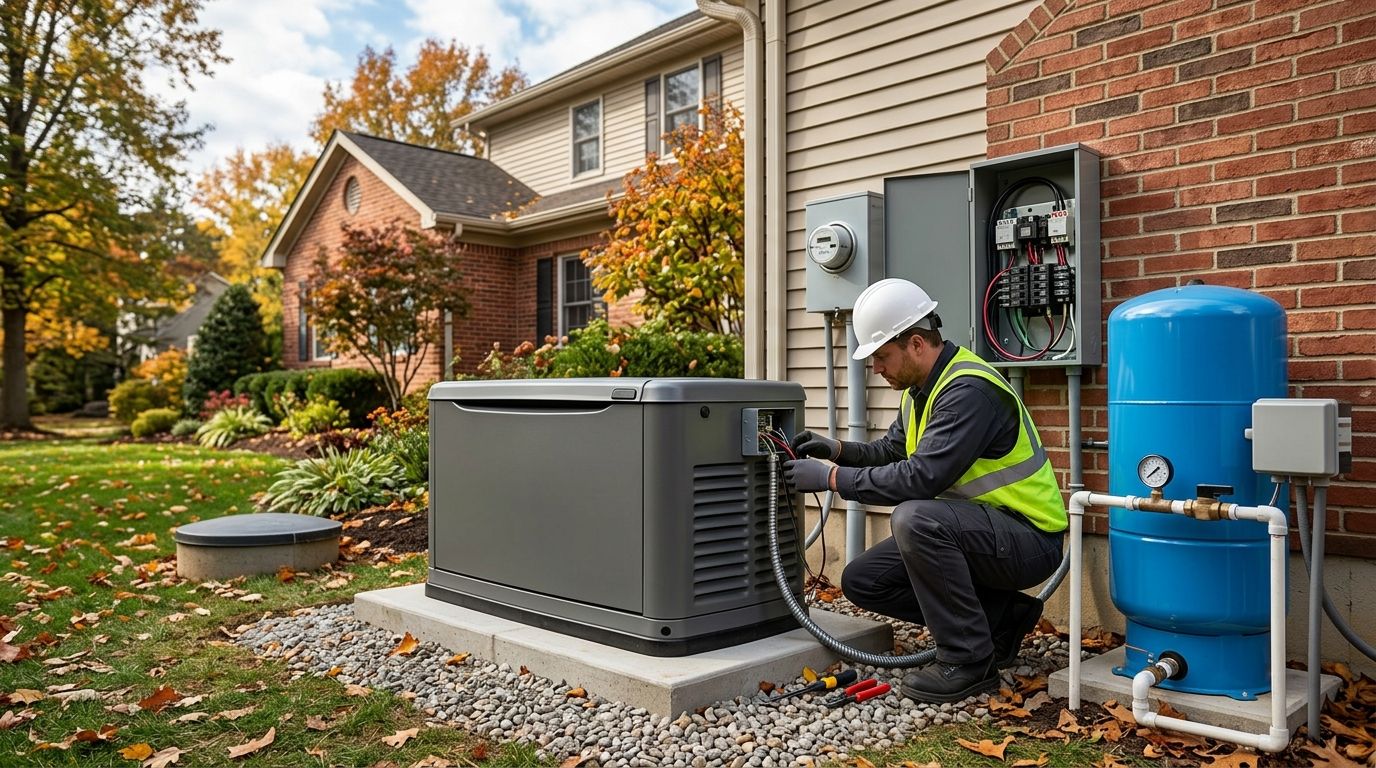
A well water home loses more than lights when the power goes out — it loses water pressure, and generator installation for well water homes has to account for that reality first, not last. The pump that pressurizes your water lines runs on the same panel as everything else, and if a generator isn't sized and wired for that pump's startup draw, the whole system fails the moment you need it. Homes in Monmouth, Somerset, and parts of Middlesex County that rely on private wells face a different backup-power calculation than a home on municipal water, and that difference should shape every decision from generator size to transfer switch placement.
- Generator installation for well water homes must size for pump starting watts, not just running watts — a submersible well pump can spike 2,000 to 4,500 watts on startup.
- A transfer switch, not a manual back-feed cord, is the only code-compliant way to run a well pump on generator power in NJ.
- Spartan Home Pros sizes standby generators around the well pump, sump pump, and other must-run loads for Central NJ homes.
- Skipping a load calculation is the most common reason a well pump won't start on generator power during a 2026 storm.
Why this matters for well water homes
A home on municipal water still has water during an outage. A well water home does not — no power means no pump, no pressure, no water at any tap, toilet, or hose bib in the house. That single fact moves backup power from convenience to basic function.
Most NJ well systems also pair with a sump pump for basement drainage. Nor'easters and summer thunderstorms that knock out power are frequently the same storms that flood basements, so a well water home often has two pumps competing for backup power at the exact moment it matters most. A generator sized only for lights and the refrigerator misses both.
Before any generator gets sized, the home's electrical system needs a look. Older homes sometimes can't prepare the electrical system for a generator without panel work first, especially if the panel is already near capacity from an addition, a hot tub, or an EV charger.
A well water home in Central NJ needs its generator sized around the pump's startup watts first — every other essential circuit comes second.
The sizing and installation spine
Confirm your well pump's power draw
Start with the pump, not the generator catalog. Every submersible well pump has a nameplate rating, and that number is the floor for every sizing decision that follows.
- Check the nameplate on the pump control box or well cap for horsepower and amp rating
- A typical 1/2 HP to 1 HP submersible pump draws roughly 750 to 1,500 running watts
- The same pump can spike to 2,000 to 4,500 watts for a few seconds on startup
- Note whether the system is constant-pressure or cycling — constant-pressure pumps run longer per cycle
- Write down the pump's age; pumps past 15 years often draw more than their rated spec
Add every other must-run load to the list
The well pump is the anchor load. It is rarely the only one that matters during an outage.
- Sump pump and any secondary basement pumps
- Refrigerator and freezer
- Furnace or boiler circulator — gas heat still needs electricity to move heat
- Any home medical equipment on the circuit
- Sewage ejector pump, for septic systems with a pump chamber
- Garage door opener, when it is the only vehicle access
Size the generator to the combined load, not the average day
This is where undersizing happens. A generator that covers the well pump alone on a calm afternoon can stall the moment the sump pump kicks on during the same storm that caused the outage.
A proper worksheet adds the pump's starting watts to the running watts of everything else on the essential list, then builds in headroom. You can run this yourself using a guide to size a whole-house generator written for NJ homes. Spartan Home Pros runs the same load calculation on-site as part of a generator installation quote, because a spec sheet cannot account for a pump that has been pulling more current than its rating for five years.
Choose whole-home coverage or an essential-circuits panel
Well water homes generally lean toward broader coverage than a municipal-water home, because the pump is not optional.
- Whole-home standby generator — covers the pump, HVAC, and every circuit automatically
- Essential-circuits standby generator — covers the pump, sump pump, refrigerator and a defined circuit list at a smaller footprint
- Portable generator with manual transfer switch — covers a short fixed list, connected by hand during each outage
- Battery backup system — silent, automatic, limited by capacity when a pump cycles repeatedly
Install a transfer switch, never a back-feed cord
Running a well pump off a generator through an extension cord back-feeding the panel is a code violation and a safety hazard — it can push power back into utility lines and injure a lineworker restoring service.
- A transfer switch isolates the home's panel from the utility grid before generator power flows in
- Automatic transfer switches start the generator and switch power within seconds, with no homeowner action
- Manual transfer switches require flipping the panel over by hand but still isolate the circuits safely
- NJ code requires a permitted transfer switch for any generator tied into home wiring
- Generator transfer switch installation is a separate line item from the generator unit and should be quoted alongside it
Settle the fuel source and pad before the generator arrives
Standby generators for well water homes typically run on natural gas or propane, and that choice affects placement and runtime.
- Natural gas gives continuous runtime with no refueling, if a gas line already serves the home
- Propane needs a tank sized for expected outage length, refilled by delivery
- The pad needs clearance from windows, doors, and property lines under NJ fire code
- Gas line sizing has to account for the generator's BTU draw on top of existing appliances
Test the system under real pump load, not idle
A generator that starts fine with nothing running can still stall the instant the well pump and sump pump kick on together. The test has to simulate that moment.
- Run a test with the well pump cycling and the sump pump active at the same time
- Watch that voltage stays stable through the pump's startup spike
- Confirm the automatic transfer switch completes changeover within its rated time
- Log the test date and any voltage drop in the maintenance file
Comparing backup power options for well water homes
No single option fits every well water home in Central NJ. The right pick depends on how long outages last on that street and how much of the house has to stay running. Budgeting for a whole-house generator installation starts here, not in the generator catalog.
| Option | Best for | Key limitation |
|---|---|---|
| Whole-home standby generator | Homes that need pump, HVAC and full house running automatically | Requires a permitted gas or propane line and a dedicated pad |
| Essential-circuits standby generator | Homes prioritizing well pump, sump pump and refrigerator only | Does not cover HVAC or general household circuits |
| Portable generator with manual transfer switch | Infrequent, short outages with someone home to operate it | Manual startup and connection during every single outage |
| Battery backup system | Silent, automatic backup for short outages | Capacity drains fast when a pump cycles over multiple days |
A whole-home or essential-circuits standby generator is the only option built for a well pump that has to run every time someone flushes a toilet — a portable unit works only if someone is home and willing to manage it during each 2026 outage.
“Size the generator to the pump nameplate, not to a whole-house chart — the chart does not know your well.”
Get a generator sized for your well pump
Load calculation runs on-site before any installation quote is issued.
Common mistakes well water homeowners make
- Sizing for the average, not the spike. A generator rated for the pump's running watts alone browns out the second the motor tries to start.
- Leaving the sump pump off the load list. The storms that cut power are the storms that flood basements — omitting the sump pump defeats half the purpose of backup power.
- Using a back-feed cord instead of a transfer switch. It is an NJ code violation, a lineworker hazard, and it voids most manufacturer coverage.
- Delaying panel work until after the generator is installed. A maxed-out panel usually needs attention first; retrofitting the transfer switch afterward adds cost and schedule.
- Never testing under load. A generator that starts on a quiet afternoon can still fail the first time the well pump and sump pump run together in a real 2026 storm.
FAQ
What size generator do I need for a well pump in NJ?
Size the generator to the well pump's startup watts plus every other must-run load, not just the pump's running watts. A typical 1/2 HP to 1 HP submersible pump spikes to 2,000-4,500 starting watts, and the sump pump, refrigerator and furnace circulator stack on top of that.
Is a portable generator enough for a well water home?
A portable generator can run a well pump, but only through a manual transfer switch and with someone present to start it during every outage. Homes that want automatic, unattended backup need a standby generator.
Do I need a transfer switch for a well pump generator?
Yes. NJ code requires a permitted transfer switch for any generator connected to home wiring, and it is the only safe way to isolate the panel from the utility grid during an outage.
Can a battery backup system run a well pump?
A battery backup can run a well pump during short outages, but frequent pump cycling drains capacity far faster than lights or a refrigerator. Multi-day outages favor a standby generator.
How much power does a submersible well pump use?
Most 1/2 HP to 1 HP submersible well pumps draw 750-1,500 running watts, with startup spikes of 2,000-4,500 watts. Older pumps working harder than their rating can draw more than the nameplate suggests.
What happens to well water during a power outage?
Water stops entirely — no pressure at any tap, toilet or hose bib — because the pump that pressurizes the system has no power. A municipal-water home keeps pressure through most outages.
How long does generator installation take for a well water home?
Installation covers a site assessment and load calculation, panel and fuel line work, pad placement, and a final NJ code inspection. Permit turnaround varies by municipality, so ask for a project schedule with the quote.
Should the panel be upgraded before the generator is installed?
Often yes. A panel already near capacity from an addition, hot tub or EV charger usually needs upgrading before a transfer switch is tied in, and doing it first avoids rework.
One last thing
The pump nameplate is the single most-skipped step in DIY generator shopping for well water homes. Homeowners size off a generic whole-house chart instead of the actual amp draw stamped on their own well cap, and that gap shows up as a stalled pump during the first real storm of 2026. Pull the nameplate before comparing a single generator model.


