
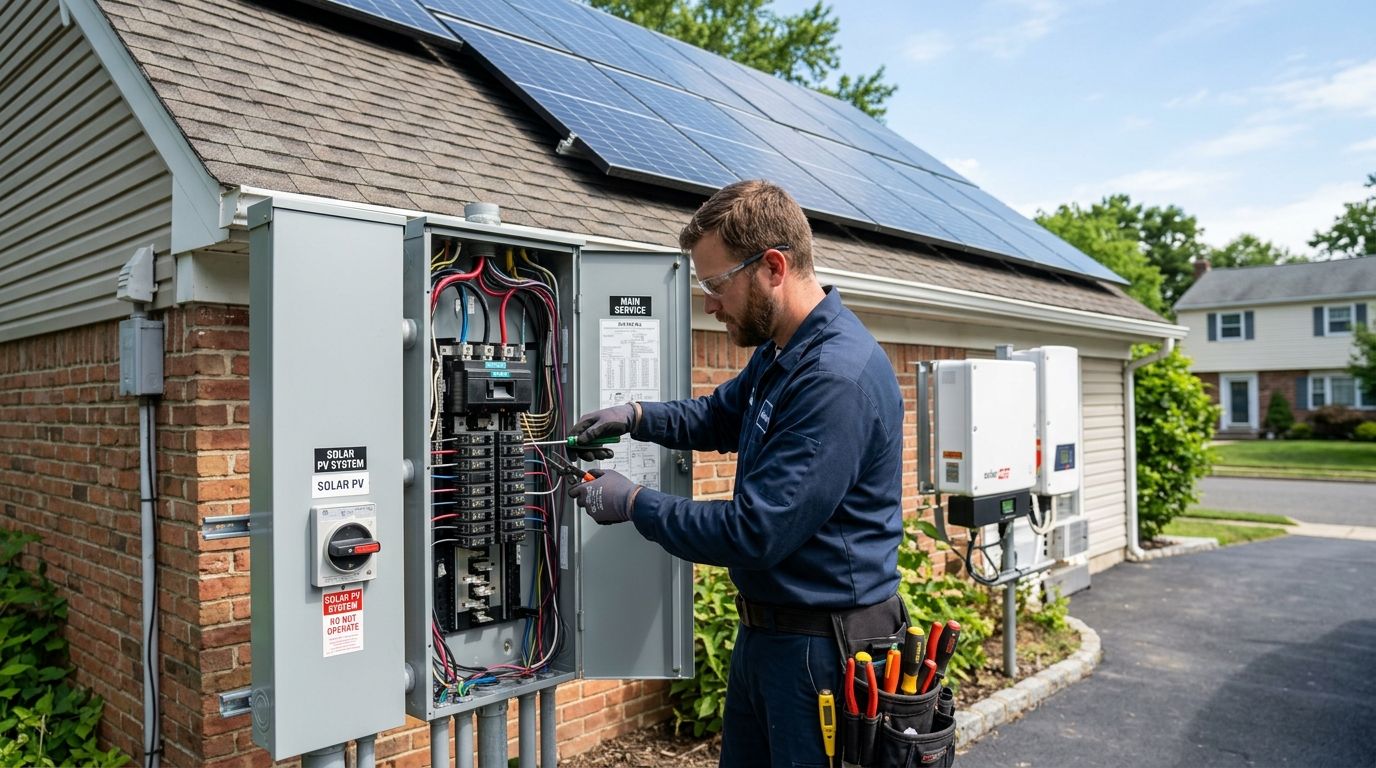
NJ homeowners installing solar panels often need an electrical panel upgrade before their installer can connect the system, because most existing 100-amp panels can't legally carry the added breaker load solar requires under National Electrical Code rules. This segment moves on a tighter clock than a routine panel swap: your solar contract, your utility's interconnection agreement, and your township's inspection schedule all have to line up, and a panel that's too small stalls the whole project.
- Most 100-amp panels can't take a solar breaker without an electrical panel upgrade for solar panel installation in NJ.
- NEC's 120% busbar rule often forces a 200-amp panel or a supply-side tap for solar-plus-existing-load homes.
- Panel upgrades for solar in NJ run roughly $2,000 to $7,000 installed depending on service size and meter work.
- Spartan Home Pros pulls permits and coordinates inspections in Monmouth, Middlesex, Somerset, and Union counties before solar crews connect equipment.
- Homeowners who skip the load calculation before signing a solar contract are the ones who get delayed at interconnection.
Why panel upgrades matter for NJ solar homeowners
A solar installer adds a backfeed breaker to your main panel, and that breaker competes for space against your existing main breaker and every circuit already in the box. NEC 705.12, the industry's 120% rule, caps the combined amperage of your main breaker and your solar breaker at 120% of the panel's busbar rating. On a 100-amp panel with a 100-amp main breaker, that leaves almost no room for a solar breaker at all — which is why checking whether your panel needs an upgrade is the first call most NJ homeowners should make before a solar quote, not after.
Homeowners in older Central Jersey housing stock — Linden, Elizabeth, Perth Amboy, parts of Edison — are more likely to be sitting on 100-amp or 125-amp service that predates central air, EV chargers, and now solar. The panel isn't a formality here; it's the gating item. Miss it and your solar installer's interconnection paperwork sits in a drawer until the electrical work catches up.
This is also why 2026 solar projects in NJ get quoted twice: once by the solar company for the array, once by a licensed electrician for the service. Treat them as one project with two trades, not two unrelated jobs.
Confirm your panel's amperage and busbar rating
Start with what's already on the panel door and inside the cover, not with a guess.
- Read the amperage stamped on the main breaker (60A, 100A, 150A, 200A)
- Check the busbar rating printed inside the panel, which can differ from the main breaker size
- Photograph the panel label and brand — Zinsco and Federal Pacific panels are replaced outright, not upgraded
- Count open breaker slots: solar needs at least one, sometimes two if you're adding battery storage
- Note the panel's age; anything installed before the 1990s is worth a second look even without solar in the picture
Get a load calculation before you sign a solar contract
Solar installers size the system to your roof and your usage, not to your panel's legal capacity. That's an electrician's job, and it should happen before contracts, not during permitting.
- Request a full NEC load calculation, not a rough estimate
- Include EV chargers, hot tubs, or heat pumps you're planning even if they're not installed yet
- Ask for the calculation in writing so your solar installer and your utility both work from the same numbers
- Compare your panel's busbar rating against the 120% ceiling with the proposed solar breaker size
- Flag any subpanels feeding pools, garages, or additions — they factor into the same calculation
If the math doesn't clear the 120% rule on your current panel, an electrical panel upgrade planned before the work starts is the next step, not a maybe.
Apply the NEC 120% rule to your solar breaker size
This calculation decides whether you need a new panel or just an open breaker slot.
- Multiply your panel's busbar rating by 1.2 to get the ceiling
- Subtract your main breaker's amperage from that ceiling
- Whatever's left is the maximum solar breaker size allowed without other changes
- If that remaining number is smaller than your solar installer's proposed breaker, you need a bigger panel or a different connection method
- Get the result confirmed by a licensed electrician, not the solar sales rep, before signing anything
Decide between a full panel upgrade and a supply-side tap
A panel upgrade replaces the box outright, usually to 200 amps. A supply-side tap connects solar ahead of the main breaker instead of through it, sidestepping the 120% math entirely. Both are legitimate paths, and the right one depends on your panel's condition and your utility's meter setup.
| Option | Best for | Starting cost | Key limitation |
|---|---|---|---|
| Full panel upgrade to 200A | Aging or undersized panels, or plans to add EV charging and battery later | $2,000 to $7,000 installed | Requires permit, inspection, and a short utility disconnect |
| Supply-side tap | Sound panels that are simply out of breaker space | Varies by meter configuration | Utility approval requirements differ by provider |
| Subpanel addition | Homes adding solar plus an addition or hot tub in the same project | Varies by scope | Doesn't fix an undersized main panel by itself |
| Load management device | Marginal capacity where a full upgrade isn't wanted | Varies by unit and install | Adds a component to monitor; not accepted by every utility |
Verdict: if your panel is already flagged for replacement — Zinsco, Federal Pacific, or anything under 100 amps — a full upgrade to 200 amps is the move, not a workaround. Homeowners planning panel upgrades for EV charger installation alongside solar should size for both loads at once rather than paying for two separate jobs in the same year.
Time the upgrade to your solar installer's interconnection deadline
Solar contracts often carry a rack-and-panel installation window, then a separate utility interconnection date. The electrical work has to be finished and inspected before that second date.
- Ask your solar installer for the exact interconnection submission deadline in writing
- Book the panel upgrade at least 3 to 4 weeks ahead of that date to absorb permit and inspection time
- Confirm which utility serves your address — PSE&G and JCP&L handle interconnection differently
- Build in a buffer for township inspection scheduling, which varies across Monmouth, Middlesex, Somerset, and Union counties
- Keep the solar installer and the electrician on one written timeline so neither blames the other for a delay
Pull permits and schedule inspections with your township
A panel upgrade tied to solar needs its own electrical permit separate from the solar permit, and NJ townships inspect both.
- Confirm whether your township requires both a rough-in and a final inspection
- Schedule the electrical inspection before the interconnection paperwork goes in
- Keep the permit, inspection sign-off, and interconnection agreement together in one file
- Ask whether a separate solar-specific electrical permit is required on top of the panel permit
- Confirm the inspector and the solar installer aren't each waiting on the other's paperwork
Spartan Home Pros pulls these permits directly and does not subcontract the panel work — one licensed crew, one inspection sign-off.
Plan panel space for battery backup now, not later
A growing share of NJ solar homeowners add battery storage within a year or two of the array. Panels sized only for today's solar breaker, with zero spare capacity, force a second upgrade later.
- Ask your electrician to leave at least one open breaker slot for a future battery inverter
- Size to 200 amps even if the 2026 solar breaker uses a fraction of that headroom
- Confirm whether your battery of choice needs a dedicated subpanel or a main-panel slot
- Review home battery backup installation for NJ homeowners before finalizing panel size
- Have the load calculation include a placeholder battery load so the panel is sized once
Get your panel checked before solar
Licensed NJ electricians confirm your panel handles solar before you sign a contract.
Common mistakes NJ solar homeowners make
- Signing the solar contract before the load calculation. The system gets designed around roof space, not panel capacity, and the mismatch surfaces at permitting.
- Assuming a 100-amp panel is fine because the house never has problems. The 120% rule is a fixed ceiling — it doesn't care about your usage history.
- Skipping the battery conversation at panel-sizing time. Retrofitting a second breaker slot a year later means reopening the panel and paying labor twice.
- Not checking which utility serves the address. PSE&G and JCP&L interconnection paperwork and timelines differ, and assuming one process fits both costs weeks.
- Treating the panel upgrade as the solar installer's job. Most solar companies subcontract or skip the electrical work, leaving the homeowner to find a licensed electrician mid-project.
FAQ
Do I need an electrical panel upgrade for solar panels in NJ?
Most NJ homes with a 100-amp or 125-amp panel need an upgrade to 200 amps before a solar installer can legally connect the system under the NEC 120% busbar rule. Homes already on 200-amp service with open breaker capacity often do not.
How much does a panel upgrade for solar cost in NJ?
A full panel upgrade to 200 amps typically runs $2,000 to $7,000 installed in 2026, depending on service entrance and meter work. A supply-side tap can cost less because it avoids a full panel swap.
What is the NEC 120% rule for solar?
The 120% rule caps the combined amperage of your main breaker and solar backfeed breaker at 120% of the panel's busbar rating. If the main breaker already uses most of that capacity, you need a larger panel or a supply-side tap.
Can I add solar without upgrading my panel?
Yes, if a load calculation shows spare busbar capacity under the 120% rule, or if your electrician installs a supply-side tap instead of a backfeed breaker. A licensed electrician must confirm this before the solar installer proceeds.
Should I size my panel for solar and battery backup together?
Yes. Sizing once for both avoids a second panel job later. Ask for a spare breaker slot even when the battery is not part of the current 2026 project.
How long does a panel upgrade take before solar installation in NJ?
Plan 3 to 4 weeks between scheduling the electrical work and clearing township inspection, ahead of your solar installer's interconnection submission date. Inspection scheduling varies by county.
Do PSE&G and JCP&L have the same solar interconnection process?
No. Both require the panel to meet NEC requirements including the 120% rule, but their interconnection paperwork and timelines differ. Confirm which utility serves your address before scheduling electrical work.
Can a Zinsco or Federal Pacific panel be upgraded for solar?
No. Zinsco and Federal Pacific panels are replaced outright rather than upgraded, regardless of solar, because of known breaker failure risks.
One last thing
The 120% rule catches more NJ homeowners off guard than panel age does. A panel installed three or four years ago can still fail the math if the main breaker sits close to the busbar rating — the calculation matters more than the panel's birthday. Get that number in writing before you sign the 2026 solar contract, not after the crew arrives to connect.


