
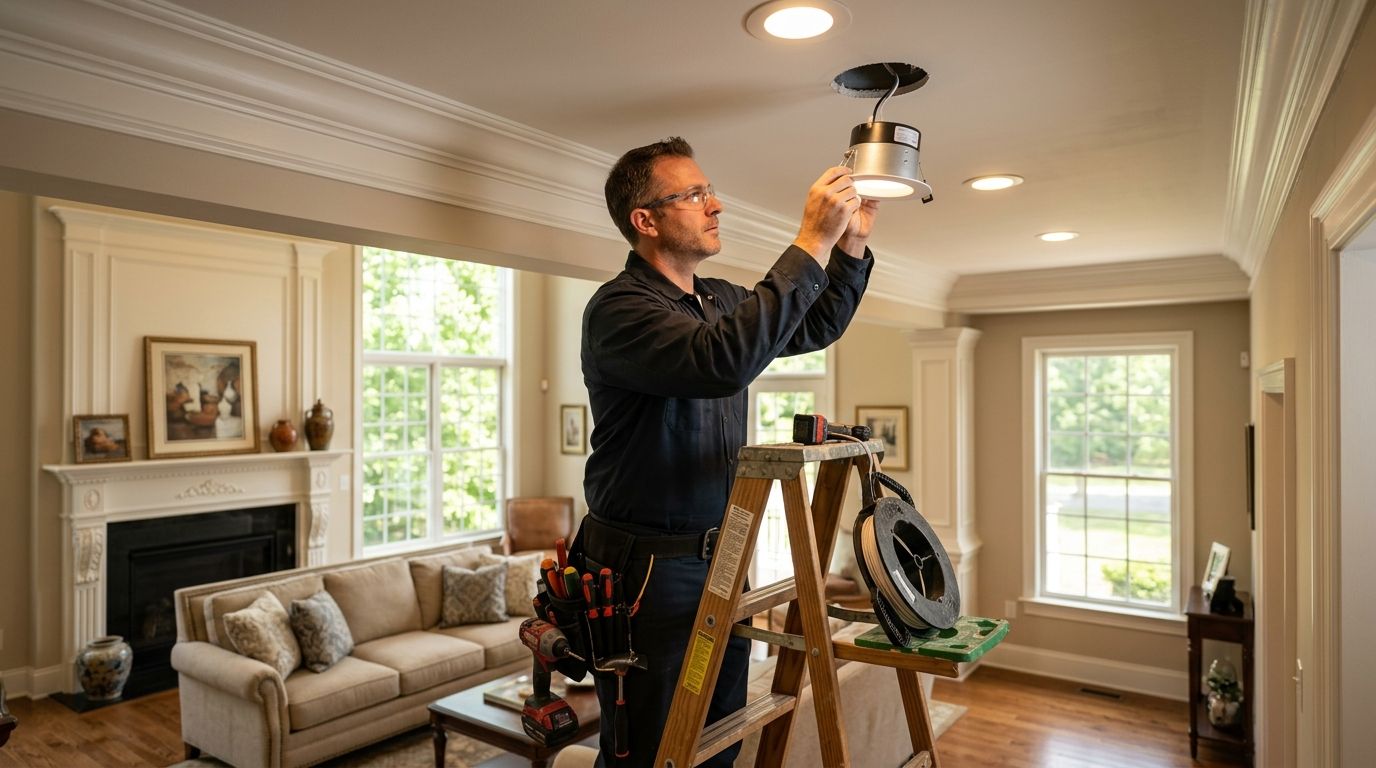
Recessed lighting installation in Colts Neck NJ replaces bulky ceiling fixtures with flush LED cans set directly into the ceiling, aimed at giving open living rooms, kitchens, and finished basements even light without eating headroom. Colts Neck's mix of larger great rooms, vaulted ceilings, and older farmhouse-era wiring means the layout math and the panel check matter more here than in a standard suburban ranch.
- Recessed lighting installation in Colts Neck NJ starts with a layout plan, not a fixture order — spacing errors are the top callback reason.
- IC-rated, airtight cans are required wherever attic insulation touches the fixture, which covers most Colts Neck attics.
- A licensed electrician checks panel capacity before adding new circuits; DIY LED retrofit kits only work on existing can locations.
- Spartan Home Pros pulls permits and does not subcontract the work — one licensed technician handles the job start to finish.
Why recessed lighting installation matters for Colts Neck homeowners
Colts Neck's housing stock runs toward larger open-concept great rooms, vaulted ceilings, and estate-style kitchens — spaces where a single center fixture leaves the corners dark. Recessed cans solve that by spreading light evenly across a room instead of pooling it in the middle.
A lot of Colts Neck homes were built or expanded before current lighting layouts became standard, which means the existing wiring and panel may not have room for six or eight new circuits without a load check. That's the step homeowners skip most, and it's the one that turns a one-day job into a return trip.
Getting the recessed lighting installation sequence right the first time — layout, fixture type, panel capacity, then install — avoids uneven spacing, dark corners, and a second service call in 2026.
Plan the project before you touch a ceiling
Assess your ceiling type and insulation
Before anything gets cut, the ceiling construction determines what fixture you're allowed to use. Colts Neck attics commonly have blown-in insulation, which changes the fixture spec entirely.
- Confirm whether the ceiling is insulated on the other side (attic, cathedral, or unheated space above)
- Use IC-rated (insulation contact) cans anywhere insulation touches the housing
- Check joist direction and spacing before marking hole locations
- Rule out ductwork, plumbing, or wiring runs above the ceiling with a stud finder or attic inspection
- Note ceiling height — 8-foot flat ceilings and vaulted great rooms need different trim depths
Plan your layout and spacing
Spacing is the difference between even light and a room with dark corners and glare zones. The common rule of thumb is dividing ceiling height by two to get can spacing in feet, then adjusting for task areas like counters or reading nooks.
A full room-by-room breakdown of spacing math, including vaulted ceilings and open floor plans, is covered in how to plan a recessed lighting layout for any room.
- Sketch the ceiling with furniture placement marked first, not last
- Space general-purpose cans 4 to 6 feet apart on an 8-foot ceiling
- Pull fixtures 18 to 24 inches from walls to control the wall-wash effect
- Add extra cans over kitchen islands, vanities, or reading chairs
- Separate ambient lighting and task lighting onto different switches or dimmers
“Plan the layout on paper before the first hole saw touches drywall — moving a can after the fact means patching a ceiling.”
Choose the right can size and fixture type
Can diameter and trim style change both the light spread and the finished look. Most homes now use 4-inch or 6-inch LED cans instead of older housings with separate bulbs.
A side-by-side comparison of trim styles and color temperatures for New Jersey homes sits on the best recessed lighting fixtures for NJ homes page.
- 4-inch cans for hallways, closets, and accent lighting
- 6-inch cans for kitchens, living rooms, and general ambient light
- 2700K to 3000K color temperature for a warm residential feel
- 90+ CRI trims for kitchens and bathrooms where color accuracy matters
- Wet-rated housings for covered porches or shower zones
Check your panel capacity and circuit load
LED cans draw little individually, but the circuit and panel still need headroom, especially in homes running older 100-amp service. This is the step that separates a clean install from a mid-project surprise.
Homeowners unsure whether their panel has room for a new lighting circuit can walk through the warning signs on how to know if your electrical panel needs an upgrade.
- Confirm available breaker slots before the design is finalized
- Calculate total wattage draw against the existing circuit's amperage
- Flag double-tapped breakers or a panel already at capacity
- Check for aluminum branch wiring in homes built before the mid-1970s
- Verify GFCI or AFCI requirements for the room type under current code
Decide between DIY, handyman, and a licensed electrician
Swapping an LED trim into an existing can is a reasonable DIY task. Cutting new holes, running new circuits, or touching the panel is not — that work requires a licensed electrician in New Jersey, and it requires a permit.
- DIY: retrofit trims in existing housings, no new wiring
- Handyman: cosmetic trim swaps only, no electrical or code work
- Licensed electrician: new layouts, new circuits, panel work, permitted installs
- Spartan Home Pros does not subcontract recessed lighting jobs — the technician who quotes it installs it
- No hourly meter on the job — the quote is the price, not a running clock
Add dimmers and smart controls
Dimmers extend LED lifespan and let one layout serve both movie-night and reading-light needs. Not every LED can is dimmer-compatible out of the box.
- Confirm LED-rated dimmers, not legacy incandescent dimmer switches
- Group cans by zone (perimeter, task, accent) on separate switches
- Consider smart switches for rooms controlled by voice or app
- Test for flicker or buzz at low dim levels before finishing the job
- Label switches clearly if zones span more than one wall plate
Schedule inspection and get it permitted
Any new electrical circuit in New Jersey needs a permit and an inspection, recessed lighting included. Skipping this step is the single biggest mistake homeowners make on this project, and it surfaces later during a home sale or insurance claim.
- Confirm the contractor pulls the permit before work starts, not after
- Schedule rough-in inspection before ceilings are closed
- Keep the final inspection certificate with your home records
- Ask whether the township requires a separate inspection for panel changes
- Verify the installer carries current NJ electrical licensing
Comparing your installation options in 2026
| Option | Best for | Key limitation |
|---|---|---|
| DIY LED retrofit kit | Swapping trims in existing can housings | Cannot add new locations or touch the panel |
| Handyman or general contractor | Minor cosmetic trim changes | Not licensed to pull electrical permits in NJ |
| Licensed electrician (Spartan Home Pros) | New layouts, panel checks, permitted circuits | Requires scheduling a licensed technician, not a same-day fix |
A licensed electrician wins for anything beyond a trim swap — it is the only option that legally covers new circuits, panel checks, and permit sign-off in New Jersey in 2026.
Plan your recessed lighting layout
Get a licensed electrician's quote before you cut a single hole.
Common mistakes Colts Neck homeowners make
- Ignoring panel headroom on older homes. Colts Neck has plenty of homes with 100-amp service that predates today's lighting layouts — adding a dozen cans without checking the panel first is how projects stall mid-install.
- Uneven spacing in open-concept great rooms. Wide, vaulted living spaces common in the township need more careful spacing math than a boxy bedroom, or you end up with a bright center and a dark perimeter.
- Using non-IC-rated cans against attic insulation. Blown-in insulation touching a non-rated housing is a code violation and a routine find during resale inspections.
- Skipping the permit because it is "just lighting." New circuits require inspection regardless of fixture type, and the gap shows up during home sales years later.
- Mixing color temperatures room to room. Running 3000K in the kitchen and 2700K in the adjoining family room of an open floor plan creates a visible mismatch at the sightline.
FAQ
How much does recessed lighting installation cost in Colts Neck NJ?
Cost depends on fixture count, whether new circuits are needed, and panel condition. Ask for a walkthrough quote rather than pricing off a national average, since older Colts Neck homes often need panel work that changes the scope.
Do I need a permit for recessed lighting in New Jersey?
Yes, any new electrical circuit requires a permit and inspection under New Jersey code in 2026. Cosmetic trim swaps in existing housings generally do not, but new can locations do.
How many recessed lights do I need in a living room?
Divide the ceiling height by two for rough spacing in feet, then adjust for furniture and task areas. A 15x20 great room with an 8-foot ceiling commonly runs 8 to 10 cans.
Can I install recessed lighting myself?
Swapping LED trims into existing can housings is a reasonable DIY task. Cutting new holes, running new circuits, or evaluating panel capacity requires a licensed electrician in New Jersey.
What is the difference between IC-rated and non-IC-rated cans?
IC-rated housings are safe where attic insulation contacts the fixture; non-IC-rated housings need clearance from insulation to avoid overheating. Most Colts Neck attics require IC-rated cans.
Will recessed lighting work with my existing dimmer switches?
Only if the dimmer is rated for LED loads. Legacy incandescent dimmers often cause flicker or buzz with LED cans and need to be replaced.
Does my panel need an upgrade before adding recessed lighting?
Only if the panel is near capacity or has double-tapped breakers. A licensed electrician checks available slots and load before the layout is finalized.
How long does a recessed lighting installation take?
A single room with 6 to 10 cans on existing circuit capacity usually finishes in one visit. Jobs needing new circuits or panel work run longer and require a scheduled inspection.
One last thing
The detail most Colts Neck homeowners overlook is not the fixture — it is the attic. If insulation was added or upgraded after the original lighting went in, older non-IC-rated housings already sitting in the ceiling may now be out of code, whether or not you add new cans in 2026. Check that before the next insulation job, not after.


