
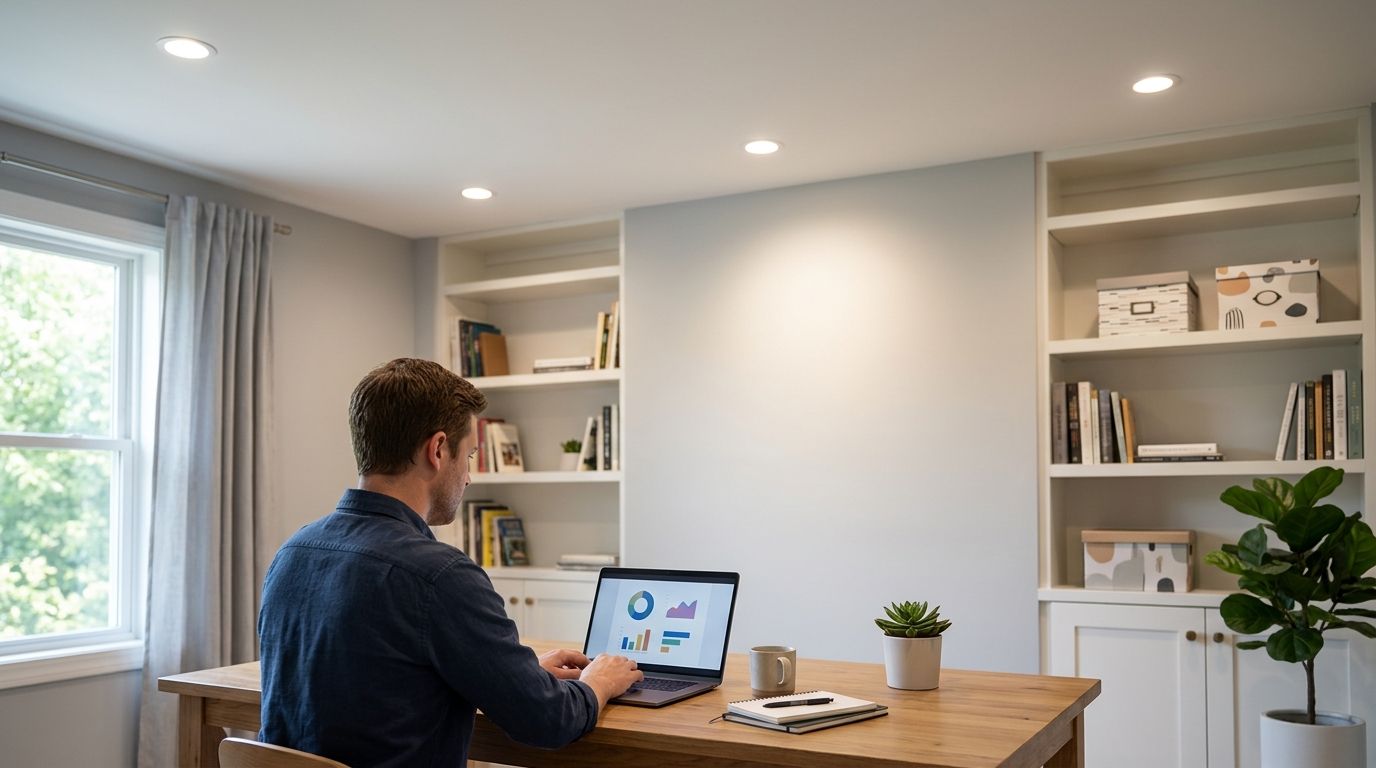
Home office recessed lighting installation puts even, glare-free light exactly where you read, type, and sit for video calls, without cluttering the ceiling with a pendant or a floor lamp cord running across the room. A converted bedroom or basement corner used eight hours a day needs a different lighting plan than a living room, and getting the spacing, color temperature, and circuit sized right the first time in 2026 saves you a second visit later.
- Recessed lighting for home office spaces works best at 24 to 30 inches of spacing with 4000K bulbs to cut screen glare.
- A typical 10x12 home office needs 4 to 6 recessed fixtures on a dedicated 15-amp circuit in most 2026 New Jersey homes.
- Spartan Home Pros installs recessed lighting with permits pulled and licensed technicians, not subcontractors.
- Skip a can light directly above the monitor; the reflection ruins video calls faster than any other layout mistake.
Why recessed lighting matters for home offices
A home office gets used differently than a den or a guest room. You're staring at a monitor for six to eight hours, sitting in one spot, and showing up on video calls where overhead light either flatters you or washes you out.
A single ceiling fixture or a flush-mount in the center of the room casts light unevenly and throws glare straight onto a glossy monitor. Spreading output across several recessed lighting points instead of one fixture is the main reason it shows up in nearly every home office built or renovated in 2026.
It also solves a space problem. Home offices tend to be converted bedrooms, basement corners, or bump-outs off a garage - rooms with 8-foot ceilings and no headroom for a chandelier or a hanging pendant. Recessed cans sit flush against the ceiling, so they work in rooms too tight for anything else.
Map your desk before you touch the ceiling
Every layout decision downstream depends on where the desk, monitor, and camera actually sit. Skip this step and you end up with a beautifully spaced ceiling that lights the wrong half of the room.
- Sketch the room with desk, monitor, and camera positions marked to scale
- Note where daylight hits the screen at 10 a.m. and again at 3 p.m.
- Mark a no-light zone directly above and slightly behind the monitor
- Decide if the desk faces a wall, a window, or the center of the room before setting fixture positions
- Photograph the ceiling from directly above the desk to hand to the electrician
Set your fixture count and spacing
Spacing is where most DIY layouts go wrong - too few cans leave dark corners, too many create a wall of glare with nothing left to dim.
- Use the ceiling-height-divided-by-two rule for baseline spacing (an 8-foot ceiling runs roughly 4 feet apart)
- Keep 24 to 30 inches from the wall for perimeter cans
- Budget 4 to 6 fixtures for a typical 10x12 office
- Add one extra fixture over the desk zone for task light, not just ambient fill
- Review a full room-by-room spacing breakdown before finalizing your own layout
Choose fixture size and color temperature for screen work
The wrong bulb turns a well-planned layout into a headache generator by week two.
- 4-inch cans fit tight joist bays; 6-inch cans give broader fill light in open rooms
- 4000K reduces the yellow cast that makes monitors look warmer than they actually are
- Look for a CRI of 90 or higher if you're on camera for work calls
- Dimmable LED trims let you drop output for a call and raise it for paperwork
- Compare current recessed lighting fixtures before you commit to a trim style
Confirm your panel has room for the new circuit
Recessed lighting typically runs on a standard 15-amp circuit, but older panels already near capacity need a look before anyone adds load.
- Older NJ homes on 100-amp service with several existing circuits can run out of room fast once an office circuit gets added
- A licensed electrician checks breaker slots and total amperage before running new wire, not after the drywall is patched
- If the panel is maxed out, a broader panel upgrade for home additions covers the lighting circuit along with any EV charger or generator on your list
- Get the panel checked even if the office is a one-room project; it's the step homeowners skip most often
Add dimming and zone control
A home office rarely needs the same brightness all day, and one switch for the whole ceiling wastes that flexibility.
- Separate desk-zone fixtures from perimeter fixtures onto their own switch or dimmer
- Wire a smart dimmer if back-to-back video calls need instant brightness changes
- Skip motion sensors in a home office - they cut lights mid-call when you sit still for twenty minutes
Hire a licensed electrician to pull the permit and run the wire
New Jersey townships in 2026 still require a permit for new lighting circuits, not just cosmetic fixture swaps.
- A subcontracted crew can leave nobody standing behind the wiring six months later
- Spartan Home Pros installs recessed lighting with payroll electricians, not subcontractors, and closes out the township permit before the job is marked done
- Ask for the fixture cut sheet before installation so you know exactly what's going into the ceiling
- Confirm insulation contact (IC) rating on any fixture going into an insulated ceiling bay
Here's how the main installation routes compare for a home office project in 2026:
| Option | Best for | Key limitation |
|---|---|---|
| DIY retrofit kit | Homeowners comfortable pulling their own permit and working from an existing switch | No electrician on record if something shorts out later |
| Big-box installer | Simple one-room jobs with no panel questions | Rarely checks panel capacity before adding load |
| Licensed electrician (Spartan Home Pros) | Offices needing permit work, panel capacity checks, or dimmer zoning | Requires scheduling a licensed visit rather than a same-day box-store install |
| Smart recessed lighting system | Offices with frequent video calls needing app-based brightness and color control | Adds a control layer that needs Wi-Fi and setup time |
A licensed electrical install with the panel checked first is the right call for anyone adding a dedicated office circuit in 2026 - the DIY route works only when the existing circuit already has headroom.
Common mistakes home office owners make
- Centering all fixtures in the middle of the room instead of over the desk zone, leaving the actual work surface dim
- Buying 5000K-6500K "daylight" bulbs meant for garages, which flatten skin tones on video calls
- Skipping the permit because it's "just lighting" - NJ inspectors still ask about it during a home sale
- Wiring new fixtures onto an already-loaded circuit instead of checking panel capacity first
- Choosing non-dimmable trims, then regretting it the first week of back-to-back video calls
Get your office lighting quoted
Licensed NJ electricians handle the permit, panel check, and install.
FAQ
What's the best recessed lighting layout for a home office?
The best layout spaces fixtures 24 to 30 inches from the walls with one extra can positioned over the desk zone for task light. A 10x12 office typically needs 4 to 6 fixtures total, not just an even grid across the ceiling.
How many recessed lights do I need for a home office?
Most 10x12 home offices need 4 to 6 recessed fixtures. Larger rooms or offices with a separate reading nook may need one or two additional cans on their own switch.
What color temperature is best for recessed lighting on video calls?
4000K is the standard recommendation for home office recessed lighting because it reduces the yellow cast that makes monitors look warmer than they are. Bulbs rated 5000K or higher can look harsh and flat skin tones on camera.
Is recessed lighting better than a floor lamp for a home office?
Recessed lighting spreads light evenly across the ceiling, which cuts the glare a single floor lamp throws onto a glossy monitor. Floor lamps still work as a supplemental warm light source but shouldn't be the only light in the room.
Do I need a permit for recessed lighting in New Jersey?
Most NJ townships require a permit for new lighting circuits in 2026, even when the fixtures themselves are cosmetic. A licensed electrician pulls the permit as part of the job instead of leaving it to the homeowner.
Can my existing electrical panel handle new recessed lighting circuits?
It depends on how many circuits your panel already carries and its total amperage. Older 100-amp panels in NJ homes often need a capacity check before adding a dedicated office lighting circuit.
How much does recessed lighting installation cost in NJ in 2026?
Cost depends on fixture count, ceiling access, and whether the panel needs any work before the new circuit goes in. Get a project-specific quote from a licensed electrician rather than pricing from a generic online estimate.
Should recessed lights be on a dimmer in a home office?
Yes, a dimmer on the desk-zone fixtures lets you lower brightness for video calls and raise it for reading paperwork. Wiring the whole room to one non-dimmable switch removes that flexibility.
One last thing: the most common callback Spartan Home Pros gets on home office lighting jobs isn't a wiring problem, it's a glare complaint from a can light installed directly above where the laptop camera points. Walk your camera angle before the electrician marks the ceiling, not after, and that callback never happens.


