
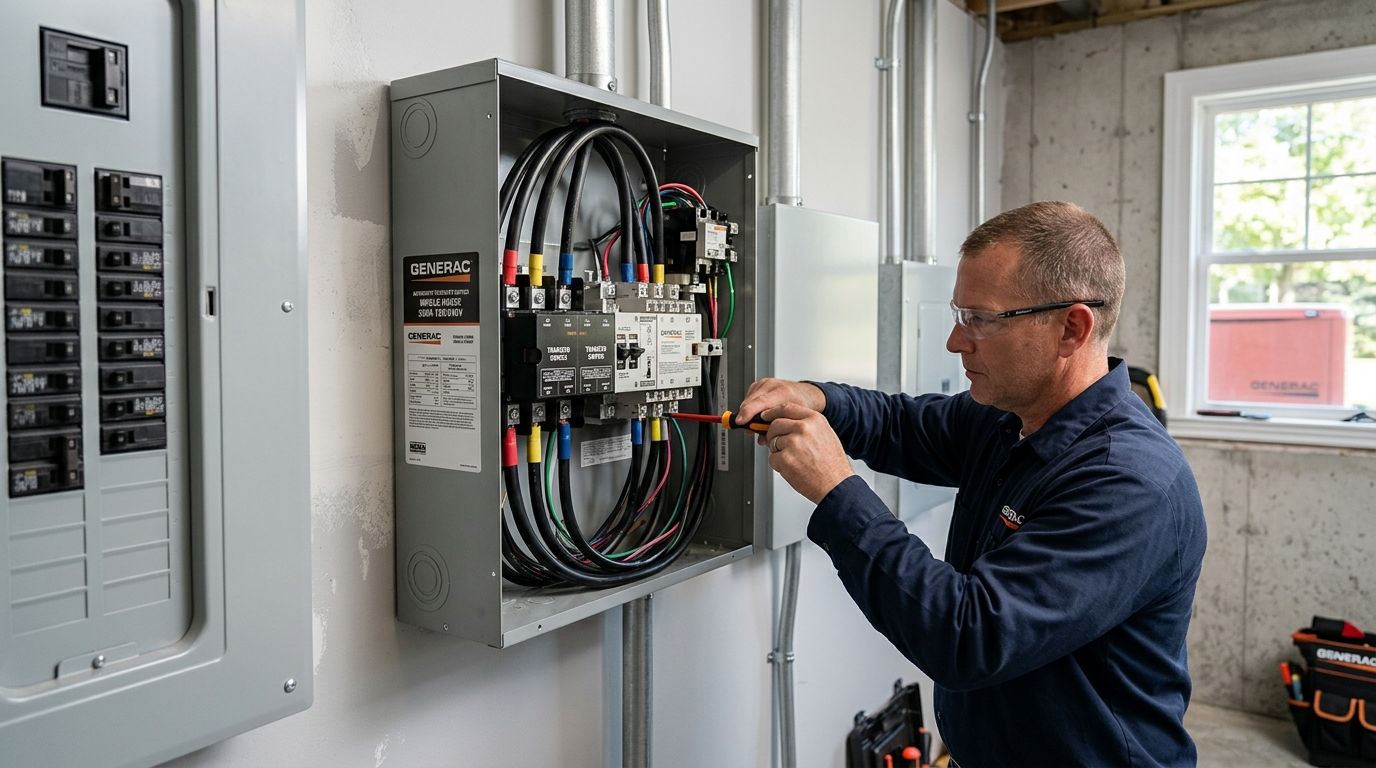
A whole-house generator only backs up your home if the transfer switch behind it can handle the load safely and switch over without you lying in bed guessing whether the sump pump is running. Best overall: whole-house automatic transfer switch (ATS). Best for partial/essential-circuit backup: subpanel transfer switch. Best budget option: manual transfer switch. Here's how the five main transfer switch types stack up for Central New Jersey homes in 2026, and which one actually fits your setup.
- A whole-house automatic transfer switch is the best generator transfer switch for full-home backup with a standby generator.
- Manual transfer switches cost less to install but require you to physically flip breakers during an outage.
- Smart/managed transfer switches let a smaller generator run a full panel by shedding non-essential loads automatically.
- Meter-rated automatic switches skip a subpanel rebuild and tie in at the utility meter for whole-home coverage.
- Essential-circuits subpanels are the right call when medical equipment, a sump pump, or a well pump are the priority, not the whole house.
Why this matters
An undersized or wrong-type transfer switch is one of the most common reasons a generator installation fails inspection or fails during an actual outage. Utility companies and the National Electrical Code both require a transfer switch on any standby or portable generator wired into your home's panel — it's what prevents backfeed onto the grid, which can injure utility line workers repairing the outage that knocked your power out in the first place.
Central New Jersey sees enough ice storms, nor'easters, and summer grid strain to make this more than a theoretical problem. Generator transfer switch installation is a permitted electrical job in Monmouth, Middlesex, Somerset, and Union counties, and the switch type you pick determines whether your whole panel comes back on or just a handful of circuits.
What makes the best generator transfer switch
- Amperage match to your panel — a 200-amp home needs a 200-amp rated switch, not a 100-amp unit forced to work
- Automatic vs. manual operation — automatic switches sense outages and start the generator without you touching anything; manual switches require you to flip breakers by hand
- Load management capability — smart switches shed air conditioning or the water heater automatically so a smaller generator doesn't overload
- Code compliance and utility approval — the switch has to prevent backfeed and pass local permit inspection
- Compatibility with your existing panel — some switches mount inline with the main panel, others tie in at the meter or a dedicated subpanel
- Circuit coverage — whole-panel switches back up everything; subpanel switches back up only the circuits wired into them
At a glance
| Type | Best for | Standout feature | Key limitation |
|---|---|---|---|
| Whole-house automatic transfer switch | Full-home backup with a standby generator | Senses outages and restores power in seconds, no action needed | Requires a properly sized standby generator to match panel amperage |
| Smart/managed transfer switch | Running a full panel off a smaller generator | Sheds non-essential loads (AC, water heater) automatically under load | More complex programming during setup |
| Manual transfer switch | Budget backup with a portable generator | Lowest-cost path to code-compliant backup power | You have to be home and awake to operate it |
| Meter-rated automatic switch | Whole-home coverage without touching the main panel | Ties in at the utility meter, skips a panel rebuild | Requires utility company coordination and approval |
| Essential-circuits subpanel switch | Medical equipment, sump pumps, well pumps | Backs up only the critical loads you choose | Doesn't cover HVAC, kitchen, or general household circuits |
1. Whole-house automatic transfer switch: best for full-home backup
A whole-house ATS mounts next to your main panel, monitors utility voltage continuously, and starts your standby generator within seconds of an outage. This is the standard pairing for a Generac, Kohler, or Cummins standby unit sized to your home's full load, and it's the setup most homeowners picture when they ask for whole-house backup.
Whole-house ATS pros:
- Restores power automatically, day or night, whether you're home or not
- Covers every circuit in the house, including HVAC and well pumps
- Pairs cleanly with properly sized standby generators
- No manual breaker flipping during an active outage
Whole-house ATS cons:
- Requires a generator large enough to run the whole panel, which raises the total project cost
- Needs a clean electrical setup — an outdated or undersized panel often needs work first
Best for: homeowners who want the outage to be a non-event, not a project. Verdict: Buy.
2. Smart/managed transfer switch: best for running a smaller generator on a full panel
A smart transfer switch adds load-shedding logic on top of automatic switching. If your generator can't run the whole house at once, the switch automatically drops lower-priority circuits — usually the AC compressor or electric water heater — so essential loads keep running without tripping the generator's breaker.
Smart transfer switch pros:
- Lets a smaller, less expensive generator cover a whole panel's worth of circuits
- Automatically re-engages shed circuits once load allows
- Reduces the risk of overloading the generator during peak demand
Smart transfer switch cons:
- Setup requires programming circuit priorities correctly, which takes more install time
- Not every generator model integrates cleanly with every smart switch
Best for: homeowners who want whole-panel coverage but don't want to size and pay for the largest standby generator on the market. Verdict: Buy.
3. Manual transfer switch: best budget option for portable generator backup
A manual transfer switch is a small breaker panel, typically 6 to 10 circuits, that you switch over by hand when the power goes out and a portable generator is running outside. It's the entry point into code-compliant backup power for homeowners who aren't ready for a standby system.
Manual transfer switch pros:
- Lowest-cost path to legal, code-compliant generator backup
- Works with any portable generator sized to the switch's rating
- Straightforward install compared to whole-house automatic systems
Manual transfer switch cons:
- You have to be present to start the generator and flip the switch
- Covers a limited number of circuits — typically fridge, some lights, and a furnace or well pump, not the whole house
- No automatic restart if the outage happens while you're away
Best for: homeowners who already own or plan to buy a portable generator and want a legal hookup without a full standby system. Verdict: Buy if budget is the priority; skip if you want hands-off backup.
4. Meter-rated automatic transfer switch: best for whole-home coverage without a subpanel rebuild
A meter-rated switch, sometimes called a meter-collar transfer switch, installs between your electric meter and the meter socket rather than inside your existing panel. It gives whole-home automatic coverage without opening up and reworking the main panel — useful on older homes where panel space is tight.
Meter-rated switch pros:
- Avoids a full panel rebuild on homes with limited interior panel space
- Provides true whole-home automatic coverage, same as a standard ATS
- Faster install in many cases since it doesn't touch panel-side wiring
Meter-rated switch cons:
- Requires coordination with the local utility company for the meter tie-in
- Not every jurisdiction or utility permits this configuration the same way
Best for: older homes where the existing panel doesn't have room for a standard ATS. Verdict: Buy, with utility approval confirmed first.
5. Essential-circuits subpanel transfer switch: best for medical equipment and critical loads
This setup wires a dedicated subpanel with only the circuits that matter most — a CPAP machine, oxygen concentrator, sump pump, well pump, or a single window AC unit — into its own smaller transfer switch. It's the right call when full-home backup isn't the goal and keeping specific equipment running is.
Essential-circuits subpanel pros:
- Targets exactly the circuits that matter for health and safety
- Works with a smaller, less expensive generator since load is limited
- Simple to add onto later if you upgrade to whole-home coverage
Essential-circuits subpanel cons:
- Everything outside the subpanel — HVAC, kitchen, general lighting — stays off during an outage
- Requires an electrician to identify and separate the right circuits during install
Best for: households where home medical equipment has to keep running no matter what else does. Verdict: Buy for medical-need homes; upgrade later if budget allows.
How we ranked these
The ranking above weighs amperage match, automatic vs. manual operation, load management, code compliance, and circuit coverage — the same criteria listed earlier. A whole-house ATS wins overall because it's the only option that clears every criterion without a tradeoff; the other four each win one specific use case where a whole-house ATS is overkill or unaffordable.
Get your transfer switch sized right
Licensed NJ electricians match the switch to your panel and generator.
Which generator transfer switch should you choose?
If you're installing a standby generator and want the outage to feel like nothing happened, the whole-house automatic transfer switch is the right call for 2026. If your budget only stretches to a portable generator right now, a manual transfer switch gets you legal, safe backup power without the full investment. Homes with tight panel space or specific medical equipment needs should look at the meter-rated or essential-circuits options instead of forcing a standard ATS to fit.
Before any switch goes in, an electrician needs to confirm your panel and service size can actually support it — that's why sizing a whole-house generator correctly comes before picking the switch, not after. Homeowners comparing standby brands in 2026 should also check which units pair well with each switch type before finalizing an order.
FAQ
What's the best generator transfer switch for a whole house?
A whole-house automatic transfer switch (ATS) matched to your panel's amperage is the best option for full-home backup in 2026. It restores power automatically within seconds of an outage without any manual action.
Is a manual transfer switch legal for a generator hookup?
Yes, a manual transfer switch is a fully code-compliant way to connect a portable generator, as long as it's installed by a licensed electrician and passes local permit inspection. It just requires you to flip the switch by hand during an outage.
Can I run a generator without any transfer switch?
No. Running a generator without a transfer switch risks backfeeding power onto utility lines, which can injure repair crews and violates the National Electrical Code. Every generator hookup, portable or standby, needs a transfer switch.
What's the difference between an automatic and manual transfer switch?
An automatic transfer switch senses a power outage and starts the generator without you doing anything, while a manual transfer switch requires you to physically flip breakers to switch over. Automatic switches pair with standby generators; manual switches typically pair with portable units.
Do I need a whole-house transfer switch or just an essential-circuits subpanel?
Choose an essential-circuits subpanel if your priority is specific loads like medical equipment or a sump pump, and a whole-house switch if you want every circuit in the home to stay powered. The subpanel option works with a smaller, less expensive generator.
What amperage transfer switch do I need for a 200-amp panel?
A 200-amp panel needs a transfer switch rated for at least 200 amps to handle the full service load. Undersizing the switch relative to the panel is one of the most common reasons a generator installation fails inspection.
Can a smart transfer switch run a whole house on a small generator?
A smart or managed transfer switch can run a full panel on a smaller generator by automatically shedding lower-priority circuits like AC or the water heater during peak demand. It re-engages those circuits once load allows.
Does a meter-rated transfer switch need utility company approval?
Yes, a meter-rated transfer switch ties in at the utility meter, so it requires coordination and approval from the local utility company before installation. Not every jurisdiction handles this configuration the same way.
One last thing
The transfer switch is only as good as the electrical system feeding it — an older panel or aluminum branch wiring can undercut even the best whole-house ATS. Before scheduling a generator install for 2026, get the panel itself checked; preparing your electrical system for a generator upfront avoids a mid-project surprise that delays the whole job.


